
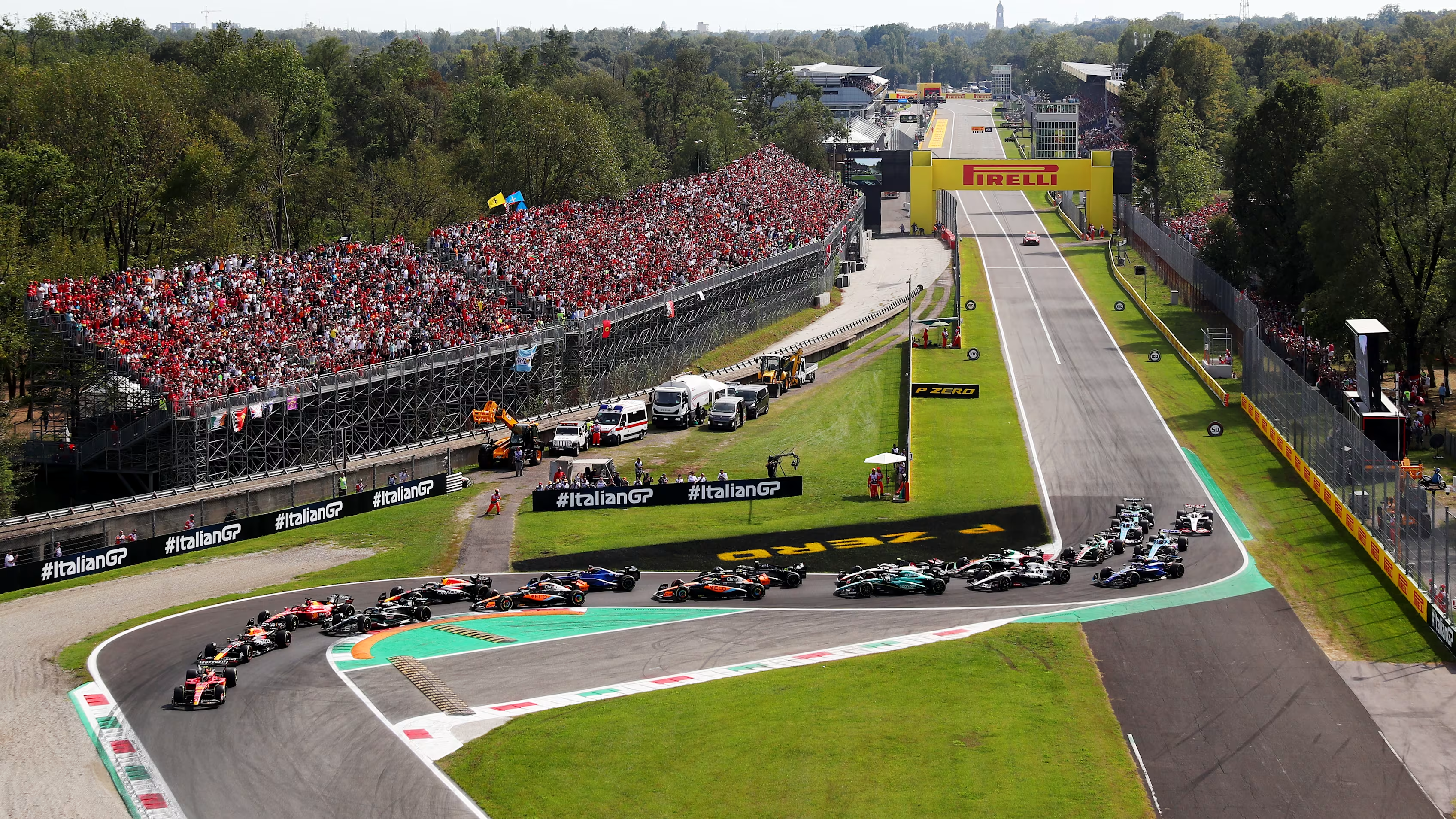
The all-new 2026 powertrain regulations are once again under scrutiny. Monza was always going to be the ultimate test of the manufacturer’s desire to build engines which are 50% powered by the internal combustion engine and 50% from the hybrid.
A Glimpse into the Future of Frustration
Way back in 2023, Red Bull Racing simulated the effect of the planned new engine regulations highlighting that Monza would be the worst affected circuit layout. The data revealed the cars would look ridiculous at what is known as the ‘Temple of Speed’ as they ran out of battery halfway along the lengthy straights and the internal combustion engine would then not only be solely responsible for propelling the car, but also act as a generator for the battery.
Max Verstappen predicted the drivers would in fact have to downshift at the fastest sections of the track to ensure the battery regeneration was optimised. The Red Bull Team Principal Christian Horner warned that the sport was about to create a “technical Frankenstein” and that the proposed regulations were fundamentally flawed, forcing the FIA to legislate for active aero packages merely to compensate for the massive straight-line deficits.
Practice Reality Bites
Whilst the F1 media remain in line with F1’s position that “there’s nothing to see here,” the data from the first practice at the Italian Grand Prix is truly shocking. F1’s tentative claim to be the fastest racing series in the world is not looking remotely true.
Whilst both Ferrari drivers topped the timesheets in FP1, the picture over the pecking order for this weekend’s racing is not yet clear. Track temperatures were in excess of 50 degrees Celsius, which usually works against Mercedes’ true pace, and the expectations are that for qualifying, the weather will return to something more normal.
Driver Verdicts from the Paddock
Ahead of the opening session, Fernando Alonso predicted the hybrid power available would be the worst of the season so far. “It will be worse than Silverstone and Suzuka. Along with Las Vegas, it’s the worst on the calendar,” he claimed during the media day on Thursday.
Max Verstappen was as candid as always: “It’s going to be really painful,” said the Dutchman. “We simply have to be careful with the accelerator, let’s just say it like that.” Lewis Hamilton too was pessimistic about the incoming racing experience, suggesting the cars would arrive some 20–30 kph slower into the braking zones than previously.
“It was always amazing to arrive here and just hear the engine screaming at the end of the straight and pulling and pulling and pulling just up into the braking zone,” he said. “That won’t be the case this weekend. Likely, the drivers will be downshifting before they get to the braking zone, which, for me, still doesn’t feel ultimately the best.”
The Speed Trap Shock
In fact, it was worse than anyone could have predicted. The speed guns showed the cars were arriving at the first chicane a massive 40 kph slower than last season. The TV director was doing his best to hide this from the viewers by cutting frequently between onboard and offboard camera shots to prevent the viewer from understanding the true picture.
And as if the statistics are not terrible in terms of the speed of their cars, Carlos Sainz Jr. now predicts that ‘yo-yo’ racing will return on Sunday. “If you overtake, you’ll be overtaken again on the next lap,” said the Spaniard. “I prefer the classic Monza, when the engines didn’t lose power halfway down the straight.”
Redesigning 2027
It has emerged this week in Italy that the FIA’s decision for 2027 to reduce the contribution of the hybrid systems to around 58-42 in favour of the internal combustion engine will mean the historic length of the Grand Prix will have to be reduced for next season.
The FIA’s proposal was to move to a 60/40 split, but Audi protested this would mean a complete redesign of the chassis to accommodate the extra fuel required. Whilst it will become circuit-specific, the length of the Grand Prix in 2027 will now drop below the standard 300 kilometres, to somewhere in the region of 285–290 km. Meanwhile, the weight of the cars will once again increase to accommodate the extra fuel required.
The Temple of Slow
Monza, famed for its outright flat-out speed historically, proved to be slower than in Hungary or Zandvoort, and as Racing Bulls driver Arvid Lindblad explained, the cars will not visibly slow given the limited amount of hybrid power they have available will be used mostly in the corners for maximum efficiency.
McLaren’s Oscar Piastri revealed: “We were actually quicker on the front straight in Hungary than we were here. It doesn’t make a whole lot of sense, but it’s more that we just don’t have the energy to spend.”
Qualifying Chaos Awaits
To ensure qualifying remains somewhere near the spectacle it should be, the FIA have upped the amount of charging allowed to 9 megajoules. However, for the out-laps and cool-down laps, this will be reduced to just 5 megajoules.
This could mean the ghost of 2019 returns, where the drivers drive so slowly that in the final part of qualifying a number of them miss the chance to post a final push lap.
Would you like to see more TJ13 Formula 1 coverage? Add us to your favourites list on Google to receive trusted F1 news.

A.J. Hunt is Senior Editor at TJ13, where Andrew oversees editorial standards and contributes to the site’s Formula 1 coverage. A career journalist with experience in both print and digital sports media, Andrew trained in investigative journalism and has written for a range of European sports outlets.
At TJ13, Andrew plays a central role in shaping the site’s output, working across breaking news, analysis, and long-form features. Andrew’s responsibilities include fact-checking, refining editorial structure, and ensuring consistency in reporting across a fast-moving news cycle.
Andrew’s work focuses particularly on the intersection of Formula 1 politics, regulation, and team strategy. Andrew closely follows developments involving the FIA, team leadership, and driver market dynamics, helping to provide context behind the sport’s biggest stories.
With experience covering multiple seasons of Formula 1’s modern hybrid era, Andrew has developed a detailed understanding of how regulatory changes and competitive shifts influence the grid. Andrew’s editorial approach prioritises clarity and context, aiming to help readers navigate complex developments within the sport.
In addition to editorial duties, Andrew is particularly interested in how media narratives shape fan perception of Formula 1, and how reporting can balance speed with accuracy in an increasingly digital news environment.
