
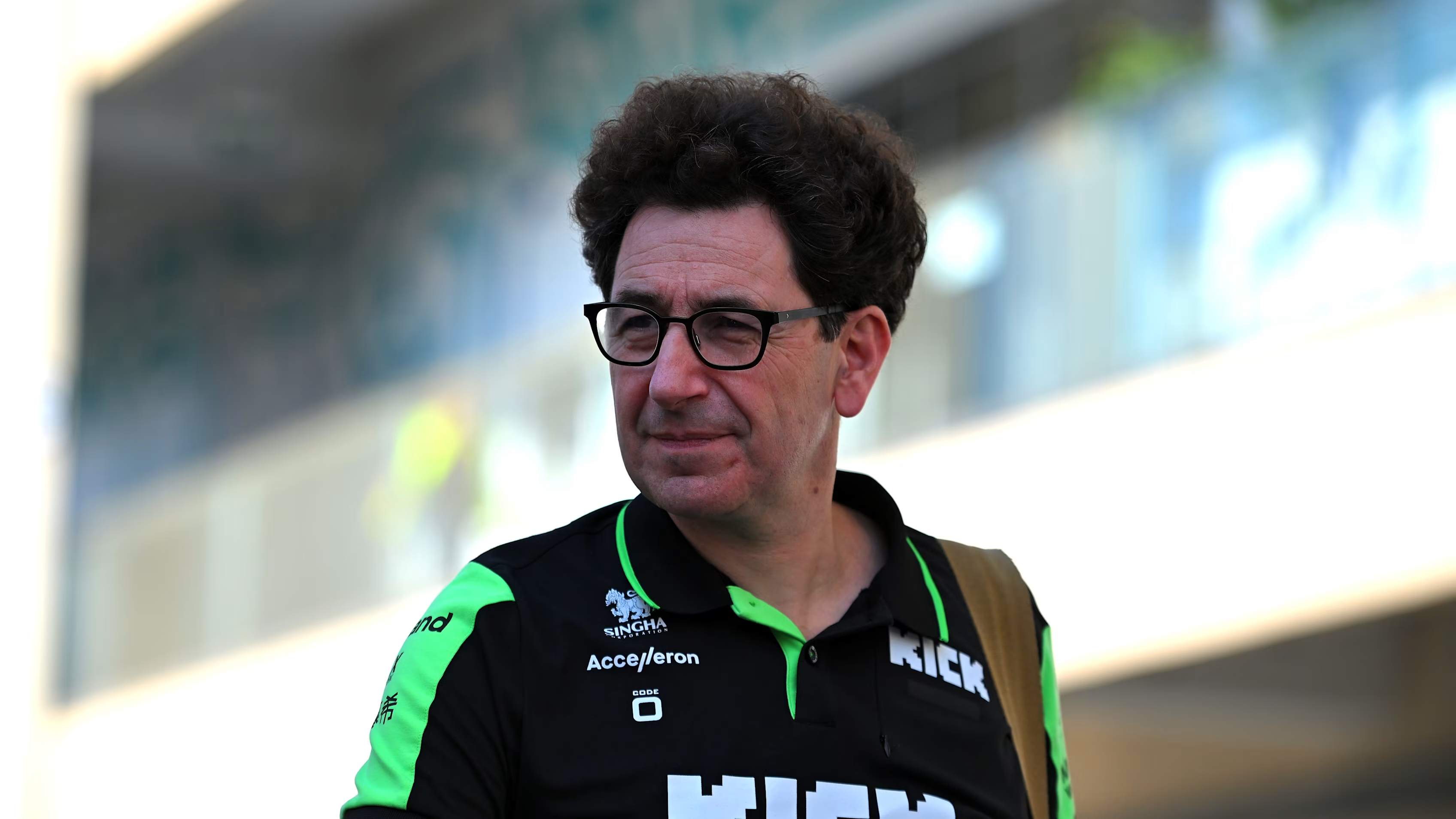
Mattia Binotto is a Formula One ‘lifer’. After collecting a bachelor’s degree in mechanical engineering then a Master’s in motor vehicle engineering he joined Ferrari age 26 in 1995 as the Jean Todt revolution was under way.
He was the key individual behind the 2019 Ferrari engine which caused much controversy, as Charles Leclerc and Sebastian Vettel enjoyed a power advantage over their rivals.
Yet the engine was the subject of many paddock whispers and whilst never officially charged boy the FIA with wrong doing, new technical directives and fuel sensors were mandated and suddenly the Ferrari advantage mysteriously disappeared.
Being team principal at Ferrari didn’t go well
Binotto was promoted to team principal in Maranello in 2019 replacing Maurizio Arrivabene, yet his tenure was not without difficulties. His poor communication skills led him into conflict with the Italian media and for several months he refused to speak to the British TV broadcasters.
Whilst an excellent engineer, Binotto struggled with the power dynamics inside Maranello which led to a tense relationship with the chairman John Elkann and CEO Benedetto Vigna in 2022. Binotto resigned at the end of the 2022 season and was replaced by Fred Vasseur.
Yet this was not the end of his F1 life as Audi came a calling for him to oversee their F1 project. Previous incumbents had made a mess of the early parts of the process so the Italian was brought in to replace Andreas Seidel who left alongside Oliver Hoffman who had been previously chairman of the Sauber companies.
Audi’s publicity machine has been remarkably quiet over the progress of their F1 programme, but last week they launched the livery for 2026 where Binotto spoke at length.
Christian Horner meets F1 CEO and Zak Brown in an F1 return bid
Binotto speaks of early 2026 early front runner
When asked about the radical new technical regulations, cars and power units, he argued it won’t be the team who comes out the traps quickest who will succeed, but the one that adapts more quickly when the cars hit the track.
“I don’t think we can judge who will be the best team by the start of next season,” he said. “It’s more how the team will be capable of reacting later.
“Because whatever will be the level of competition and the level of performance of each single team, for me, the best team will be the ones that are capable of reacting quickly, and developing quickly.”
Even when the technical regulations are stable, teams will often develop their car over a season to become 1-2 seconds quicker than it was at the opening Grand Prix. However, with new chassis and power units the opportunity for development will be even greater, something Binotto believes will be key to the 2026 championship.
Return of a Grand Prix. Set to happen?
‘Unparalleled F1 changes’
As the former Ferrari boss, he piloted the team through a number of regulations changes, but he warns the scale of change coming next year is unparalleled in the sport.
“There will be a significant change as well on the aero and on the vehicle side,” he explains. “So, it’s combining two effects, both the power unit and the chassis and the aero.“
“We believe that the parameters, or the variables that before were important for performance, may be different tomorrow. So, we believe that with the new regulations, what counted before to go fast could be different.“
Teams have been collecting vast amounts of data through the current regulation cycle which has been tuned to perfection so their pre-race weekend simulations are often sport on. Yet all this will need to be revised in 2026 given the same parameters from track to track will differ in their levels of importance.
Binotto predicts virtual tools reset
“I think that change is something which we are not used to. And it may be that at the start of next season, some of the teams would have done it properly, some others not, because the tools are not yet properly tuned,” Mattia continues.
Of course Audi don’t have the data which the other teams posses and whose wind tunnels and CFD tools have been dialled into perfection, yet this tools and the current data will become obsolete overnight.
Both Audi and Cadillac who are joining F1 in 2026, at least in this respect have some kind of m ore level playing field. Yet those team’s who can get their virtual tools quickly up to speed should unlock a rapid rate of development which could catch rivals by surprise.
With Audi arriving as a full works outfit – building both powertrain and chassis – the challenge will be be intense, but Binotto sounds like he is making a statement of intent.
Cost cap for PU’s should reign Mercedes in
In 2014 Mercedes smashed the new V6 turbo hybrid rules creating a series of cars which were amongst the most dominant F1 has ever seen. Yet this time around they won’t have the financial advantage they reportedly had 12 years ago, when a number of insiders revealed they had spent as much as four to five times on the research and development of the hybrids of their rivals.
There are cost cap restrictions as there are for the racing teams, along with resource allocation restrictions limiting bench testing time along with other restraints.
Audi are well resourced and have dominated in other categories of motorsport such as the WEC, yet Binotto seems to managing expectations, especially for the early part of the season. ‘Don’t judge us too soon’ appears to be the message. ‘We will be agile and make up any deficit quickly’ appears to be the Italian’s rallying cry.
Meanwhile Sauber have been engaged in a midfield battle for sixth place in the constructors’ for most of the season, briefly rising to the top of the pile ahead of their rivals after Nico Hulkenberg’s historic third place at the British Grand Prix.
Yet despite the form of grail Bortoletto improving in recent weeks, they have slid to P9, 8 points behind Haas F1 and a further two back from Aston Martin. The Racing Bulls head that particular group a further ten points ahead of the Silverstone team.
Verstappen calls the shots with Pirelli
Formula One is on the cusp of equalling one of its longest held records. In 1976 for eight consecutive race weekends between Long Beach and the Nurburgring, the pole sitter went on to win the race. Since the summer break, this has been the case this season meaning a repeat in Sin City will equal that record.
The tyres will be key in the cold desert evening with Mercedes expected to do well given their car operates best in these conditions. Conversely McLaren who have dominated much of the year have less expectations.
The MCL39 handles its tyres better than the rest of the field when temperatures are high, but this means their drivers will struggle to get the tyres up to temperature with the track hovering around just 7 degrees celsius…. READ MORE

A.J. Hunt is Senior Editor at TJ13, where Andrew oversees editorial standards and contributes to the site’s Formula 1 coverage. A career journalist with experience in both print and digital sports media, Andrew trained in investigative journalism and has written for a range of European sports outlets.
At TJ13, Andrew plays a central role in shaping the site’s output, working across breaking news, analysis, and long-form features. Andrew’s responsibilities include fact-checking, refining editorial structure, and ensuring consistency in reporting across a fast-moving news cycle.
Andrew’s work focuses particularly on the intersection of Formula 1 politics, regulation, and team strategy. Andrew closely follows developments involving the FIA, team leadership, and driver market dynamics, helping to provide context behind the sport’s biggest stories.
With experience covering multiple seasons of Formula 1’s modern hybrid era, Andrew has developed a detailed understanding of how regulatory changes and competitive shifts influence the grid. Andrew’s editorial approach prioritises clarity and context, aiming to help readers navigate complex developments within the sport.
In addition to editorial duties, Andrew is particularly interested in how media narratives shape fan perception of Formula 1, and how reporting can balance speed with accuracy in an increasingly digital news environment.
