
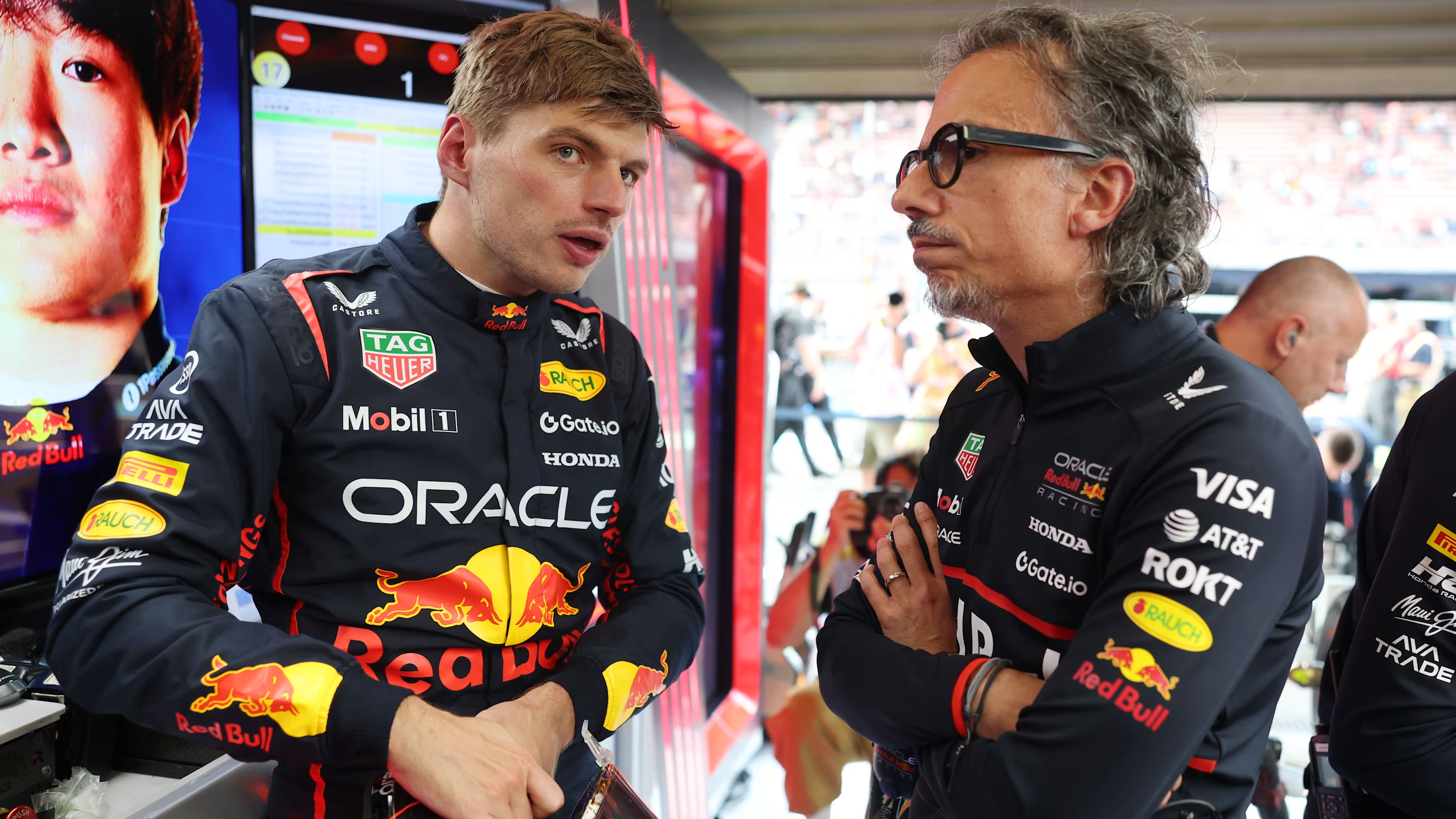
Red Bull solves three major issues, but is still chasing perfection – Red Bull has made significant progress with its 2026 car following upgrades introduced in Miami. However, two key performance issues remain unresolved, according to Sky Sports F1 pundit Karun Chandhok.
After speaking with Max Verstappen and team boss Laurent Mekies, Chandhok revealed that the team had initially identified five weaknesses compared to rivals, three of which have now been addressed, with work ongoing on the remaining two.
These developments mark a turning point in Red Bull’s season after a difficult start, with Verstappen finally regaining confidence in the car. However, while the improvements have brought the team back into contention, they are not yet fully satisfied with their level of performance heading into the next phase of the championship.
Would you like to see more TJ13 Formula 1 coverage? Add us to your favourites list on Google to receive trusted F1 news.
Steering, balance and predictability transformed in Miami
The most noticeable gains for Red Bull came in three core areas: steering feel, car predictability and operating window. These had previously been identified as fundamental weaknesses that limited both driver confidence and overall pace.
“The best thing about Red Bull’s upgrade package is that Max’s steering issues have been resolved,” explained Sky Sports commentator David Croft.
“The car now actually does what he expects of it. When he has that feeling, he is capable of anything.”
Chandhok backed up that assessment with insights from Mekies.
“He indicated that there are five areas where he thinks they are falling short,” said Chandhok. “They’ve sorted out the steering feel. They’ve made the car more predictable to drive.”
Another critical improvement was the operating window of the car, the range within which it performs consistently. Earlier in the season, Red Bull had struggled with a narrow setup window, which made the car difficult to handle in varying conditions.
“Mekies also said that their operating window was quite narrow,” Chandhok added.
“They’ve widened that window, so the drivers now have a more consistent balance throughout the lap, especially in stronger winds.”
These changes were evident in Miami, where Verstappen demonstrated clear improvements in competitiveness.
Two unresolved weaknesses remain under development
Despite the progress, Red Bull is not yet the complete package. Chandhok confirmed that two issues remain unsolved, although the team is actively working on solutions.
“He didn’t want to say what the third issue was that they’d resolved,” Chandhok joked. “I’m going to keep that to myself. In addition, they’ve identified two other areas where they need to improve the car.”
While the exact nature of these weaknesses has not been disclosed, the fact that they remain highlights the fact that Red Bull is still chasing the final margins needed to consistently outperform rivals such as Mercedes and Ferrari.
The team is expected to introduce further updates in the upcoming races, with the Canadian Grand Prix likely to serve as a key benchmark for whether they have fully closed the gap.
Verstappen’s confidence is growing as his performance improves
Perhaps the clearest sign of Red Bull’s progress is Verstappen’s renewed confidence behind the wheel. After struggling in earlier races, the Dutch driver appeared far more comfortable in Miami, both in qualifying and in the race.
“Max was in high spirits,” Chandhok revealed. “He popped by our Sky pad to have a quick chat off-air. I believe this was the first weekend where he felt the car was working the way he wanted it to.”
This confidence was evident in his performance, with Verstappen securing a front-row start, a stark contrast to his earlier struggles.
This is particularly notable when compared to races like Suzuka, where Verstappen was eliminated in Q2 and unable to make significant progress in the race.
Red Bull Ford Powertrains impress with rapid rise
Beyond chassis improvements, Chandhok also highlighted the often-overlooked success of Red Bull Ford Powertrains. The relatively new engine programme has made an immediate impact, defying expectations for a project of its age.
“I really have to take my hat off to Red Bull Ford Powertrains,” said Chandhok. “This has been somewhat overlooked. They are a brand new engine supplier, together with Ford.”
He emphasised the magnitude of this achievement, especially considering how long it usually takes to establish a competitive power unit operation in Formula 1.
“You only have to look at the problems faced by their previous partner, Honda,” he continued. “Red Bull has really delivered.”
Chandhok went even further in his praise, describing the operation as one of the most impressive developments in the sport in recent years.
“Some people even think they are setting the standard for everyone else and are on a par with Mercedes. Five years ago, there was nothing but a patch of grass here. They have built all of this in just five or six years. That is incredible.”
Hadjar’s struggles highlight Verstappen’s superiority once again
While Verstappen’s form has improved, the contrast with his teammate, Isack Hadjar, has become more pronounced, a familiar pattern within Red Bull.
“In Japan, Verstappen and Hadjar were evenly matched,” Chandhok noted. “We all found that strange at Suzuka, because that’s a Max Verstappen circuit.”
However, as the car improved and returned to the front, the usual performance gap re-emerged.
“As soon as the cars improved and the performance window widened, we went back to those eight or nine tenths,” Chandhok explained.
Hadjar’s difficult Miami weekend, which included crashing on lap five, made matters worse and raised concerns about his confidence.
“I feel for Hadjar because crashing on lap five is the last thing he wanted,” said Chandhok.
“He needs to clock up the mileage to regain his confidence. I hope this isn’t the start of a downward spiral for him.”
This mirrors what happened with several of Verstappen’s former teammates, who struggled to match his pace once the car became competitive again.
Red Bull’s progress for the title fight
Red Bull’s recovery comes at a crucial stage of the season. After losing ground early on, the team now appears to be re-entering the fight at the front, with Verstappen once again able to perform to the best of his ability.
However, the remaining two issues could prove decisive in a closely fought championship. Even minor weaknesses could mean the difference between pole positions and second-row starts, or race wins and podium finishes.
David Croft also highlighted Miami as a venue where Verstappen has historically performed well.
“Miami is a place where Verstappen often makes a statement,” he said. ‘A few years ago, Sergio Pérez thought he had a chance… Verstappen put a stop to that straight away.”
Red Bull’s priority is clear: eliminate the final weaknesses and build on the momentum from Miami.
Canada will be the next test of whether the team has truly returned to its dominant best, or if those final two issues will continue to hold them back.
Would you like to see more TJ13 Formula 1 coverage? Add us to your favourites list on Google to receive trusted F1 news.

Thiago Treze is a Brazilian motorsport writer at TJ13 with a background in sports journalism and broadcast media, alongside an academic foundation in engineering with a focus on Computational Fluid Dynamics (CFD). This combination of technical knowledge and editorial experience allows Thiago to approach Formula 1 from both a performance and narrative perspective.
At TJ13, Treze covers driver performance, career developments, and key storylines across the Formula 1 grid, while also analysing the technical factors that influence competitiveness. This includes aerodynamic development trends, simulation-driven design approaches, and the engineering decisions that shape race weekend outcomes.
His reporting bridges the gap between human performance and machine development, helping readers understand how driver execution and technical innovation interact in modern Formula 1. Coverage often connects on-track events with the underlying engineering philosophies that define each team’s approach.
With a global perspective shaped by both journalism and technical study, Thiago also focuses on Formula 1’s international reach and the different ways the sport is experienced across regions.
Treze has a particular interest in how Computational Fluid Dynamics and aerodynamic modelling contribute to car performance, offering accessible explanations of complex technical concepts within Formula 1.
