
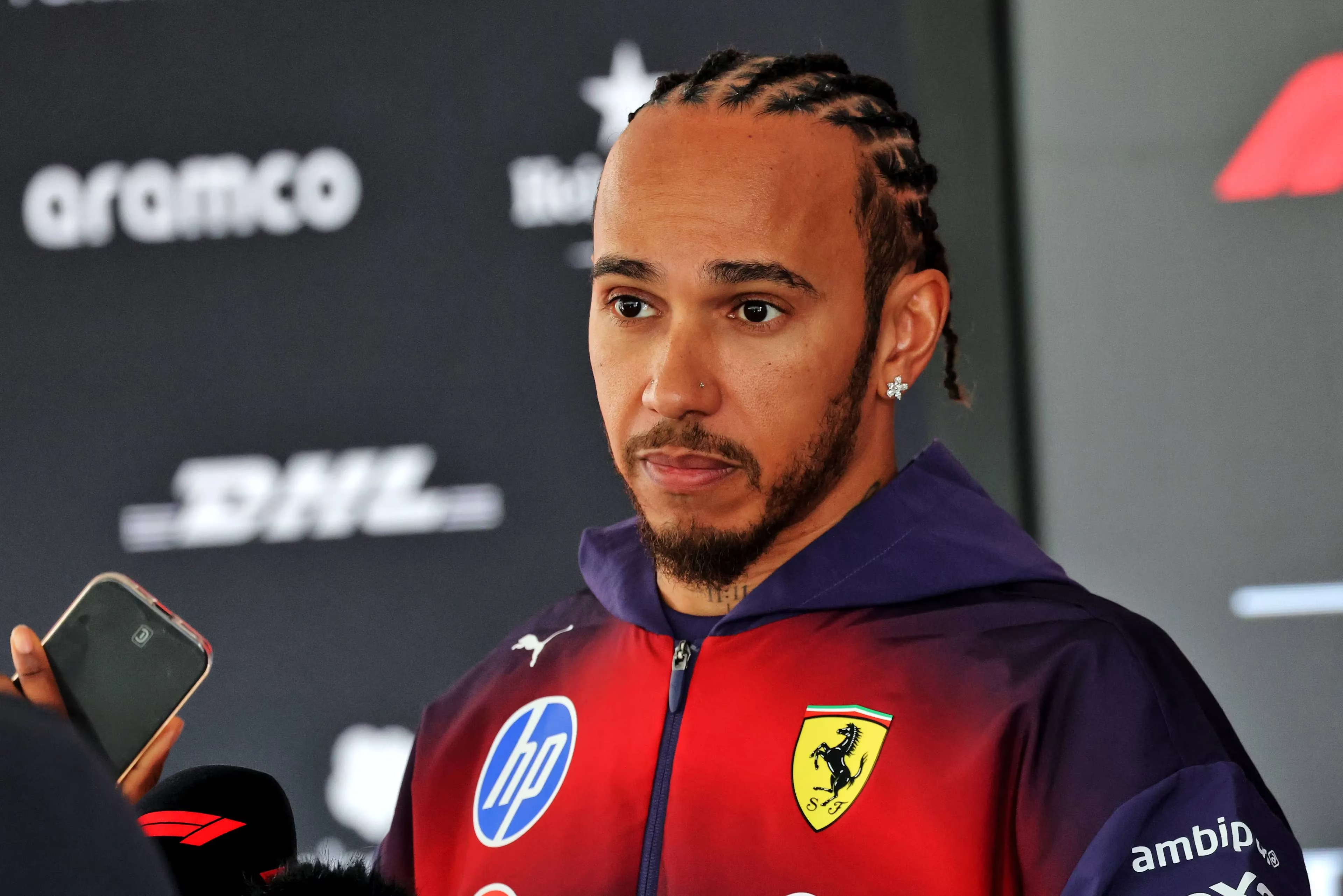
Lewis Hamilton is on a run of three straight penalties in three consecutive race weekends. At his home Grand Prix at Silverstone, the seven times world champion jumped the start and was handed a five-second time penalty to be served at his pit stop.
The last time out in Belgium, Hamilton was adjudged to have lost control of his car at the Les Comes chicane, hitting George Russell with the result the Mercedes driver spun into the gravel trap – and out of the race.
Radio Miscommunication at the Hungaroring
Yesterday in qualifying at the Hungaroring, Hamilton had set the fastest time in Q3 before his final run. Ferrari clearly tried something different with their drivers’ tyre pressures for the final run, given neither Hamilton or Leclerc went quicker.
As Hamilton crossed the finish line, his engineer, Carlo Santi, came over team radio telling his driver: “Piastri pushing… yellow flag, yellow flag.”
Hamilton enquired: “Where’s Piastri?” Santi replied “Behind – yellow flag.” “Where’s [the] yellow flag?” Lewis then asks to which he receives the reply: “Track is clear. Max went off in [Turn] 14. Mode slow, please.”
On-Track Conflict and the Stewards’ Verdict
Hamilton was then caught on the racing line by a flying Oscar Piastri who was on his final push lap. After the McLaren passed the Ferrari on the run down to turn 2, Hamilton asked: “Was Piastri on a lap or…?”
Yet the onboard cameras show Hamilton looking in his mirrors on the run down to turn 1, then Piastri sarcastically giving Hamilton the thumbs up as he passes the Ferrari. Lewis responds by waving an apology. The stewards later issued a slam dunk penalty for the British driver, who will start today’s Grand Prix three places further back in P5 from where he qualified.
Differing Accounts of the Incident
Later Lewis claimed he could not see Piastri and was unsure as to whether he was on a push lap or in lap. Piastri accused Hamilton of not looking in his mirrors.
“I was told literally when he was at the apex behind me, so I had no idea he was coming,” Hamilton claimed to assembled media after the session. “I thought everyone came out behind me – I was the first out, so I thought everyone had finished their lap, and I think Charles was the car that was behind me when I left the pit lane, so as far as I was aware.
“So yeah, crazy, because it had been clean and obviously it wasn’t intentional.” Ferrari boss Fred Vasseur decided the team would take the responsibility for the transgression telling Sky F1: “We told him [Piastri was coming], but far too late. If there is a mistake, it’s our mistake.”
Dissecting the Radio Timeline
Yet Hamilton’s claim he was only told at the apex when Piastri was right behind him, doesn’t stack up. The length of the exchange between him and his engineer lasts several seconds and around the time the car took from the finish line to turn 1.
The first words from Santi were “Piastri pushing” which is common radio speak for there is a driver behind you on a fast lap – do not obstruct him. Yet Hamilton had completed his final qualifying lap almost a second slower than his previous provisional pole time and was almost certainly confused at his lack of pace.
Grid Shakeup and Ferrari Pace Concerns
Piastri was fortunate that neither Hamilton nor Leclerc went quicker and neither did the Mercedes pair. Max Verstappen spun off at the final corner, so despite not completing his final push lap, the Aussie qualified P5. This becomes P4 following Lewis’ three-place grid drop penalty.
The Ferrari chassis appears to be working well at the twisty Budapest circuit, yet down the start finish straight, the lack of pace from the Ferrari power unit is very evident. The speed gun on the finish line revealed that Charles Leclerc was 14th quickest whilst his teammate was 16th.
Strategic Wildcards for Race Day
Hamilton does have an ace up his sleeve for the Grand Prix, given he is the only one of the front runners who has a brand new set of soft tyres. Ferrari sent Leclerc and Hamilton out in Q1 on the slower medium tyre. Both drivers posted times worthy of the top three, although Leclerc’s was deleted by the stewards for exceeding track limits.
The Monegasque driver was then forced to use his saved set of reds to ensure he made Q2. The drivers from the top four teams all have two sets of new hard tyres and a set of new medium tyres for the race. These are the preferred compounds for the optimum Pirelli tyre strategy.
Yet Hamilton could in theory start on the soft tyre, which Pirelli say over the run down to turn one it is worth 2.09 metres of extra distance compared to a driver starting on the medium tyre.
Yet given the cars start 8 metres apart, this tyre advantage on the run down to turn one is not enough to make up one place. Hamilton may be minded to hold back the new soft tyre in case of a late safety car – where he could gain a cheap pit stop.
Hamilton Speaks Out
Hamilton was visibly crestfallen over his penalty for obstructing McLaren’s Oscar Piastri. He later posted on social media: “Sometimes you just can’t catch a break. Another weekend when I’ve been feeling great throughout all the sessions, but then it just falls apart.
“To go from being so close to pole to then starting P5 is extremely frustrating. I always do my best to keep positive — sport is always about the highs and lows, but it’s also in the margins. Every point counts and you have to seize every opportunity.
“After 3 penalties in 3 weekends, it’s becoming difficult to hang on to that positivity. Still, I won’t let the setbacks take away from the progress we’ve been making as a team. With the pace we have, I’m hopeful we can get something out of the race tomorrow.”
Would you like to see more TJ13 Formula 1 coverage? Add us to your favourites list on Google to receive trusted F1 news.

A.J. Hunt is Senior Editor at TJ13, where Andrew oversees editorial standards and contributes to the site’s Formula 1 coverage. A career journalist with experience in both print and digital sports media, Andrew trained in investigative journalism and has written for a range of European sports outlets.
At TJ13, Andrew plays a central role in shaping the site’s output, working across breaking news, analysis, and long-form features. Andrew’s responsibilities include fact-checking, refining editorial structure, and ensuring consistency in reporting across a fast-moving news cycle.
Andrew’s work focuses particularly on the intersection of Formula 1 politics, regulation, and team strategy. Andrew closely follows developments involving the FIA, team leadership, and driver market dynamics, helping to provide context behind the sport’s biggest stories.
With experience covering multiple seasons of Formula 1’s modern hybrid era, Andrew has developed a detailed understanding of how regulatory changes and competitive shifts influence the grid. Andrew’s editorial approach prioritises clarity and context, aiming to help readers navigate complex developments within the sport.
In addition to editorial duties, Andrew is particularly interested in how media narratives shape fan perception of Formula 1, and how reporting can balance speed with accuracy in an increasingly digital news environment.
