
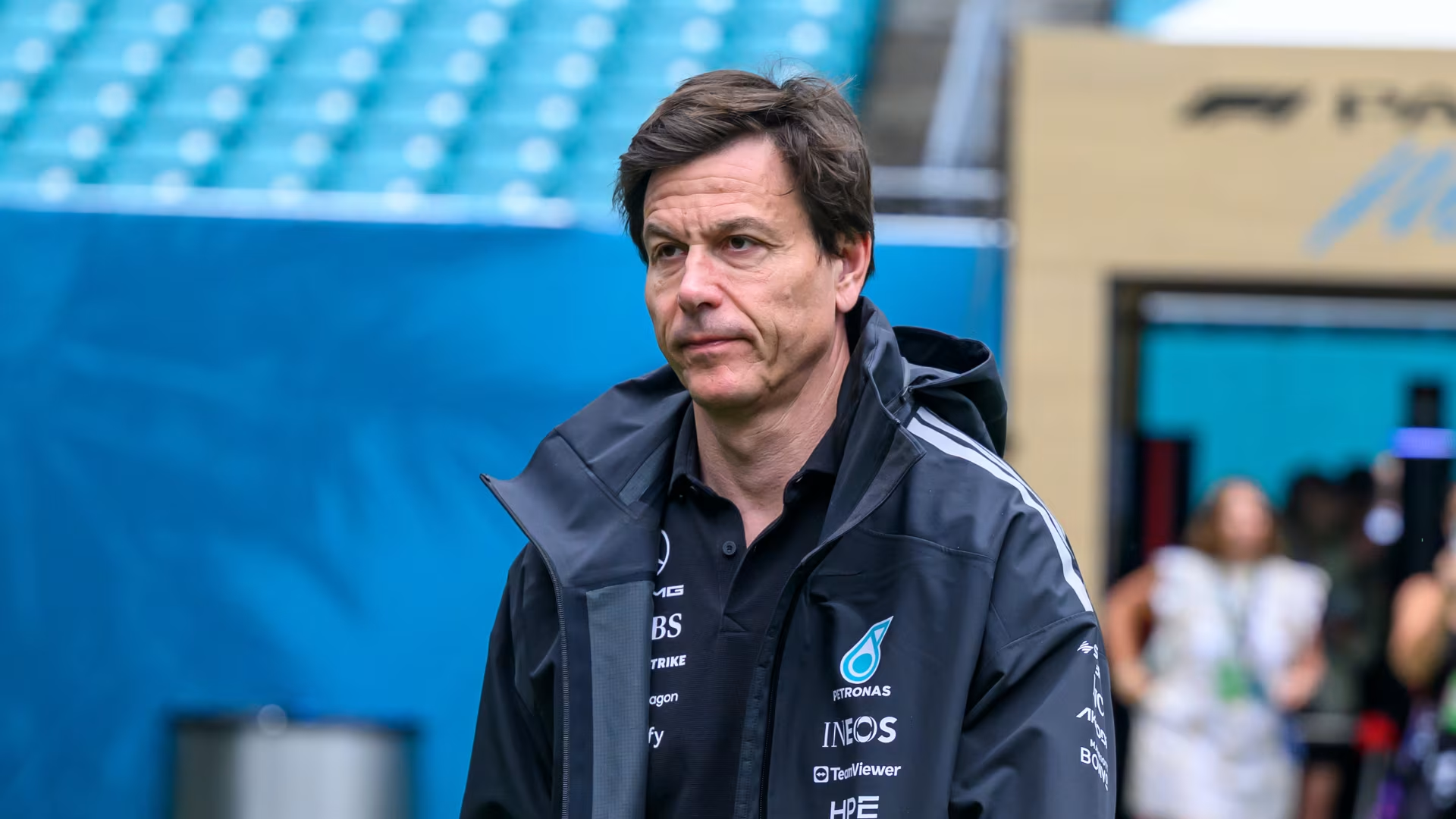
The fallout from a chaotic Monaco Grand Prix continues to fracture the Formula 1 paddock. Mercedes has now revealed it has officially withdrawn its Right of Review petition regarding George Russell’s costly pit-lane speeding penalties, choosing to have a sit-down and listen to the FIA’s explanations rather than pursue a quasi-legal battle.
The Decision to Step Back
Part of the reason for this is that Mercedes were the only team bar Williams who didn’t bother to attend the first Right of Review offered to Alpine. Clearly, having now heard out the reasoning offered at that gathering in Barcelona, they are satisfied there were no unfair practices administered.
Russell’s race in Monte Carlo was completely derailed by two separate infractions. Originally hit with a standard time penalty for pit-lane speeding, a miscommunication between the pit wall and the crew resulted in his tyres being changed before the mandatory five-second hold was served. That basic operational error triggered a subsequent drive-through penalty, which he could only serve in the closing laps of the race after a Safety Car intervention.
Despite being third during the restart after the yellow flag, the compact nature of the field meant he returned to the track after his drive-through penalty in second-to-last place. Meanwhile, Pierre Gasly, who had been awarded a similar time penalty of ten seconds, did not serve his and crossed the line in third place.
As is standard practice, the stewards then applied the ten seconds of time penalty, and Gasly was relegated to P7. He did not enjoy being part of the iconic Monaco podium celebrations and was clearly distressed in the media pen after the chequered flag.
The Loop Glitch Exposed
Alpine successfully lodged a Right of Review, with the FIA stewards’ documentation revealing a shocking technical glitch: a discrepancy in the length of one of the pit-lane timing loops, leading to multiple breaches of the pit-lane speed limit without the driver having actually done so.
Because the system (supplied by FOM to the FIA) mistakenly clocked almost all cars at a uniform 60.1 km/h, the documentation confirmed that not all the breaches may have been genuine. Because Gasly had not actually served his penalty before the chequered flag, Alpine was legally able to have it rescinded. This forced a new race classification, providing the “new and relevant information” other penalised teams needed to take action. Red Bull and McLaren both lodged appeals against the race results, as Oscar Piastri and Red Bull junior Isack Hadjar finished between Gasly’s third and seventh-place finishes.
Mercedes Statement on Withdrawal
Mercedes originally joined the protest gang, lodging their own Right of Review during the Barcelona Grand Prix weekend to protect Russell’s interests. However, following the race in Spain, the Brackley-based squad withdrew its appeal on Thursday. On Friday morning, the team released an official statement explaining their sudden exit from the legal battle:
“We can confirm that we have withdrawn our Right of Review submission relating to the penalties received and served by George Russell during the Monaco Grand Prix,” the statement said.
“Following the decision to rescind Pierre Gasly’s time penalty, it was important for us to explore all available options to address the impact of George’s pit lane speeding penalty on his race result.
“We had a limited time window in which to apply for the Right of Review during the race weekend in Barcelona, and did so in order to reserve our position in this regard.
“Our subsequent collaborative discussion with FIA and Formula One has shown their determination to review the unique circumstances arising from the Monaco Grand Prix and to proactively address the factors that caused them.
“In the face of this clear determination, we have concluded that further pursuit of our Right of Review application will not serve our team or the sport, and thus we have withdrawn our submission.”
Because FOM (the commercial rights holder) administers the timing systems used by the regulatory FIA, the scenario looks messy on paper. However, Toto Wolff firmly ruled out the possibility of a conflict of interest:
“No, I think there is no point in that; they have been doing this for many years, and there would never be any problems,” he said. “We are all aligned here. We don’t want these things to happen, mistakes can happen, and there’s no conflict of interest, it’s just we’re in this sport altogether between the FIA, the teams, the drivers, no problem for me.”
McLaren and Red Bull Stand Firm
While Mercedes is perceived as playing the diplomat, McLaren and Red Bull are refusing to back down. Red Bull’s appeal remains active, and McLaren has officially escalated the matter to the FIA International Court of Appeal, releasing a scathing statement targeting the sport’s regulatory integrity:
“While we fully respect the FIA’s judicial processes and the role of the Stewards, we believe this case raises important questions concerning sporting fairness, regulatory consistency, and the integrity of competition,” read the statement.
“Throughout the Monaco Grand Prix weekend – and in every event – all teams operated according to the regulations and established standard practices concerning the speed limit in the pit lane as they were applied at the time. Competitors adjusted their procedures accordingly and, where required, accepted and served penalties imposed under those regulations.
“In our view, the subsequent removal of penalties creates a situation in which some competitors are disadvantaged by having acted in accordance with the rules and the Stewards’ decisions. Such an outcome risks creating sporting inequity and undermining confidence in the consistent application of the FIA Sporting Regulations.
“Our decision to appeal is not directed at any competitor. Rather, it reflects our belief that the Championship benefits from regulations that are applied consistently, transparently, and fairly to all participants.
“McLaren remains committed to working constructively with the FIA, Formula One, and fellow competitors to protect the integrity of the sport and maintain confidence in its regulatory framework.”
The Future of Final Classifications
The matter will now rumble on, but the principle of fairness is vital in this case to prevent competitors ‘gaming’ the system. Every point in F1 is valuable and, to the lower teams, worth millions in sponsorship.
Should it become apparent that refusing to serve in-race penalties and arguing the toss later with the stewards becomes the norm, then the sporting integrity of F1 will fall into disrepute. Few sports allow a right of appeal after the final whistle for the ‘game’ has been blown, and F1 must look to ensure the classification at the chequered flag is accurate and final.
Would you like to see more TJ13 Formula 1 coverage? Add us to your favourites list on Google to receive trusted F1 news.

A.J. Hunt is Senior Editor at TJ13, where Andrew oversees editorial standards and contributes to the site’s Formula 1 coverage. A career journalist with experience in both print and digital sports media, Andrew trained in investigative journalism and has written for a range of European sports outlets.
At TJ13, Andrew plays a central role in shaping the site’s output, working across breaking news, analysis, and long-form features. Andrew’s responsibilities include fact-checking, refining editorial structure, and ensuring consistency in reporting across a fast-moving news cycle.
Andrew’s work focuses particularly on the intersection of Formula 1 politics, regulation, and team strategy. Andrew closely follows developments involving the FIA, team leadership, and driver market dynamics, helping to provide context behind the sport’s biggest stories.
With experience covering multiple seasons of Formula 1’s modern hybrid era, Andrew has developed a detailed understanding of how regulatory changes and competitive shifts influence the grid. Andrew’s editorial approach prioritises clarity and context, aiming to help readers navigate complex developments within the sport.
In addition to editorial duties, Andrew is particularly interested in how media narratives shape fan perception of Formula 1, and how reporting can balance speed with accuracy in an increasingly digital news environment.

F1 may well decide that results at the final whistle must stand – but that WASN’T in force at the time of the Monaco GP, so it’s immaterial!
Also – there have been many occasions in the past when notifications that penalties would be applied AFTER conclusion of a race have been announced … will THAT change also, going forward? After all, Maclaren are asking for consistency …