
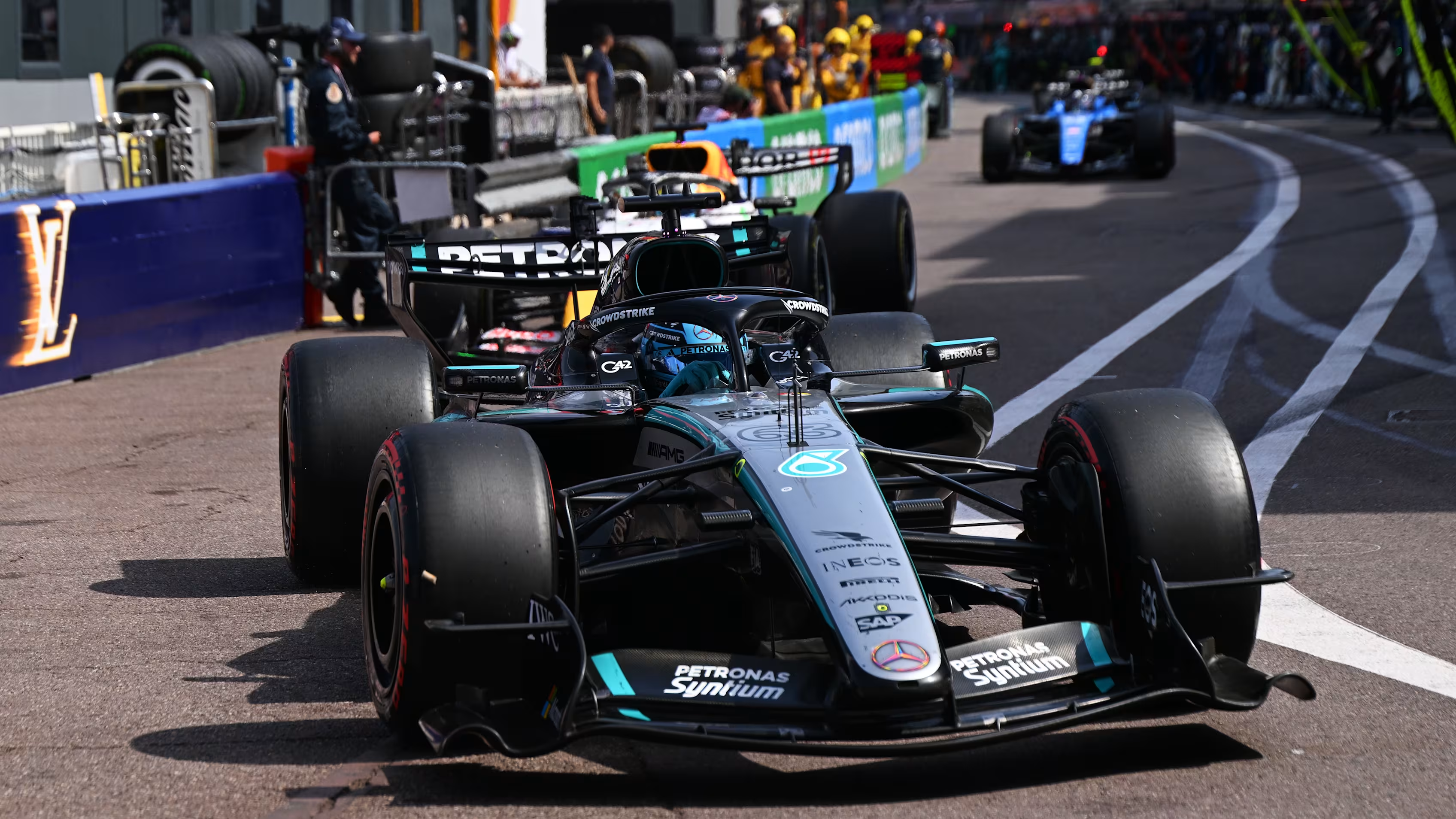
The 2026 Monaco Grand Prix looked to be heading toward its usual predictable procession until Lance Stroll crashed his Aston Martin into the barriers at Anthony Noghes. This set off a sequence of chaotic events, featuring two subsequent safety cars and a red flag period.
During the multiple pit stop windows, a total of six drivers were hit with costly speeding penalties in the pit lane. Alpine’s Pierre Gasly was penalised twice, while his teammate Franco Colapinto was punished once.
Five of the six offences were clocked at exactly 0.1 km/h over the strict 60 km/h speed limit—a phenomenon that should have immediately rung alarm bells in race control. To put that into context, this represents a mere 1/600th margin of error, strongly suggesting a fundamental issue with the FIA’s monitoring equipment rather than driver negligence.
Paddock Theories and Telemetry Anomalies
Television broadcasters struggled to analyse and explain the penalty surge in real-time, leading to a variety of paddock theories. Sky F1’s Bernie Collins highlighted a unique feature of the Monaco pit entry: drivers must accelerate up to the speed limit directly from the slow Rascasse corner, an onboarding trait unique to the Principality.
Initial suggestions argued that because team pit-limiter software is traditionally designed to reduce speed from a straightaway, software glitches may have allowed the power units to briefly over-shoot the limit under heavy acceleration.
However, the wide distribution of penalised drivers across entirely different power unit manufacturers quickly disproved this theory. Attention then shifted to track limits, with suggestions that drivers were cutting the corner on entry and ignoring the painted lines designating the pit lane.
Yet, side-by-side video analysis from Sky F1’s Anthony Davidson revealed that this tight entry line was completely identical to lines taken in previous Monaco Grands Prix—and entirely legal within the regulations. Even a direct video comparison between Pierre Gasly (who was penalised) and Red Bull’s Isack Hadjar (who was not) failed to reveal any discernible difference in their entry trajectories.
The Math Behind the Micro-Sector Loops
While the FIA never publishes the hyper-detailed blueprints of its timing loop placements to prevent teams from perfectly game-programming their pit limiters, TJ13 understands that the Formula 1 timing system utilises between 9 and 11 electronic loops distributed across the length of the Monaco pit lane.
The mechanics of how these loops catch speeding drivers rely on a highly specific automated process. The FIA does not use traditional radar speed guns, as this would allow drivers to brake purely for the camera and speed elsewhere. Instead, the system measures average speed over microscopic sectors.
Single-loop wire sensors are cut directly into the asphalt. These detect the highly precise radio signal emitted by the official FIA transponder mounted on the chassis of each F1 car, which transmits a unique telemetry signal.
The system knows the exact distance down to the millimetre between Loop A and Loop B. When a car passes Loop A, a timer starts; when it crosses Loop B, it stops. The system calculates the average speed based on the classic formula:
If that average exceeds 60 km/h over that tiny segment, an automated flag is triggered. Because the pit lane is divided into roughly 10 granular timing zones rather than just one giant start-to-end average, it effectively prevents drivers from spiking their speed in the fast lane. However, it was this exact loop density that triggered the 2026 penalty frenzy.
The Cadillac Twist and an 8.33cm Error
With an 11th team (Cadillac) squeezing into the paddock, the physical entry boundaries of the pit lane had to be made significantly more curved to accommodate the extra garage space. Because drivers naturally straight-lined the apex of this new curve, they travelled a shorter physical distance between the final loops than the FIA timing software expected.
Because they covered less physical ground, they crossed the second loop quicker in real-time. The automated system—still calculating speed based on the official, longer pre-season distance metric—falsely concluded the cars were speeding, triggering automated 5-second penalties for nearly a quarter of the grid.
For reasons yet to be officially explained—other than the physical location of their garage relative to the first timing loop—the Alpine drivers bore the brunt of the chaos, suffering three of the six total penalties. Agonisingly for Pierre Gasly, the cumulative 10-second penalty stripped him of what would have been just the sixth podium of his F1 career.
Given that the Monaco pit lane spans 520 metres from entry to exit, these micro-loops operate roughly 50 metres apart. While a 1/600th error margin sounds minuscule, it equates to a physical misplacement of the FIA sensor by approximately 8.33 centimetres. In a multi-billion dollar sport governed by millimetres, an uncalibrated tracking discrepancy of this size is completely unacceptable.
TJ13 understands that the FIA became aware of the tracking error during the event. However, rather than nullifying the automated flags, race control preferred to hold quiet, oblique discussions with certain teams. Drivers were even warned over team radio mid-race to take extreme care on pit entry to avoid the trap—proving that race engineers had quickly figured out the FIA’s calculation flaw.
The paddock now waits to see if Alpine’s official ‘Right of Review’ will force the governing body to publicly admit to a calculation mistake—something F1’s hierarchy is notoriously hesitant to do.
Would you like to see more TJ13 Formula 1 coverage? Add us to your favourites list on Google to receive trusted F1 news.

The Judge, a nom de plume of an experienced F1 journalist and site founder with long-standing sources across the paddock. With over 30 years of experience in Formula 1 as an insider journalist, I have built trusted connections across the paddock, from race engineers and mechanics to senior team figures. At The Judge 13, I and a handful of trusted colleagues share exclusive Formula 1 news, expert analysis and behind-the-scenes stories you will not find in mainstream motorsport media.

A.J. Hunt is Senior Editor at TJ13, where Andrew oversees editorial standards and contributes to the site’s Formula 1 coverage. A career journalist with experience in both print and digital sports media, Andrew trained in investigative journalism and has written for a range of European sports outlets.
At TJ13, Andrew plays a central role in shaping the site’s output, working across breaking news, analysis, and long-form features. Andrew’s responsibilities include fact-checking, refining editorial structure, and ensuring consistency in reporting across a fast-moving news cycle.
Andrew’s work focuses particularly on the intersection of Formula 1 politics, regulation, and team strategy. Andrew closely follows developments involving the FIA, team leadership, and driver market dynamics, helping to provide context behind the sport’s biggest stories.
With experience covering multiple seasons of Formula 1’s modern hybrid era, Andrew has developed a detailed understanding of how regulatory changes and competitive shifts influence the grid. Andrew’s editorial approach prioritises clarity and context, aiming to help readers navigate complex developments within the sport.
In addition to editorial duties, Andrew is particularly interested in how media narratives shape fan perception of Formula 1, and how reporting can balance speed with accuracy in an increasingly digital news environment.
