
Qualifying for the 2026 Formula 1 Grand Prix was utterly mesmerising. In the final shootout of the top-ten pole position battle, provisional pole was held by four different drivers across the final runs. The divisive new 2026 engines were temporarily forgotten, replaced by brilliant driving as the cars brushed closer and closer to the barriers of the Principality.
With his run plan for Q3 looking messy, Charles Leclerc finally clocked a time good enough for pole. This was quickly surpassed by his teammate Lewis Hamilton, who went a mere seven-hundredths of a second quicker than Monaco’s favourite son.
Antonelli Defies the Odds to Deny Verstappen
Max Verstappen had proven throughout the qualifying hour that he was firmly in the mix to top the timesheets, and he was the next to hit the front—shaving a massive quarter of a second off the time set by Hamilton. Then, in the dying seconds of the session, defying all expectations, it was the Mercedes of Kimi Antonelli who pipped the quadruple world champion to claim the fourth pole position of his young career.
Hosting the post-session interviews, Jenson Button described it as the “most exciting qualifying I’ve ever watched in F1.”Formula 1’s top brass likely hoped this breath-taking spectacle would provide some relief from the universal criticism they have faced over the disastrous new engine regulations.
The Drivers’ Reality Check: “Taping Over the Cracks”
Yet, it was not long before the drivers made it clear that despite the show, the current breed of power units must be replaced. World champion Lando Norris, who qualified a lowly eighth, was quick to reveal that the Monaco spectacle has not cured the underlying issues. Instead, the weekend has merely taped over the cracks of an ongoing, fierce engine debate.
The Monaco Exception: Continuous Energy Recharging
Following a rocky start to the 2026 era, sweeping changes are already being considered and debated behind the scenes. The sport’s new electrical recharge modes have proven wildly unpopular. In Monaco, however, battery depletion is less of a factor because the circuit’s relentless, heavy braking zones keep the hybrid systems continuously topped up. For the first time this season, drivers spent less time managing software and more time pushing for pure lap time—but the paddock remains deeply unsettled.
Lando Norris Warns of Impending Cockpit Distraction Crashes
Lando Norris offered a blunt reality check. While acknowledging that the “energy-rich” track allowed for the most pure qualifying laps seen all year, he refused to praise the current formula.
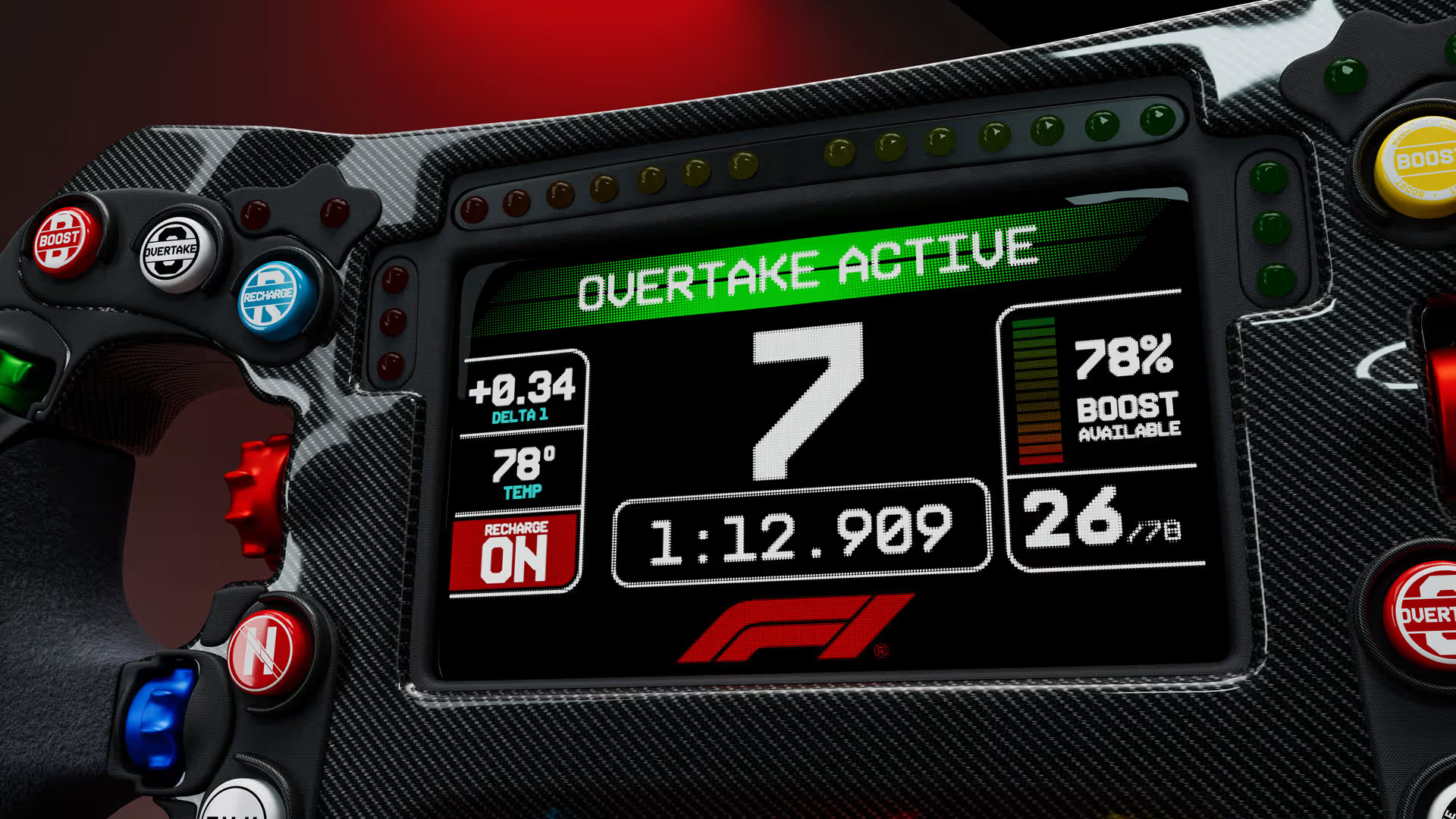
Lando Norris: “I’m not coming in and going, ‘Yeah, it was way better, therefore I’m happy.’ You’re still looking at your dash, trying to get the recharge off at the right time, get the turbo in the right point, get the battery in the right point. It’s just stuff we shouldn’t be looking at and trying to figure out. There’s still going to be a crash at some point because someone’s just looking at their dash trying to figure stuff out.”
Full Attack: Leclerc and Hülkenberg Enjoy the Breather
Charles Leclerc—who dramatically hit the wall at the end of qualifying in his pursuit of pole position—was more succinct, admitting he enjoyed the rare opportunity to go “full attack from the beginning to the end” without energy management thoughts. Audi’s Nico Hülkenberg also called the weekend “encouraging,” but the positivity ended there.
Alonso Unloads on F1’s Secret Rules Debate
Aston Martin’s Fernando Alonso refused to let Monaco’s unique layout mask his fundamental disdain for the technical regulations. Having already branded this the “worst generation of cars I ever drove in Monaco” during Friday practice, the double world champion went even further.
Fernando Alonso: “The generation of these cars is… they are not good. Obviously, we are not meant to criticise anything. Some are more public, some less public. But we are talking about changing the engine for next year and changing the engine for 2030 on race six. So that tells you, no one is happy with the current cars. If they are more publicly outspoken or not, it’s their own decision.”
The 2027 Engine Redesign & Paddock Gridlock
Proposed changes for next season include redesigning the internal combustion engine (ICE) to ensure it delivers 60% of the overall power. This shift away from the current 50/50 split aims to eliminate the excessive “lift and coast” and the myriad of software tricks drivers are currently forced to employ to keep the battery alive.
However, increasing the internal combustion power requires a higher fuel flow rate, which in turn means redesigning the chassis to accommodate a larger fuel cell. While the grid almost universally agrees on the technical solution, certain manufacturers are fiercely holding out against the FIA’s proposals.
Audi’s Data Protest vs. Red Bull’s Alignment
The German manufacturer, Audi, is protesting the sudden rule change. Given that 2026 is their debut season in F1, they argue that altering the engine formula for 2027 would completely ruin the baseline data they are currently trying to collect. On the other side of the garage, despite being in a similar position as a new power unit manufacturer, Red Bull-Ford has broken rank with Audi and aligned themselves with the FIA’s 2027 regulations.
Ferrari’s Hesitation Over the Power-Balance Report
Meanwhile, Ferrari is holding out for the results of the FIA’s initial power-balance report. This highly anticipated analysis will reveal which manufacturers are lagging behind and therefore entitled to additional FIA development and upgrade concessions. Word in the paddock is that this official analysis will be published before the end of the Monaco weekend.
Ferrari’s political hesitation is driven by a distinct fear: if the new 60/40 power balance for 2027 is agreed upon too quickly, the current engine equalization tokens might be dropped, permanently baking in their current performance deficit to Mercedes until the end of the 2026 season.
Peak Frustration at Aston Martin
Alonso’s extreme frustration with the current regulations is also heavily amplified by Aston Martin’s catastrophic lack of pace, a reality his teammate Lance Stroll laid bare when comparing their deficit to the previous ground-effect era.
Lance Stroll: “Some guys are going only, I think, one second slower than the ground-effect cars, we’re going like five to six seconds slower. For me it’s not so enjoyable, but I guess it depends on the car you drive. Some cars are going five, six seconds quicker than us, so probably a lot more downforce, a lot more grip, and then it’s more enjoyable to drive.”
While Saturday in Monte Carlo successfully masked F1’s severe battery-management headache for 60 thrilling minutes, the political storm brewing over the sport’s engine future is only just beginning.
Would you like to see more TJ13 Formula 1 coverage? Add us to your favourites list on Google to receive trusted F1 news.

A.J. Hunt is Senior Editor at TJ13, where Andrew oversees editorial standards and contributes to the site’s Formula 1 coverage. A career journalist with experience in both print and digital sports media, Andrew trained in investigative journalism and has written for a range of European sports outlets.
At TJ13, Andrew plays a central role in shaping the site’s output, working across breaking news, analysis, and long-form features. Andrew’s responsibilities include fact-checking, refining editorial structure, and ensuring consistency in reporting across a fast-moving news cycle.
Andrew’s work focuses particularly on the intersection of Formula 1 politics, regulation, and team strategy. Andrew closely follows developments involving the FIA, team leadership, and driver market dynamics, helping to provide context behind the sport’s biggest stories.
With experience covering multiple seasons of Formula 1’s modern hybrid era, Andrew has developed a detailed understanding of how regulatory changes and competitive shifts influence the grid. Andrew’s editorial approach prioritises clarity and context, aiming to help readers navigate complex developments within the sport.
In addition to editorial duties, Andrew is particularly interested in how media narratives shape fan perception of Formula 1, and how reporting can balance speed with accuracy in an increasingly digital news environment.

The matter about next season seems to have reached the following equation as a compromise:
A total downforce reduction by 40-50%, as has been pushed by the FIA, combined with a 5% increase in fuel flow to ease energy harvesting a lot via lower cornering speeds, as well as manage the dirty air effect & eliminate lift-&-coast needs.
Keeping the fuel flow increase minimal is also reasonable & eliminates any need for redesigns , even though a larger portion of the existing overall capacity could be used for races like in 2017 & 2019.