
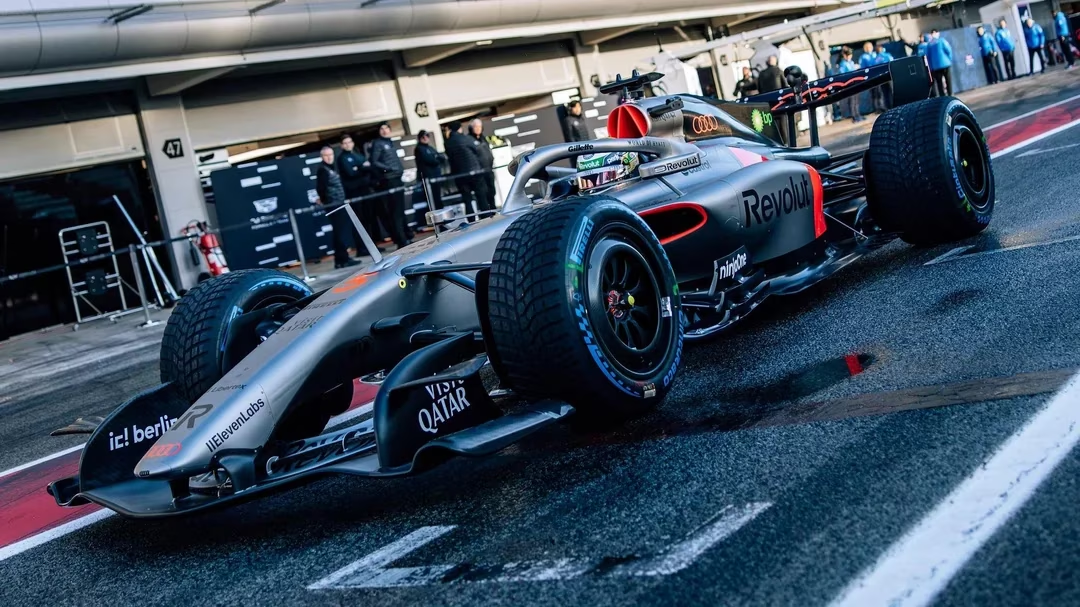
Audi’s entry into Formula 1 is one of the most calculated, high-stakes corporate takeovers the sport has seen in recent years. Rather than building a brand-new team from scratch (like Cadillac did), the German automotive giant chose to buy out an existing historic grid slot from minnow Sauber and transform it into a full factory “works” team.
For decades, Audi toyed with the idea of entering F1, but they consistently refused because the existing engine rules were too expensive and irrelevant to their road-car technology. The game changed when F1 invited the German manufacturer to join the working party to help specify the new 2026 F1 engines.
Audi pressed for 50/50 F1 hybrid power
Audi in particular pressed for the hybrid components of the power unit to deliver close to 50% of the car’s total power, and F1’s future green credentials—by adopting 100% sustainable fuels—further aligned with Audi’s corporate vision for their road cars.
For new teams to join F1 and compete even in the midfield, the adoption of the cost cap by F1 in 2020 was also crucial. This prevented long-standing teams like Ferrari and Mercedes from consistently outspending the rest of the field, and the resurrection of McLaren winning three championships in two seasons is testament to that.
With these changes locked in, Audi officially announced in August 2022 that it would enter F1 as an engine manufacturer. Believing that building a chassis infrastructure from the ground up was too steep a learning curve, the German corporation decided to buy Sauber instead.
Split operating bases for F1 project
The car’s chassis, aerodynamics, and race operations continue to be designed and built at Sauber’s traditional base in Hinwil, Switzerland. Meanwhile, the brand-new V6 hybrid engine is designed and built entirely from scratch at a specially expanded facility in Neuburg an der Donau, Germany. This marks the first time an F1 powertrain has been built in Germany since Toyota left the sport in 2009.
The transition from Sauber to Audi hasn’t been without drama. Behind the scenes, corporate infighting over the speed of investment led to a massive management shakeup. Originally brought in to lead the project having demonstrated his leadership at McLaren F1, Andreas Seidl found himself in a political infight with Oliver Hoffmann, who chaired the Audi F1 board of directors.
Hoffmann was the Chief Development Officer at Audi who originally helped push the F1 project through. When corporate shuffling pushed him out of his road-car development role, he was moved directly over to oversee the F1 program, placing him directly above Seidl.
Buying out Sauber a tortuous process
The Audi buyout of Sauber was a tortuous process lasting some three years and completed in stages. Seidl grew increasingly frustrated with the slow corporate decision-making process at Audi’s headquarters in Germany, which he felt was severely handicapping the team’s ability to recruit top engineers and build competitive infrastructure in time for the new regulations.
The infighting between Seidl and Hoffmann came to a head and the pair were sacked. To steady the ship, Audi brought in a heavy hitter in Mattia Binotto (former Ferrari Team Principal). Yet Binotto’s life experience in Maranello had been that of a power unit engineer and he required a team boss to run the chassis operation in Hinwil.
Jonathan Wheatley (the highly respected long-time Red Bull Sporting Director) was signed as Team Principal. On the driver front, they secured the veteran experience of Nico Hülkenberg to lead them onto the grid. Yet Wheatley and Binotto failed to see eye to eye, with the former believing his role had been reduced to that of the director of the trackside team only.
Persistent leadership changes
After just six months and two race weekends into the 2026 F1 season, it was announced suddenly that Wheatley would be leaving Audi. Again, Binotto is left holding the entire Audi F1 baby with no news of the team’s next principal.
The five-week enforced break in F1 track action gave Audi some time to consider their next move, which in Miami was revealed to be the appointment of the brand’s ‘lifer’ Allan McNish—although his title is Racing Director, reflecting the role Binotto wished Wheatley to operate within.
Given Audi’s history in European motorsport and their winning racing engines, the new F1 team is already under intense scrutiny after just four races. However, Racing Director Allan McNish is moving quickly to reset expectations, urging patience and perspective as the German manufacturer navigates a turbulent start to its debut campaign.
Audi bringing upgrades finally to Canada
While Audi has shown flashes of competitive single-lap pace, its opening phase has been repeatedly undermined by poor starts, reliability setbacks, and operational inconsistencies. Despite a volatile look on paper, McNish insists the real judgment should come much later.
Audi’s focus is now entirely on the upcoming race in Montreal, where the team plans to bring more development pieces to the track. “Canada is quite specific, and so is Monaco… But we do have things. We had upgrades in Miami—some front brake ducts—but small relative to what the majority of the competition had,” McNish now reveals.
He emphasizes the sheer scale of what Audi is trying to achieve, reminding critics that this is a massive integration process rather than a standard team evolution. Audi as yet is not just running a team; it is merging a brand-new works identity and power unit with the inherited Sauber structure.
“I think we’ve got to remember as well, this is race four for a new team… Therefore, judge us at the end of the year,” begs the Scot. Despite the hiccups, the car’s baseline performance has offered genuine encouragement. In Miami, despite bringing fewer upgrades than ten of their eleven rivals, Audi remained intermittently competitive.
New Audi boss says ‘give us time’
McNish praised Nico Hülkenberg’s ability to maximize the car’s potential under pressure, while acknowledging that the field is tightening rapidly: “What he did with the problem to qualify on the edge of Q3 was pretty impressive and it showed his experience. The gaps that we can see—the likes of Williams improved their race performance in Miami—so it is going to get harder and harder. We have to improve in other areas as well.”
Audi’s new Racing Director subtly observes that the Sauber folk have in fact delivered an excellent chassis, while questions over Binotto’s area of expertise—the engine—remain. For Audi, this underlying chassis strength proves the platform isn’t fundamentally flawed. The issues lie in execution, operations, and system integration. As their rivals aggressively develop, Audi is asking for the rarest luxury in modern Formula 1: time.
Would you like to see more TJ13 Formula 1 coverage? Add us to your favourites list on Google to receive trusted F1 news.

The Judge, a nom de plume of an experienced F1 journalist and site founder with long-standing sources across the paddock. With over 30 years of experience in Formula 1 as an insider journalist, I have built trusted connections across the paddock, from race engineers and mechanics to senior team figures. At The Judge 13, I and a handful of trusted colleagues share exclusive Formula 1 news, expert analysis and behind-the-scenes stories you will not find in mainstream motorsport media.

A.J. Hunt is Senior Editor at TJ13, where Andrew oversees editorial standards and contributes to the site’s Formula 1 coverage. A career journalist with experience in both print and digital sports media, Andrew trained in investigative journalism and has written for a range of European sports outlets.
At TJ13, Andrew plays a central role in shaping the site’s output, working across breaking news, analysis, and long-form features. Andrew’s responsibilities include fact-checking, refining editorial structure, and ensuring consistency in reporting across a fast-moving news cycle.
Andrew’s work focuses particularly on the intersection of Formula 1 politics, regulation, and team strategy. Andrew closely follows developments involving the FIA, team leadership, and driver market dynamics, helping to provide context behind the sport’s biggest stories.
With experience covering multiple seasons of Formula 1’s modern hybrid era, Andrew has developed a detailed understanding of how regulatory changes and competitive shifts influence the grid. Andrew’s editorial approach prioritises clarity and context, aiming to help readers navigate complex developments within the sport.
In addition to editorial duties, Andrew is particularly interested in how media narratives shape fan perception of Formula 1, and how reporting can balance speed with accuracy in an increasingly digital news environment.
