

Why Mattia Binotto now has to deliver twice as much to Audi – Audi’s long-awaited arrival as a full works team in Formula 1 has been respectable on the surface. After three race weekends in the 2026 season, the German manufacturer has proven that it belongs in the midfield battle. However, behind this steady start lies a growing sense of pressure focused squarely on one man: Mattia Binotto.
Following a significant internal shake-up, Binotto now finds himself carrying far greater responsibility than originally intended. What was once a shared leadership structure has become a one-man mission, and expectations at Audi remain uncompromising.

A Solid Start But No Room for Complacency
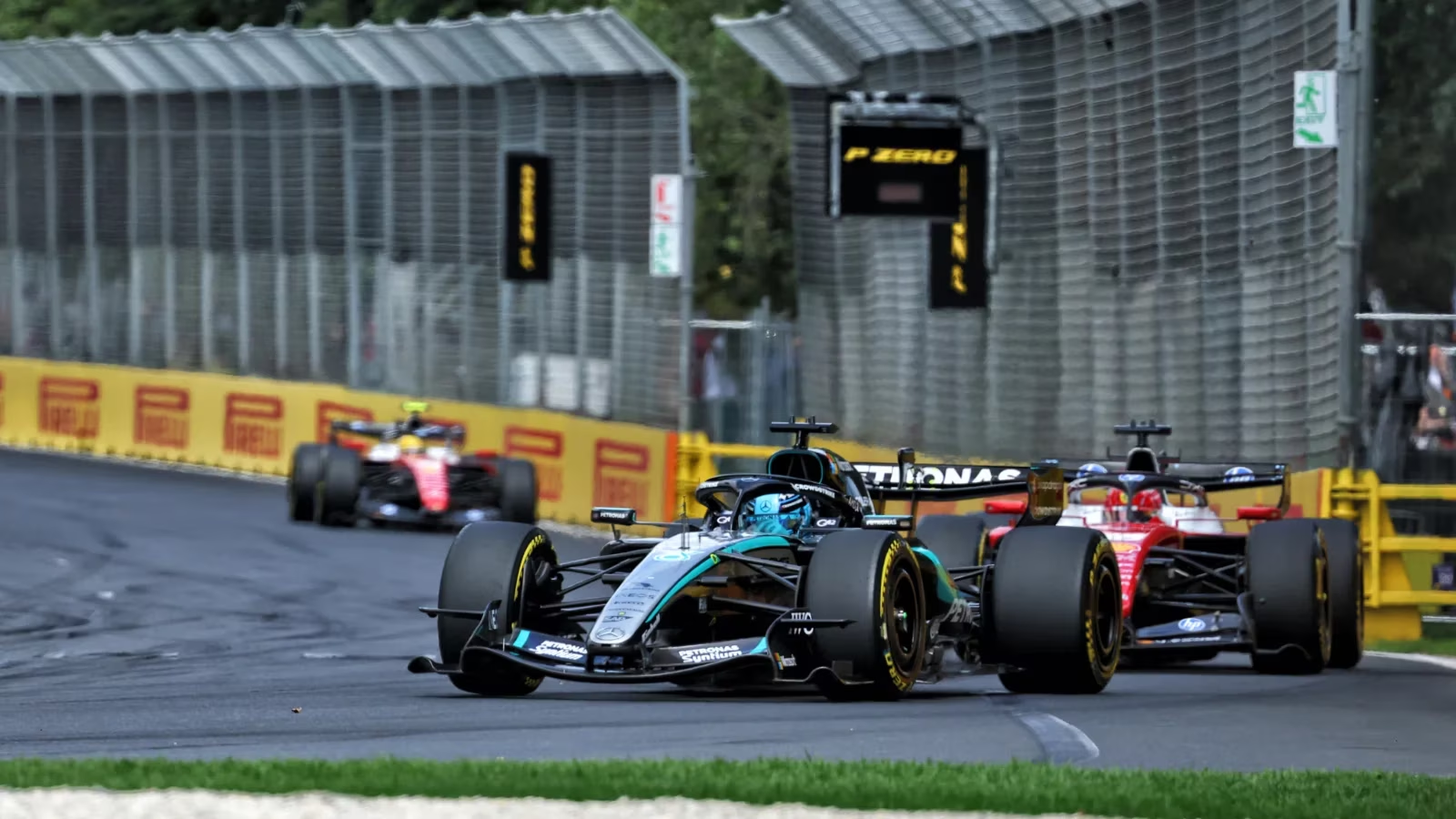
Three races into the new era, the competitive order is beginning to take shape. Mercedes has reasserted its dominance, reminiscent of its peak years, while Ferrari has emerged as a genuine contender. Meanwhile, Max Verstappen is struggling to get the best out of a challenging Red Bull car, and Aston Martin has had a disastrous start despite significant investment.
Amid this chaos, Audi’s entry has been quietly encouraging. The team, built on the foundations of Sauber, has already shown flashes of competitiveness. Rookie Gabriel Bortoleto scored points in Melbourne early on, and the car has demonstrated solid one-lap pace.
Nevertheless, Audi’s five-year plan, as outlined by CEO Matthias Döllner, calls for patience: two years as challengers, two years as front-runners, and a championship push in the fifth year. However, such linear progress is rarely seen in Formula 1.
History offers a cautionary tale: Renault returned with similarly ambitious plans, only to fall short and eventually withdraw from full involvement. Audi will be determined to avoid that fate, but ambition alone won’t guarantee success.
MORE NEWS – From Party Team to Corporate Ghost: The Inside Story of the Red Bull Racing Brain Drain
Competitive car, fundamental weaknesses
The Audi R26 has demonstrated sufficient speed to inspire optimism, particularly in qualifying trim. However, its underlying weaknesses are becoming increasingly difficult to ignore.
Reliability has been the most pressing issue. With multiple technical failures across the opening rounds, Audi currently sits near the bottom of the reliability standings. Hydraulic system faults, described by some as the car’s “Achilles heel”, have repeatedly compromised the performance of both Nico Hülkenberg and Bortoleto.
Beyond that, there are concerns about drivability and overall balance. Drivers have struggled to achieve consistent performance, and the internal combustion engine appears to lag behind those of rivals Mercedes and Ferrari in terms of outright power.
Energy management and battery deployment, challenges faced by teams across the grid in 2026, have also hindered Audi’s race pace. While these issues are not unique to the team, they further compound an already fragile package.
BREAKING – Verstappen in trouble? GP Red Bull ally exit to McLaren and Ferrari Stella link emerges
Starts: A Costly Weakness
One of Audi’s most visible problems has been its poor race starts. Time and again, both cars have lost positions at the start, immediately undoing strong qualifying performances.
In Suzuka, for example, Hülkenberg dropped from 13th to 19th place within seconds, while Bortoleto fell out of the points-paying positions. Rather than attacking, Audi’s drivers have been forced to play catch-up — an unsustainable pattern for a team aiming to establish itself.
Binotto has openly acknowledged the issue, admitting that there is no immediate solution. This only adds to the mounting pressure, especially as valuable points slip away.
Would you like to see more TJ13 Formula 1 coverage? Add us to your favourites list on Google to receive trusted F1 news.
The ‘Huge Blow’ Behind the Scenes
While Audi’s technical issues are concerning, its internal restructuring may be an even bigger cause for concern. The departure of former team principal Jonathan Wheatley after just two races has been widely described as a major setback.
Although officially attributed to personal reasons, Wheatley’s departure leaves a void that cannot easily be filled. He was known for his organisational discipline and leadership skills, and played a key role in shaping Audi’s early structure.
His influence extended beyond race operations into areas such as team culture, efficiency and long-term planning. Losing such a prominent figure so early in the project has been described by insiders as a “huge weakening” of the organisation.
There is already speculation linking Wheatley to a potential move to Aston Martin, where sweeping changes involving figures such as Adrian Newey may be underway.
MORE – Hamilton, Leclerc & Ferrari benefits from new FIA rule: Big showdown with Mercedes approaches
Binotto’s expanding burden
With Wheatley gone, Binotto has assumed full control. He is no longer just overseeing the project from a strategic level; he is now deeply involved in both technical direction and day-to-day race operations.
This is a role that requires both engineering expertise and leadership skills. Fortunately for Audi, Binotto possesses both. During his time at Ferrari, he successfully managed high-profile driver dynamics involving Sebastian Vettel and Charles Leclerc, all the while navigating intense media scrutiny.
His engineering background may prove particularly valuable in addressing Audi’s current technical shortcomings. In modern Formula 1, there is a growing trend towards team principals with a technical background — a model successfully demonstrated by figures like Andrea Stella.
However, striking the right balance is challenging. Balancing the macro strategy and micro execution of a Formula 1 team is an enormous task, even for the most experienced individuals.
A defining period lies ahead
Binotto has already made it clear that Audi will not immediately seek a replacement for Wheatley. Instead, responsibilities will be redistributed internally, with a focus on restructuring rather than recruitment.
This decision signals confidence, but also risk.
Formula 1 history is filled with examples of leaders who have been spread too thin, and even the most capable individuals can struggle under an excessive workload. The situation at Aston Martin, where Newey has reportedly been overloaded with work, serves as a timely warning.
For Audi, the coming months could define the trajectory of its entire project. The unexpected break in the calendar offers a rare opportunity to address technical flaws and stabilise operations.
Ultimately, however, the spotlight remains on Binotto.
Following what many regard as a significant weakening of Audi’s leadership structure, he is now responsible not only for delivering progress, but also for providing proof that the project can succeed under his sole leadership.
Would you like to see more TJ13 Formula 1 coverage? Add us to your favourites list on Google to receive trusted F1 news.
NEXT ARTICLE – F1 veteran claims 2026 cars in breach of fundamental F1 regulation
The war in Iran may well hit the owners of Formula One in the pocket hard, but it’s an opportunistic moment for the sport’s regulators to regain control of a runaway beast they have helped to create. Ex-F1 racer and veteran commentator Martin Brundle claims that the current breed of F1 cars are in fact in breach of a fundamental tenet embedded in the FIA’s ow regulations.
F1 engine cycles tend to be 5-7 years in length and sometimes even shorter, however since 2014 the sport retained the basic architecture of the V6 hybrid turbo powertrains for some 12 long years.
2026 F1 engines – 9 long years in the making
The 2014 V6 hybrids were initially expected to be replaced in 2020, but an FIA working party set up in 2017 to create the new PU regulations became mired in politics and at the mercy of the manufacturers.
Given that Red Bull Racing had almost found themselves in the dire situation where they had no engine supplier, the FIA was desperate to attract more manufacturers to ensure this situation could never arise again. But the lunatics took over the asylum.
Porsche, Audi, Mercedes and Honda were adamant the future of road cars would be hybrid and demanded that F1 reflected this trend to continue is association with road car relevant technology. Yet as the war in Iran has proven, electric is becoming increasingly popular with the highest sales of electric road cars in the UK since the middle east conflict exploded.
As the F1 teams began to simulate the all new engines with their 50/50 split in output between the internal combustion engine and the battery, deep concerns were raised about what Christian Horner described as “Frankenstein monsters.” He claimed the cars would run out of power on certain circuits with long straights and that the internal combustion engine would have to serve merely as a…CONTINUE READING THIS STORY

Alex Stanton is a Formula 1 journalist at TJ13 with a focus on the financial and commercial dynamics that underpin the sport. Alex contributes reporting and analysis on team ownership structures, sponsorship trends, and the evolving business model of Formula 1.
At TJ13, Alex covers topics including manufacturer investment, cost cap implications, and the strategic direction of teams navigating an increasingly complex financial environment. Alex’s work often examines how commercial decisions translate into on-track performance and long-term competitiveness.
With a strong interest in the intersection of sport and business, Alex provides context around Formula 1’s global growth, including media rights, expansion markets, and manufacturer influence.
Alex’s reporting aims to explain the financial realities behind headline stories, helping readers understand how money, governance, and strategy shape the competitive order in Formula 1.
