
With the Christian Horner era now firmly in the rear view mirror, Red Bull Racing is starting its first season without input from its founding team principal and genius car designer Adrian Newey. Horner was a victim of a corporate takeover by the Austrian overlords at the energy drinks empire following the death of billionaire founder and entrepreneur Didi Mateschitz.
Horner’s named was besmirched early in 2023, when it was leaked by Red Bull GmbH he was undergoing an internal enquiry into “inappropriate behaviour.” The resulting King’s Counsel enquiry exonerated the Red Bull team boss completely, as did a second investigation made after an appeal from the alleged victim.
It appeared the de facto founder of the Red Bull F1 Racing team had escaped the night of the long knives, yet the Austrian men in grey suits were happy to wait. Clearly the attempted coup attempt by the executives at GmbH had unsettled the team and Adrian Newey decided to call time on his two decades with the Milton Keynes based crew.
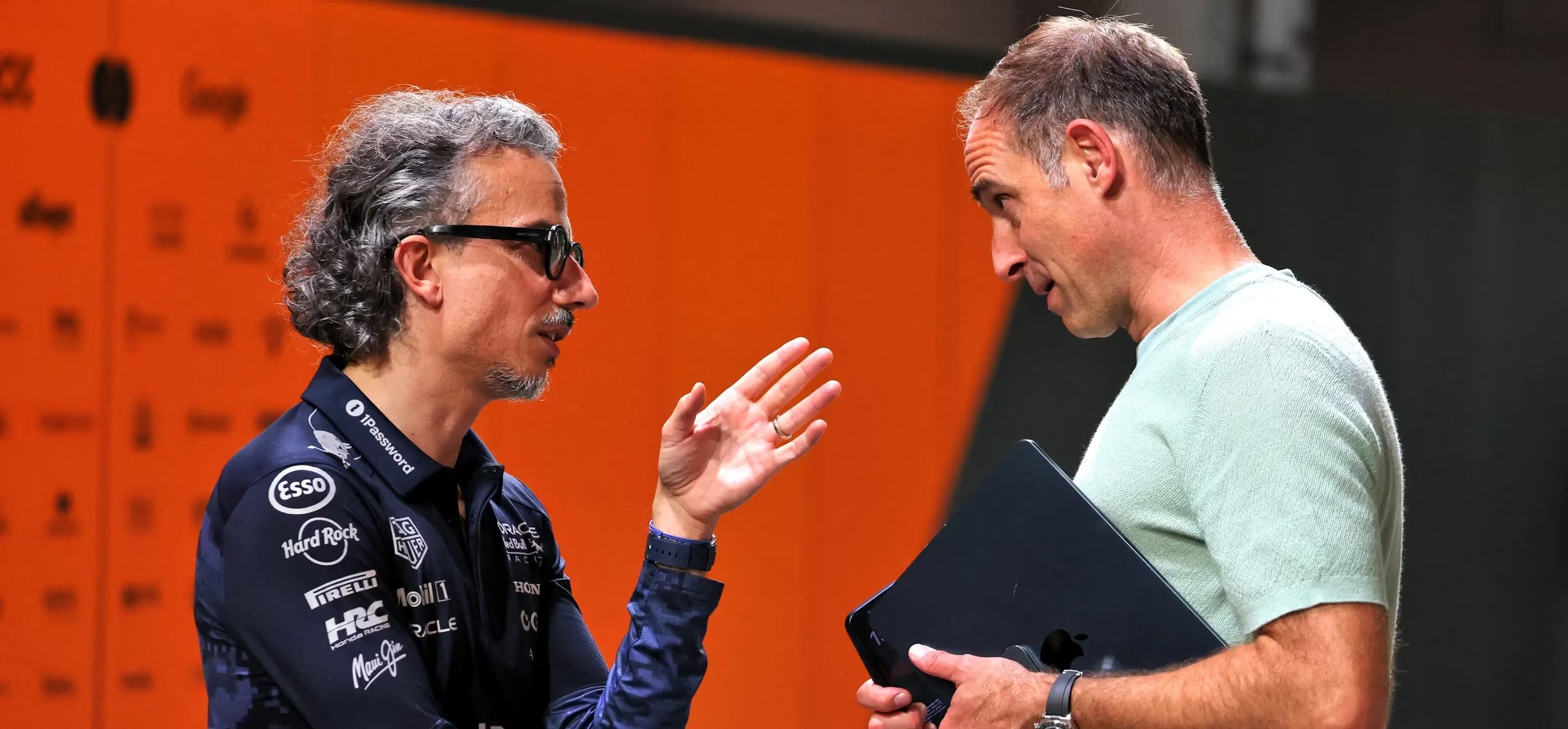
The Mekies “bounce” following Horner’s departure
Legendary Sporting director Jonathan Wheatley had also given notice he was leaving Red Bull Racing, although it was understandable given his new role was a promotion to the team principal role at Audi. As Red Bull stumbled during the second quarter of 2025, the media narrative changed.
Now the story was about Red Bull losing their iconic driver, Max Verstappen, publicly being courted by Mercedes boss Toto Wolff. Then following the 2025 British Grand Prix came the shock announcement that Horner had been sacked by the Austrian’s.
Laurent Mekies, an French engineer was appointed as Horner’s immediate full time successor and within a month it appeared he had radically turned the fortunes of the F1 team – at least Max Verstappen’s around. The Dutch driver won at his home race in the Netherlands, his previous victory was nine rounds earlier.
From thereon Verstappen claimed a further 6 Grand Prix wins, a second place and two third place finishes in each of the races towards the end of the year. Mekies was hailed as the man of the hour for Red Bull whilst Horner’s two decade legacy was disappearing quickly.
“The Monza Floor” conceived under Horner’s reign
The “Monza floor” was hailed as making all the difference to the handling of the RBR car, which previously Max had described as “undriveable.” Yet TJ13’s sources in Milton Keynes explained the new floor design began its journey well before Horner was sacked.
When asked about the impact of the new Monza floor, Laurent Mekies played it down several times suggesting it was a number of things which Red Bull had to get on top of to sort out the balance of the car for Max.
At the hastily called meeting to announce to the team of his sacking, Horner received an emotional response from the crowd. There were tears and groans audible in one video shot by an RBR employee. In the weeks following, TJ13 received information that a number of Red Bull employees CV’s were being circulated in particular at Cadillac.
Whilst the season almost ended on a miraculous high for Verstappen who chased down a deficit of more than a hundred points to take the drivers championship to the last race of the year, dark clouds continued to gather.
Would you like to see more TJ13 Formula 1 coverage? Add us to your favourites list on Google to receive trusted F1 news.
Red Bull GmbH executives take control of PR and comms
When Horner was sacked, GmbH director Oliver Mintzlaff also dismissed the team’s marketing director, Oliver Hughes together with communications director Paul Smith, making public these departments now reported into HQ in Salzburg – not the new team principal. There was further upheaval in these divisions at the start of 2026 with the departure of Alice Hedworth, Joanna Fleet, Julia George and Simon Smith-Wright.
Minztlaff is known for his ‘modern view’ of how a sports club or entity should be run. It is by executive decisions being made in the corporate division and handed down to the day to day managers to initiate.
The final Red Bull ‘lifer’ to leave the team, was Dr. Helmut Marko at the end of the season. Those who took on the challenge of taking the ashes of the Jaguar F1 programme and building a multi-championship winning F1 team are no more. Yet the brain drain continues.
According to F1-insider, veteran engineer ole Schack has now called time on his Red Bull life having been with the team more than two decades. The report cites Schack is unhappy with a “change in the team’s working atmosphere” and that the mood is “threatening to turn sour.”
Verstappen senior engineer quits as RBR team culture ‘sours’
Schack is not the only Verstappen engineer to have called it a day, Michael Manning one of the Dutch driver’s most trusted aides left last December. Another, Tom Hart is set to following him out in the coming months, having received an offer from lowly Williams.
Last week reports emerged that Adrian Newey had offered Verstapen’s race engineer and the team’s head of racing was offered the team principal role at Aston Martin, but as yet there’s no word on his long term future.
The Mekies bounce is now long forgotten, as Red Bull Racing lie in joint sixth place with Alpine having scored just 16 points from four events, Red Bull Racing awaits its first double points finish of the season.
With the departure of Dr. Marko, the last of the Mateschitz gang who created Red Bull Racing and formed them into an F1 force to be reckoned wit is gone. The new Red Bull CEO for sports, Oliver Minztlaff clearly embodies the new generation of sports managers and corporate management.
Corporate “pressure” tactic being applied at RBR
“He knows exactly one management tool: pressure,” a former employee is quoted as saying. In the meantime, even revered football manager Jurgen Klopp is said to be readying his exit from his role as the head of Red Bull GmbH soccer, after joining recently in January 2025.
Despite the relative lack of success in all the sporting endeavours he has controlled, Mintzlaff’s results have been remarkably poor. It is said he has one tool in his management armoury – that of “pressure” on all concerned to deliver success.
The history of F1 teams enduring a heavily involved corporate oversight into their day to day operations is littered with failure. Honda, Toyota and Jaguar all suffered the same interference in the naughties. In a sport like F1 it requires an entrepreneurial style of management, given the rapid pace of change a team undergoes each season in its development race.
This needs a brotherhood culture, a feeling of ultimate trust in your team mates and a vision from the leadership as to what can be achieved. Pressure and threats merely stifle the collaborative inspiration of an F1 team and the final nail in the remarkable Red Bull F1 story will be if Max Verstappen decides enough is enough.
NEXT ARTICLE: Has George Russell lost the Mercedes’ garage to his team mate?
Last Updated on March 30 2026, 11:43 am
After three rounds of the 2026 Formula One season the sport will return to hibernation for five weeks as the war in Iran continues making the Bahrain and Saudi Grand Prix impossible to run. George Russell lost the lead of the championship yesterday in Japan as his young charger of a team mate claimed is second career Grand Prix victory.
The Kimi Antonelli is remarkably the first Italian since Albert Ascari to win back to back F1 Grand Prix and is also the youngest ever to hold the lead in the F1 drivers’ title race. The Mercedes driver was fortunate with timing of the safety car deployed after a horrendous crash for Haas’ Oliver Bearman, meaning Antonelli’s pit stop time loss was just ten seconds, around half of a normal change of tyres in Suzuka.
Yet despite his good luck which saw him take the lead after switching for fresh rubber, prior to the safety car Antonelli was comfortable the quickest driver on track. Whilst he was making moves on Lando Norris and Lewis Hamilton, climbing through the field, his team mate George Russell was for lap after lap stuck behind the surprise leader Oscar Piastri in his McLaren…. CONTINUE READING


A.J. Hunt is Senior Editor at TJ13, where Andrew oversees editorial standards and contributes to the site’s Formula 1 coverage. A career journalist with experience in both print and digital sports media, Andrew trained in investigative journalism and has written for a range of European sports outlets.
At TJ13, Andrew plays a central role in shaping the site’s output, working across breaking news, analysis, and long-form features. Andrew’s responsibilities include fact-checking, refining editorial structure, and ensuring consistency in reporting across a fast-moving news cycle.
Andrew’s work focuses particularly on the intersection of Formula 1 politics, regulation, and team strategy. Andrew closely follows developments involving the FIA, team leadership, and driver market dynamics, helping to provide context behind the sport’s biggest stories.
With experience covering multiple seasons of Formula 1’s modern hybrid era, Andrew has developed a detailed understanding of how regulatory changes and competitive shifts influence the grid. Andrew’s editorial approach prioritises clarity and context, aiming to help readers navigate complex developments within the sport.
In addition to editorial duties, Andrew is particularly interested in how media narratives shape fan perception of Formula 1, and how reporting can balance speed with accuracy in an increasingly digital news environment.

surely noughties? Or am I missing something… 😉