


Former Formula 1 and IndyCar test driver Simona de Silvestro will represent Italy at the upcoming Winter Olympics after qualifying for the bobsleigh events at the Milan–Cortina Games. Her remarkable career shift from single-seater racing to elite winter sports adds another chapter to motorsport’s long tradition of athletes excelling beyond the cockpit.
The Milan–Cortina Winter Olympics will take place from 6 to 22 February, with de Silvestro scheduled to compete in the monobob and two-woman bobsleigh events midway through the Olympic programme. For the Swiss-born driver of Italian heritage, this achievement marks the culmination of a bold and unconventional career move.

From Formula 1 Ambitions to Olympic Qualification
De Silvestro first gained wider attention in Formula 1 circles in 2014 when she tested a Sauber C31 at Ferrari’s Fiorano circuit. She was being evaluated as a potential race driver at the time, but despite the significance of the test, her prospects of securing a full-time F1 seat quickly faded.
With limited opportunities in Formula 1, de Silvestro redirected her focus to the United States, where she had already established herself in IndyCar. She went on to compete in a variety of top-level championships, including Formula E and V8 Supercars, building a reputation for her ability to adapt to different cars, formats, and racing cultures.
However, in 2022, de Silvestro made the dramatic decision to step away from professional circuit racing altogether. Instead, she committed herself to a completely different sporting discipline: bobsleigh.
Williams Admit: “We Still Don’t Know What Went Wrong” after missing testing entirely in Spain
A Radical Career Change Pays Off
Transitioning from motorsport to a winter sport was far from straightforward, yet de Silvestro’s background proved to be surprisingly well suited to bobsleigh. Skills such as high-speed decision-making, physical conditioning, mental resilience, and teamwork translated well to life on ice.
On her first serious attempt at Olympic qualification, she earned the right to represent Italy, leveraging her Italian roots to compete internationally. Her rapid progress through the bobsleigh ranks has been widely praised, particularly in view of the discipline’s physical demands and the limited time frame in which she made the transition.
Upon confirming her qualification, de Silvestro took to social media to share her excitement.
“We’ve officially made it; we’re going to the Olympics,” she wrote on Instagram. “Proof that a little bit of madness, mixed with conviction, can make the impossible real. It all started with a dream that I wasn’t afraid to pursue. I can’t wait to represent Italy at Milan–Cortina 2026!”
Her story is one of the most unusual Olympic qualification journeys in recent memory.
Motorsport’s Long Tradition of Sporting Crossovers
De Silvestro’s Olympic appearance continues a long and varied tradition of Formula 1 drivers testing themselves beyond the boundaries of traditional motorsport. While modern contracts often limit such ventures, earlier generations of drivers regularly competed across disciplines — sometimes even on the Olympic stage.
MORE NEWS – Red Bull shake-up deepens as four more employees sacked ahead of the 2026 F1 season
Formula 1 drivers have competed at the Olympic and Paralympic Games
Several former Formula 1 drivers have competed at the highest level of international sport outside of racing.
Alex Zanardi remains the most inspirational example. After losing both legs in a 2001 CART crash, the former Jordan, Minardi, Lotus and Williams driver reinvented himself as a para-cyclist and won multiple gold medals at the London 2012 and Rio 2016 Paralympic Games.
Prince Bira, the first Thai Formula 1 driver, represented his country in sailing at four Olympic Games between 1956 and 1972, long after his Grand Prix career had ended.
Divina Galica competed in downhill skiing at three Winter Olympics before racing in Formula 1 in the 1970s. She later returned to Olympic competition in speed skiing in 1992.
Bobsleigh itself has historical links to Formula 1. Alfonso de Portago competed in the 1956 Winter Olympics, finishing fourth in the bobsleigh event, just months before his fatal crash at the 1957 Mille Miglia. Robin Widdows and Bob Said also represented their nations in the four-man event at the 1968 Grenoble Games.
Success Beyond Single-Seaters
Other drivers have extended their careers across elite motorsport categories rather than into Olympic sports.
Graham Hill remains the only driver to have achieved motorsport’s “Triple Crown”, having won the Monaco Grand Prix, the Indianapolis 500, and the 24 Hours of Le Mans. Fernando Alonso followed a similar multidisciplinary path, securing two Le Mans victories and competing in the Dakar Rally after retiring from Formula 1.
Other drivers who have successfully crossed between Formula 1, IndyCar, endurance racing, NASCAR and rallying include Nigel Mansell, Kimi Räikkönen, Jacques Villeneuve, Juan Pablo Montoya and Nico Hülkenberg.
MORE F1 NEWS – Zak Brown confirms Horner “Frankenstein” F1 cars prediction
An Unusual but Fitting Olympic Story
While many drivers have explored life beyond Formula 1, Simona de Silvestro’s qualification for the Winter Olympics is one of the most unusual transitions in modern motorsport history. Her journey from Formula 1 test sessions to Olympic ice tracks highlights the versatility of racing drivers and the enduring appeal of elite competition, regardless of the arena.
As the Milan–Cortina Games approach, de Silvestro will line up not as a former racing driver, but as an Olympian, proving that reinvention is possible even at the highest levels of sport.
NEXT ARTICLE – Safety concerns raised over dramatic closing speeds in new F1 era
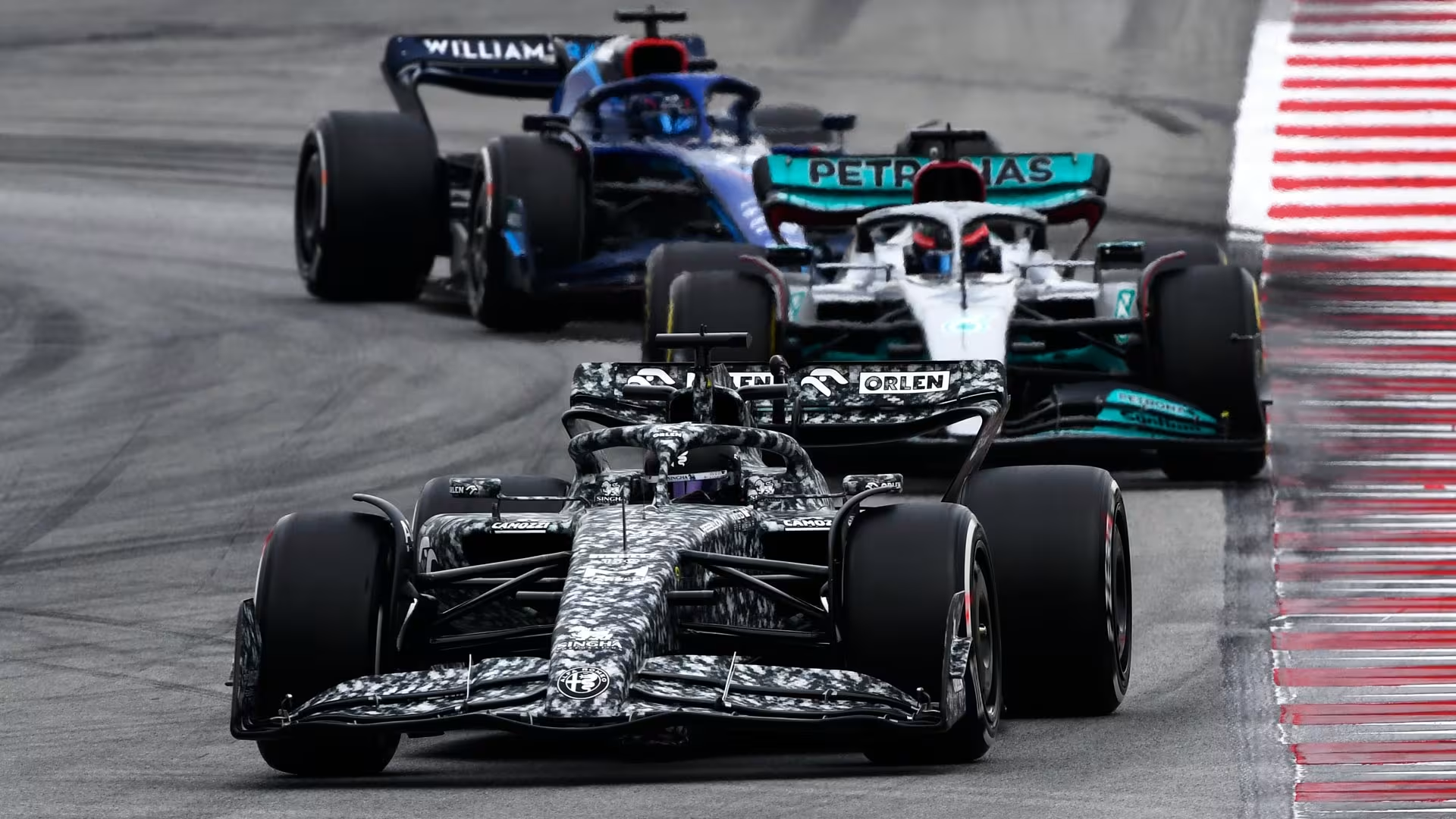
The all new Formula One era has been eagerly anticipated although the recent test in Barcelona behind closed doors has kept fans and F1 analysts alike guessing as to who will come out on top. Following drivers having tested their new machines in the simulator before the five days at the Circuit de Catalunya, the consensus was that in 2026 there will be a lot more overtaking.
Gone is the Drag Reduction system in use since 2011, which was introduced to improver overtaking although its usefulness came under fire in recent years. At certain circuits a car wishing to overtake the one in front needed to be as much as a second a lap quicker then its prey even with the DRS engaged.
In, is an Indycar style push to pass system which will allow a driver to deploy extra energy from the battery to either make a pass or to defend a potential overtake. With the electrical energy available more than three times that of the previous F1 era, harvesting energy will become a critical part of the drivers armoury.
Massive closing speeds in Barcelona test
However, what is clear from Barcelona is that a number of the cars were running out of charge before the end of the front straight. This means the driver will then either lift and coast or more likely shift down through the gears to increase the engine revs and use the internal combustion engine as a generator for the battery pack.
With one driver harvesting on the straight, whilst the one behind is deploying their battery power the closing speeds between the cars will increase dramatically compared to last season. Toto Wolff revealed that…CONTINUE READING

Clara Marlowe is a Formula 1 writer at TJ13 with over 15 years of experience in motorsport journalism, having contributed features to established sports magazines such as Evo, MCN, Wisden Cricket Monthly and other digital outlets.
Clara specialises in human-interest storytelling, focusing on the individuals behind the sport, including drivers, engineers, and team personnel whose roles are often overlooked in mainstream coverage.
At TJ13, Clara contributes long-form features and narrative-driven pieces that explore the personal and professional journeys within Formula 1. This includes coverage of career-defining moments, internal team dynamics, and the human impact of high-pressure competition.
Clara’s work brings depth and perspective to the sport, complementing news and analysis with stories that highlight the people behind the machinery.
Clara has a particular interest in how personal narratives intersect with performance, and how individual experiences shape outcomes across a Formula 1 season.
