


There is grave concern at the FIA over how the all new 2026 Formula One power units will perform. In a desperate bid to prevent an epic failure in the racing spectacle, F1’s governing body convened an emergency meeting with the manufacturers in Bahrain to correct the ‘over optimistic’ power output from the hybrid side of the new engines.
Concerns were first raised by Christian Horner in 2023 that the all new specification of power units would create “Frankenstein monsters” due to an over reliance on electrical output. Almost two years later the FIA’s pow wow in Bahrain sought to address this issue.
The problem is that at a number of circuits where braking is limited and the straights are long, that the cars will be incapable of generating enough electrical charge to deliver the mandated 50% of power output.
Concerns electrical output overstated
This would result in cars ruing out of electrical charge towards the end of the straights, visibly slowing the cars as they approached the next turn. The spectacle could be disastrous for the fans and the series would descend into farce.
Yet any reduction in the amount of electrical output had to be agreed by all but one of the PU manufacturers and such agreement could not be found. The result was both the FIA and FOM issuing statements suggesting the current F1 power cycle could be truncated and a return to V*’s introduced before even 2030.
Foiled by their attempt to introduce what would be a mere software adjustment for all the teams, the FIA issued a dictate in August which outlined how they would prevent F1 becoming a farce or dominated by a single manufacturer who has aced the new PU regulations.
FIA director of day to day operations, Nicolas Tombazis revealed: “We’ve introduced a programme for this that we call ‘additional development opportunities for performance gaps’. It was in the rules from the beginning. In recent months, we’ve refined how we want to manage it. Essentially, we’ll measure the average performance for each manufacturer every six races.”
FIA preliminary talks over next F1 power units
The catch up programme includes allowing the qualifying manufacturers to upgrade their power units during the season, which includes an incremental spending allowance and bench testing time along with “other measures necessary”. However, given the restrictions placed on the manufacturers in terms of R&D spend, its unlikely that any single manufacturer will do as Mercedes did in 2014, where they outspent the field by significant factors and dominated the sport winning a record eight consecutive constructor titles.
However, part of the ‘balancing up’ operation may well include demanding the teams reduce the balance of power out put from the hybrid component. In the end the FIA will prevail and the long term power of the manufacturers will likely be reduced.
TJ13 understands that preliminary talks with potential third party engine manufacturers have already taken place over the next generation of F1 engines and how they can be simplified and the costs reduced significantly. Even Ferrari consider the power of the German manufacturers Mercedes and Audi together with Honda too be too great in terms of deciding the future of the F1 engines and the talks over the next generation of F1 power will begin later in 2026.
There are other late tweaks to the regulations for 2026 as today the FIA reveal they will be firming up the regulations surrounding red flags during qualifying. This follows the chaotic scenes at the Emilia-Romagne Grand Prix which surrounded Oliver Bearman who had qualified for Q2.
Red Flag rules to be enforced to the letter
The red flag had been thrown towards the end of Q1 and Bearman completed his lap a mere three seconds after its deployment. There was a 25 monte delay whilst Haas F1 argued the red flag was due to an incident at another sector of the circuit and didn’t affect their driver completing his lap.
On board footage confirmed Bearman was unaware of the red flag until after he crossed the start/finish line. To prevent any future ambiguity today the FIA released the following statement.
“Where an automobile crosses the control line to complete a lap after the red flag has been displayed: (a) that lap time shall not be considered valid; (b) the moment of first display shall be determined by the official timekeeping system or, where this is not available or not synchronised, as jointly confirmed by the race director or clerk of the course and the chief timekeeper; (c) if a lap time is nevertheless recorded after the first display of the red flag, the stewards shall delete that lap time.”
F1’s governing body also made clear that the scope of the change is broad and uncompromising: “This provision applies to all practice sessions, qualifying sessions and races.”
Fuel flow concerns and protest fees
Another potential loophole has also been addressed to prevent teams from exploiting the fuel flow regulations. The mass of fuel flow being the containing factor has been dropped and replacing it is a new fuel energy flow limit.
Red Bull Racing were disqualified at the first race of the new 2014 power unit regulations for Daniel Ricciardo’s car car exceeding the fuel flow limit of 100kg/h. Now the measure will be based on the measure of the amount of energy produced, rather than the actual mass of the fuel flow.
Other late measure being introduced are a $20,000 fee for any team wishing to protest the actions of a competitor. This system was used for decades by the FIA given the teams understood the potential technical breaches of their competitors better than the FIA officials.
Yet now there are what are deemed a number of ‘frivolous’ protests being made and the fee is designed to prevent such occurrences. However, in terms of an F1 team’s spend, this is unlikely to prevent further arguments over flexi-wings, illegal DRS operations and even the water filled tyre accusations made by Red Bull against McLaren this season.
Kimi Antonelli blames Mercedes for his 2025 mid season slump
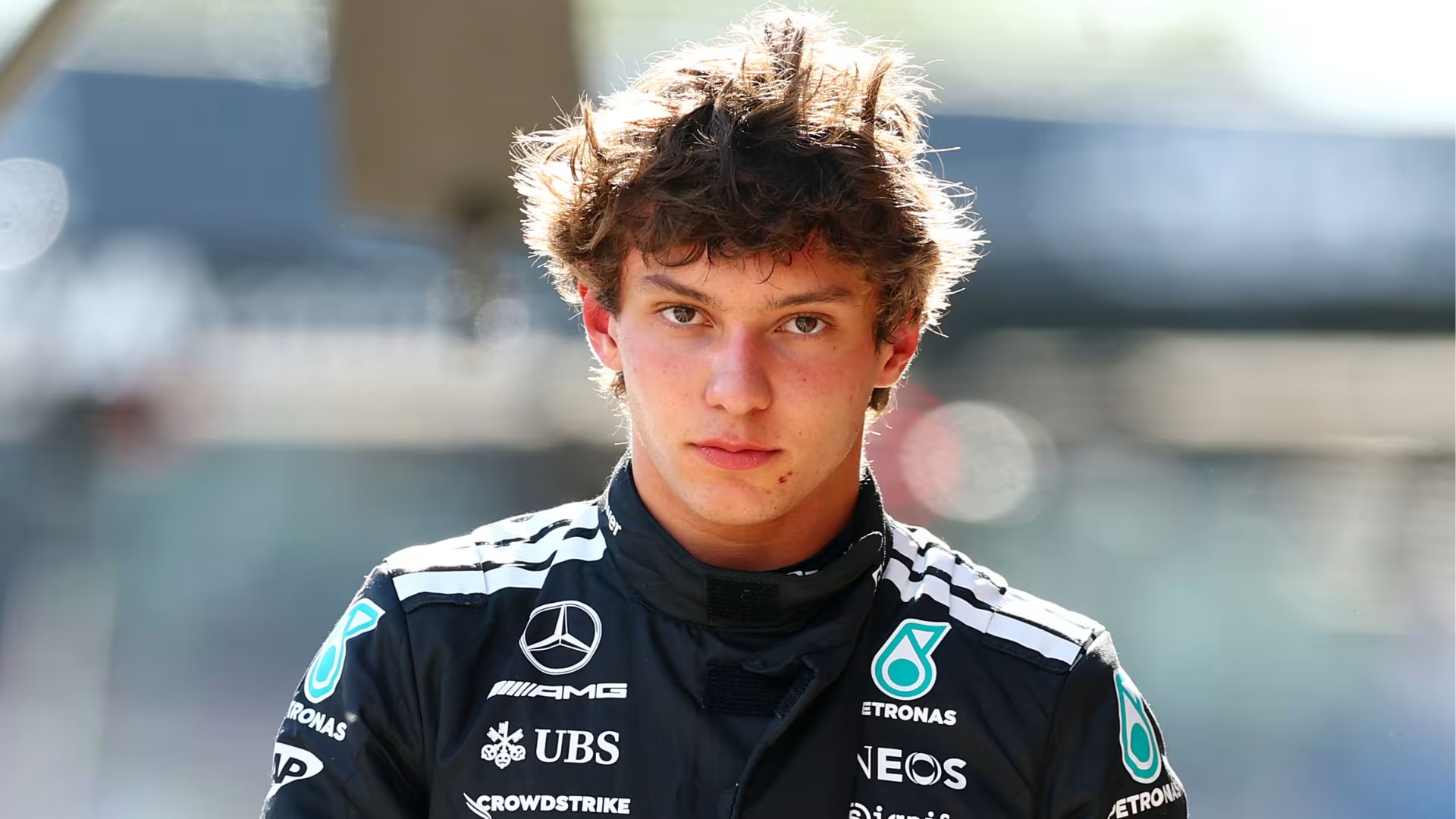
Rookie Kimi Antonelli had a bright start to his Formula One career in 2025, but come the European racing season he fell off a cliff. He now blames a decision take by the Mercedes team for his collapse in form on a decision made during the opening flyaway races.
The bright Italian racing star scored points in five of his first six race weekends averaging a P5 finish with the exception of Bahrain. Yet his P5 start resulting in a P11 finish in the Arabian Kingdom was not all his fault.
Mercedes elected to start Antonelli on the medium tyre at the Sakhir International Circuit which meant he lost out on lap one to Lando Norris and Max Verstappen who both began the Grand Prix on the quicker soft tyre…. READ MORE

A.J. Hunt is Senior Editor at TJ13, where Andrew oversees editorial standards and contributes to the site’s Formula 1 coverage. A career journalist with experience in both print and digital sports media, Andrew trained in investigative journalism and has written for a range of European sports outlets.
At TJ13, Andrew plays a central role in shaping the site’s output, working across breaking news, analysis, and long-form features. Andrew’s responsibilities include fact-checking, refining editorial structure, and ensuring consistency in reporting across a fast-moving news cycle.
Andrew’s work focuses particularly on the intersection of Formula 1 politics, regulation, and team strategy. Andrew closely follows developments involving the FIA, team leadership, and driver market dynamics, helping to provide context behind the sport’s biggest stories.
With experience covering multiple seasons of Formula 1’s modern hybrid era, Andrew has developed a detailed understanding of how regulatory changes and competitive shifts influence the grid. Andrew’s editorial approach prioritises clarity and context, aiming to help readers navigate complex developments within the sport.
In addition to editorial duties, Andrew is particularly interested in how media narratives shape fan perception of Formula 1, and how reporting can balance speed with accuracy in an increasingly digital news environment.
