
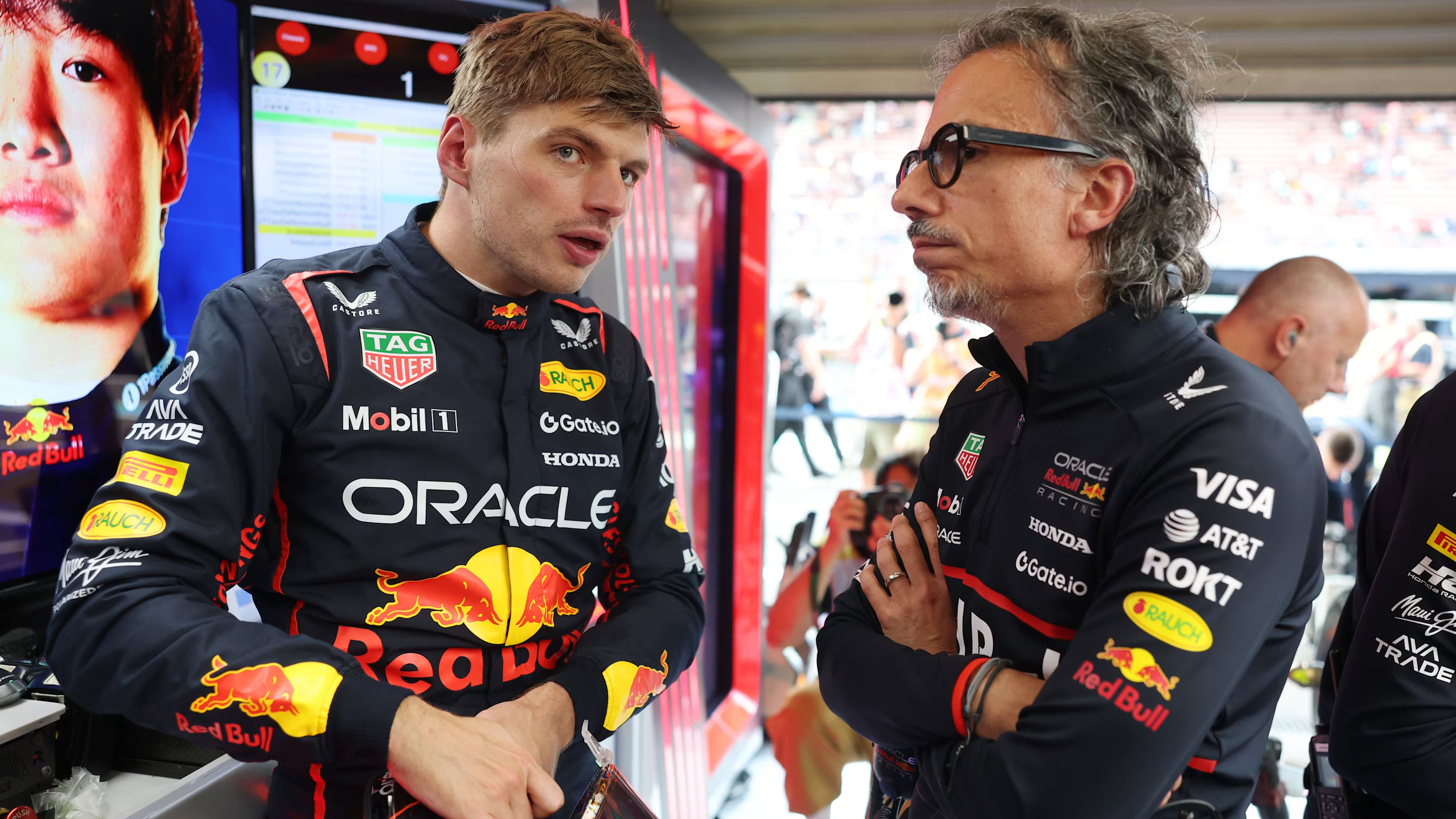
The Formula 1 gods of irony never rest. Laurent Mekies, Red Bull’s new team principal and one of Max Verstappen’s closest allies, has revealed that he once received direct orders to prevent the Dutchman from ever racing in Formula 1. The same man who is now strategising Verstappen’s next world championship had, in fact, the official paperwork to stop him before he even started. Somewhere, Jean Todt is sipping espresso and smiling knowingly.
The FIA panic button
Flashback to 2015. Verstappen is 17, armed with absurd talent and an ego the size of Zandvoort. Crucially, he has no road driving licence. Yet somehow, he’s been handed a super licence to race 1,000-horsepower F1 machinery. The world looks on in astonishment, the FIA frowns, and Jean Todt reaches for the bureaucratic panic button. The words ‘that’s ridiculous’ reportedly echo through the corridors of power in Paris.
Enter Laurent Mekies, a rising FIA official at the time, who was tasked with cleaning up the mess. Todt’s orders are simple: it must never happen again.
“People won’t understand that you can drive an F1 car but not a normal car,” Todt laments, presumably staring out of the window and wondering what the world has come to. Mekies nods dutifully and sets out to design a new, sensible system, one that would ensure that no teenage phenomenon could ever do this again.
Thus, the super licence system we know today, complete with a minimum age requirement and a cumbersome points structure, was born. All because Max Verstappen was too good, too young and too much of an inconvenience for the FIA.
Mission: stop Max!
Mekies now admits with a chuckle that his first official FIA assignment was essentially to stop Verstappen.
“You shouldn’t tell him this,” he confesses, “but it’s actually the exact opposite of what people think. I didn’t help him get into F1, I tried to stop him!”
It’s the kind of confession that would make any Netflix producer salivate. The Frenchman wasn’t plotting sabotage out of malice, of course, just following orders. But, as is often the case in Formula 1, fate had other plans.
Not only did Verstappen make it into F1, he also tore up the record books, terrified veterans and redefined the sport’s limits. Years later, the man once sent to regulate him is now sitting beside him on the Red Bull pit wall, headset on, plotting the next weekend’s dominance. Somewhere, irony writes its own script.
From rulemaker to rulebreaker
Verstappen’s career has been a masterclass in unintended consequences. His mere existence has triggered more FIA rule changes than entire teams have. First came the age rule, born from his debut. Then came the ban on braking manoeuvres, dubbed the ‘Verstappen rule’, after his defensive manoeuvres caused heart palpitations across the paddock.
Max doesn’t just race; he rewrites the regulations through sheer force of will.
Now, Laurent Mekies, who helped codify those regulations, is tasked with managing Verstappen rather than controlling him. It’s a poetic twist worthy of Shakespeare, if Shakespeare had written about tyre degradation and DRS zones.
When Mekies looks across the Red Bull garage and sees Verstappen effortlessly dismantling another Sunday afternoon, it must feel somewhat surreal. Once upon a time, his job was to protect Formula 1 from Max. Now, it’s to ensure that nobody gets in his way.
Hamilton at war with FIA stewards
The perfect partnership
Since Mekies replaced Christian Horner in July, the partnership has been surprisingly harmonious. Red Bull’s technical boss, Pierre Waché, handles the machinery, while Mekies manages the chaos. Together with Verstappen, they’ve racked up three Grand Prix wins and two sprint victories in just a few months. The title fight isn’t entirely lost, although it’s become trickier since São Paulo. Nevertheless, with Verstappen at the wheel, it would be unwise to rule anything out.
As Mekies puts it, Max still doesn’t know that he once tried to stop him — and ‘that’s for the best’. You can almost picture Verstappen’s reaction if he ever finds out: a raised eyebrow, a half-smirk and a sarcastic ‘Good luck with that.’
Because stopping Max Verstappen has always been a fool’s errand. Ask Hamilton, ask Leclerc, ask physics. The Dutchman doesn’t slow down; he bends the sport to his will. Mekies may have been the man sent to enforce the rules, but he now leads a driver who doesn’t believe in them.
Red Bull responds to McLaren accusations
It’s come full circle, FIA style
So here we are, ten years on. The boy who wasn’t supposed to be there has become a four-time world champion. The bureaucrat who tried to rein him in now runs his team. And the rulebook written to prevent another Verstappen may soon need to be rewritten, by Verstappen himself.
Formula 1, ever the theatre of chaos and contradiction, loves a good redemption story. Laurent Mekies’ transformation from rulemaker to race winner is one of the most entertaining yet. As for Max, he’ll continue to do what he always does: drive faster than is reasonable, leaving everyone, including his former regulators, scrambling to catch up.
If Mekies ever confesses his past role, perhaps Verstappen will laugh, flash that trademark grin and say what everyone’s thinking: ‘Well, you didn’t do a very good job, did you?’
MORE F1 NEWS – Ferrari “consider a Sainz return”

Ferrari are once again in a mess. The historic Italian Formula One team these days appears never far from a crisis. Questions were raised in the Italian media over the leadership of Fred Vasseur, only for Ferrari to answer within days by awarding him a new contract.
The signing of Lewis Hamilton was heralded in Maranello by some as the sign the team may be entering another Michael Schumacher era, where through his experience he wold lead the team back to winning ways.
Yet Schumacher was a much younger driver when he joined the Scuderia and it was a time when Jean Todt was leading a long term project of revolution, which meant Schumacher only found championship success in his fifth season with the team.
Hamilton’s highs and lows
Hamilton presents as somewhat of a bi-polar personality. His highs are monumental, but then so are his lows. Having missed out on a top ten shootout again in Hungary while his team mate claimed pole, a dejected Lewis Hamilton stated: “It’s just me every time.”
“I’m useless, absolutely useless. Team has no problem, you’ve seen the car’s on pole. They probably need to change driver,” Lewis said live on air.
Whether intentionally or not, Hamilton has channeled the spirit of Schumacher as he revealed on a number of occasions he has assembled dossiers to present to the engineers at Ferrari. These are presumably to assist them in overcoming the inherent problems in the SF-25, although one ex-Ferrari driver Arturo Merzario, claimed “90 percent of engineers didn’t want Hamilton” to join the team…READ MORE

The Judge, a nom de plume of an experienced F1 journalist and site founder with long-standing sources across the paddock. With over 30 years of experience in Formula 1 as an insider journalist, I have built trusted connections across the paddock, from race engineers and mechanics to senior team figures. At The Judge 13, I and a handful of trusted colleagues share exclusive Formula 1 news, expert analysis and behind-the-scenes stories you will not find in mainstream motorsport media.

Craig Alderson is Senior Editor at TJ13, where Craig oversees newsroom operations and coordinates editorial output across the site. With a background in online sports reporting and motorsport magazine editing, he plays a key role in maintaining consistency, speed, and accuracy in TJ13’s coverage.
During race weekends, Craig acts as desk lead, directing contributors, prioritising breaking stories, and ensuring timely publication across a fast-moving news cycle.
Craig’s work focuses heavily on real-time developments in the paddock, including team updates, regulatory decisions, and emerging controversies. This role requires a detailed understanding of Formula 1’s operational flow, from practice sessions through to race-day strategy and post-race fallout.
With experience managing editorial teams, Craig ensures that TJ13 delivers structured, reliable coverage while maintaining the site’s distinctive voice.
Craig has a particular interest in how information moves within the paddock environment, and how rapidly developing stories can be accurately translated into clear, accessible reporting for readers.
