
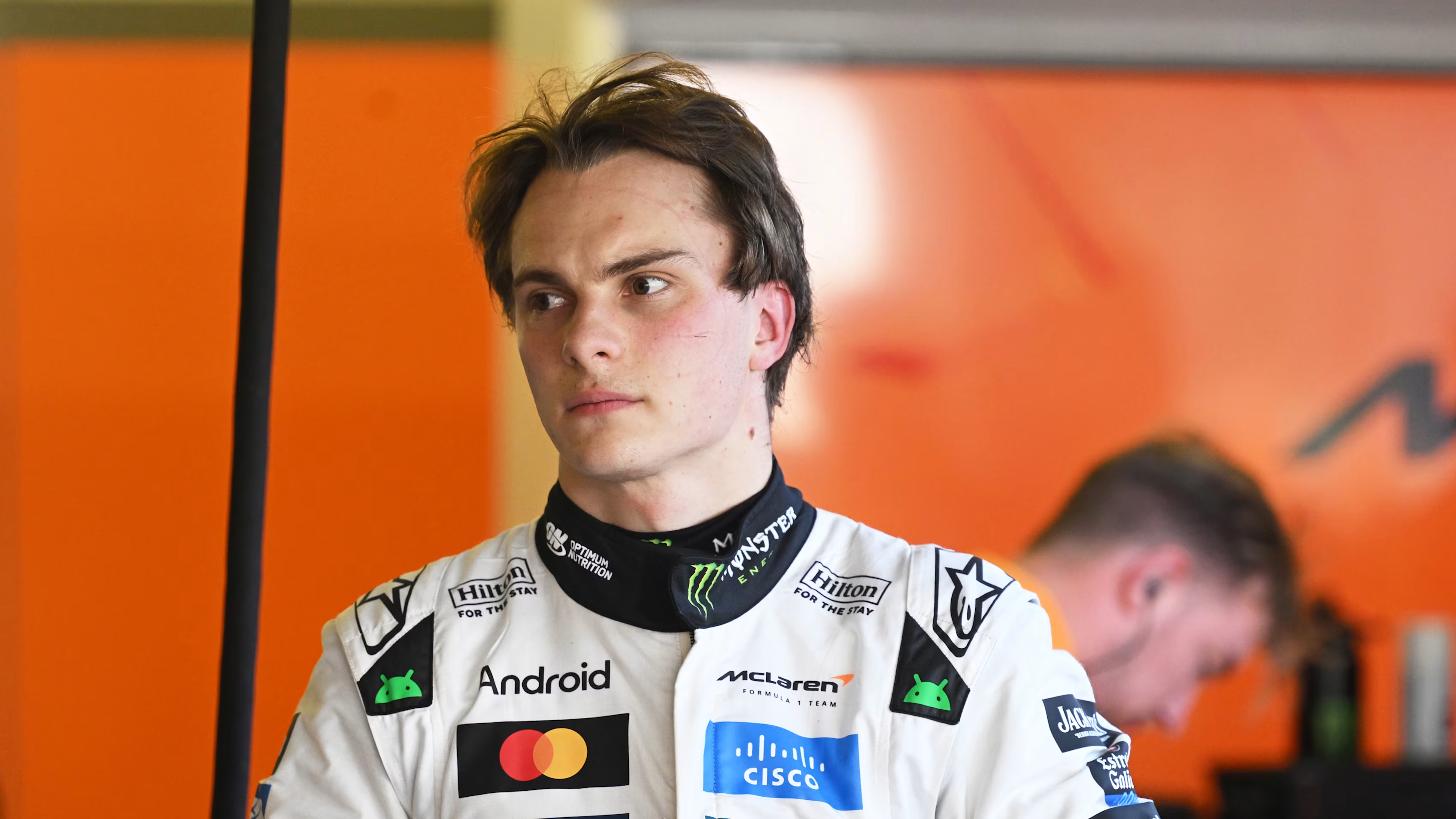
It all looked so good just five race weekends ago for Oscar Piastri. At the Dutch Grand Prix the Australian entered the exclusive Formula One drivers’ club – there Grand Chelm – by claiming pole position, fastest lap and leading from lights out to the chequered flag.
Jim Clarke leads this iconic group of drivers with eight Grand Chelms and of the current drivers Lewis Hamilton and Max Vertsappen each have six – Max’s latest in Baku this season – Fernando Alonso, Charles Leclerc and now Oscar Piastri have just one.
A Grand Chelm is particularly difficult to achieve as Lando Norris found out last weekend in Mexico. Although he claimed pole position and led every lap, it was George Russell who claimed the fastest lap of the race, by a whopping 7/10ths of a second from the McLaren driver who was clearly looking after his tyres.
McLaren boss warned about Red Bull after Monza
Yet since Piastri’s achievement in Zandvoort, the wheels have come off his championship challenge. Then 34 points ahead of his team mate Lando Norris and with McLaren looking each week as though they would finish 1-2, the title was surely all but in the bag for the Aussie.
Then came Monza. A genius Red Bull upgrade saw Max Verstappen romp to victory in Ferrari’s back year by a whopping twenty seconds. McLaren team boss Andreas Stella was immediately concerned and when asked was the world champion back in the title fight despite his 94 point deficit, he was adamant.
“I used the capital letters already… We’re talking about Max Verstappen, we’re talking about Red Bull. We have already seen in Monza that they improved. They seem to have made an improvement with their car, because the way they won Monza was something more for what was our assessment than simply a car that adapts well at low drag.
“They were fast in the corners, medium-speed and low-speed corners, fast in the straights, and we know that Max, when he has a competitive car, can deliver strong weekends. Conversely, we also knew that… Baku for us would have been a difficult circuit,” concluded the McLaren boss.
Austin revealed a Piastri weakness
Then came Azerbaijan, a disaster for McLaren and particularly Piastri. He put his MCL39 into the wall in qualifying, then made a false start in the Grand Prix which left him last going into turn one. In his desperation to make places back through the field, Oscar didn’t survive half a lap and again his papaya liveried car was making friends with the tech pro wall and he was out of the race.
Singapore was a respectable recovery for Piastri although he was niggled that his team mate had clipped him going into turn three on the opening lap, but come Austin it was to be another depressing weekend fore the Australian racer.
A naive move in turn one during the Sprint saw him and team mate Norris out of the race, with Verstappen going on to win. Whilst Norris was challenging for pole position, his team mate struggled and started the race in just sixth place. Oscar made up one place before the chequered flag but his team boss Stella made an interesting observation after the Sprint race.
McLaren suggested Oscar change his driving style
“This is certainly one of the most important points that we need to review, which is the fact that Oscar, in qualifying and in the race, seemed to have a couple of tenths that he was not able to fully realise and that possibly was available in the car.
“We are actually now checking that we are completely happy with the setup of the car, the setup of the floor, that everything is as intended from a car point of view and at the same time, we’ll be looking at the driving.
“I think we know with Oscar that when the conditions are such that we have low grip, you really need to challenge the car and lean on the understeer, oversteer, locking. This is an area of his driving that he has an opportunity to improve. And in Oscar’s standards, this needs to [and] will improve pretty fast,” concluded Stella.
Asking a driver to change his driving style whilst in the most of a title battle is a remarkable thing for his team to suggest.
Piastri unsure if changes have helped
Piastri himself admitted in Mexico that he had been trying certain things to adapt his driving style. After another disappointing weekend Piastri was asked whether the changes to his driving style had helped in anyway: “It’s difficult to say ultimately, I think we certainly tried a lot of different things, but at the back with cars as well, so it was difficult to kind of get a read on whether what I was changing with my driving was working that well or not.
“But ultimately, yeah, we’ll have to analyse it and see if it looks good and in terms of the numbers and stuff, because, from a feeling point of view, when you’re behind that many cars, it’s very difficult to tell,” said the Australian.
Thats a pretty huge pill for Oscar to swallow, being told your driving style has contributed to a catastrophic loss in form. Yet the secret to Piastri’s decline may be more simple to understand.
Oscar is in his third season of Formula One and whilst he has made significant improvements on 2024, the secret to his demise may well lie in his historic performances. Having won in Baku last season, Piastri was 28 points behind Lando Norris, but his form fell away across the final six race weekends.
McLaren start war of words with Red Bull
The final run in circuits are historically Piastri’s weakest
P5 in the USA was followed by two P8’s in Mexico and Brazil. Then in Las Vegas it was P7 before a podium P3 in Qatar was followed by Oscar scoring a single point in the seasons finale in Abu Dhabi.
These are the circuits he is least experienced at, given during his time in Formula 2 he only raced at the Las Marina circuit. In his first year with McLaren, again with the exception of Qatar, Piastri failed to make the top five in any of the remaining closing rounds.
An examination of Piastri’s prior results over the remaining four weekends, would suggest his only joy will be at the penultimate weekend at the Losail circuit in Qatar. Its looking good for Lando Norris who appears to have hit his stride and for Piastri it seems all but over and having to tinker with your driving style in a title fight makes the task even more impossible.
Oscar may have joined the exclusive Grand Chelm club this season, but it appears he is not yet the finished article and has work to do on his driving style and with circuits he doesn’t know well.
Pirelli gambled worked despite widespread paddock criticism
Those at the top of Formula One have long sought ways to engineer most of the races towards a two stop strategy. This year for the first time in F1 history, the usually processional Monaco Grand Prix was mandated by the FIA as a two stop race.
This followed the Grand Prix in 2014, where a red flag meant all the drivers had a free change of tyres and merely cruised to the end mostly in the order they started.
Pirelli have been tasked with engineering rubber which degrades more quickly than its predecessor’s bull proof Bridgestone’s. In their fifteen year tenure they have often delivered tyres which create an opportunity for different race strategies, although at times the structural integrity of the tyres has been called into question…. READ MORE


A.J. Hunt is Senior Editor at TJ13, where Andrew oversees editorial standards and contributes to the site’s Formula 1 coverage. A career journalist with experience in both print and digital sports media, Andrew trained in investigative journalism and has written for a range of European sports outlets.
At TJ13, Andrew plays a central role in shaping the site’s output, working across breaking news, analysis, and long-form features. Andrew’s responsibilities include fact-checking, refining editorial structure, and ensuring consistency in reporting across a fast-moving news cycle.
Andrew’s work focuses particularly on the intersection of Formula 1 politics, regulation, and team strategy. Andrew closely follows developments involving the FIA, team leadership, and driver market dynamics, helping to provide context behind the sport’s biggest stories.
With experience covering multiple seasons of Formula 1’s modern hybrid era, Andrew has developed a detailed understanding of how regulatory changes and competitive shifts influence the grid. Andrew’s editorial approach prioritises clarity and context, aiming to help readers navigate complex developments within the sport.
In addition to editorial duties, Andrew is particularly interested in how media narratives shape fan perception of Formula 1, and how reporting can balance speed with accuracy in an increasingly digital news environment.
