


The FIA has officially concluded its 2024 Formula 1 cost cap review, confirming that nine of the ten teams were fully compliant with financial regulations. The only exception was Aston Martin, which was found to have committed a procedural violation rather than exceeding the cost cap itself. In a detailed statement, the governing body confirmed that Aston Martin’s infraction was ‘of a very minor nature’ and did not result in any sporting or financial advantage.
The FIA stated that nine Formula 1 teams were found to be compliant for 2024. This declaration comes as a relief to the paddock after several weeks of speculation that more teams could have fallen foul of the regulations. This clarification brings an end to months of uncertainty and ensures stability as the sport prepares for the 2026 regulation changes.
Pirelli gamble works despite widespread paddock criticism in Mexico
Nature of Aston Martin’s breach
Aston Martin, operating under the legal entity AMR GP Ltd, accepted responsibility for a procedural error through an Accepted Breach Agreement (ABA), which was signed on 29 September. The FIA’s Cost Cap Administration (CCA) clarified that the breach was caused by circumstances outside the team’s control and described them as ‘unforeseeable’.
The FIA explained that “Aston Martin did commit a procedural violation, but the cost limit was not exceeded, and the violation was of a very minor nature”.
The governing body added that the situation arose from ‘unforeseeable circumstances beyond the control of the Formula 1 team’, emphasising that the team ‘acted cooperatively and in good faith throughout the entire review process’.
This finding is consistent with previous procedural cases where administrative oversights, rather than deliberate overspending, have led to minor penalties or none at all.
McLaren start war of words with Red Bull
No financial penalty was imposed
Given the context of the violation, the FIA opted not to impose any financial or sporting penalty on Aston Martin. The Cost Cap Administration noted that, due to these exceptional and unforeseeable circumstances, no financial penalties were imposed on AMR. The statement also confirmed that there was ‘no allegation or evidence that AMR sought or obtained an unlawful advantage through the violation’.
This decision marks a departure from the harsher outcomes seen in previous seasons, where cost cap breaches led to fines or performance restrictions. In this case, the FIA’s recognition of the team’s transparency and cooperation appears to have been a decisive factor.
The duration and scope of the review process
The FIA revealed that the review process spanned seven months in total, requiring teams to submit detailed financial documentation for the 2024 season by the end of March 2025. The Cost Cap Administration then verified all submissions with the support of independent auditors to ensure accuracy and compliance.
During this period, all Formula 1 teams and power unit manufacturers were required to provide full financial disclosure. The FIA stated: “All Formula 1 teams and all powertrain manufacturers have provided their full cooperation in providing the necessary information. The CCA notes that all teams and manufacturers have acted in good faith and cooperated throughout the process.”
Alongside the review of team finances, the FIA confirmed that all five engine manufacturers preparing for the 2026 season had met their financial obligations. The statement read: ‘All five engine manufacturers have been found to be compliant for 2024.’
MORE F1 NEWS – Piastri’s decline: The analysis
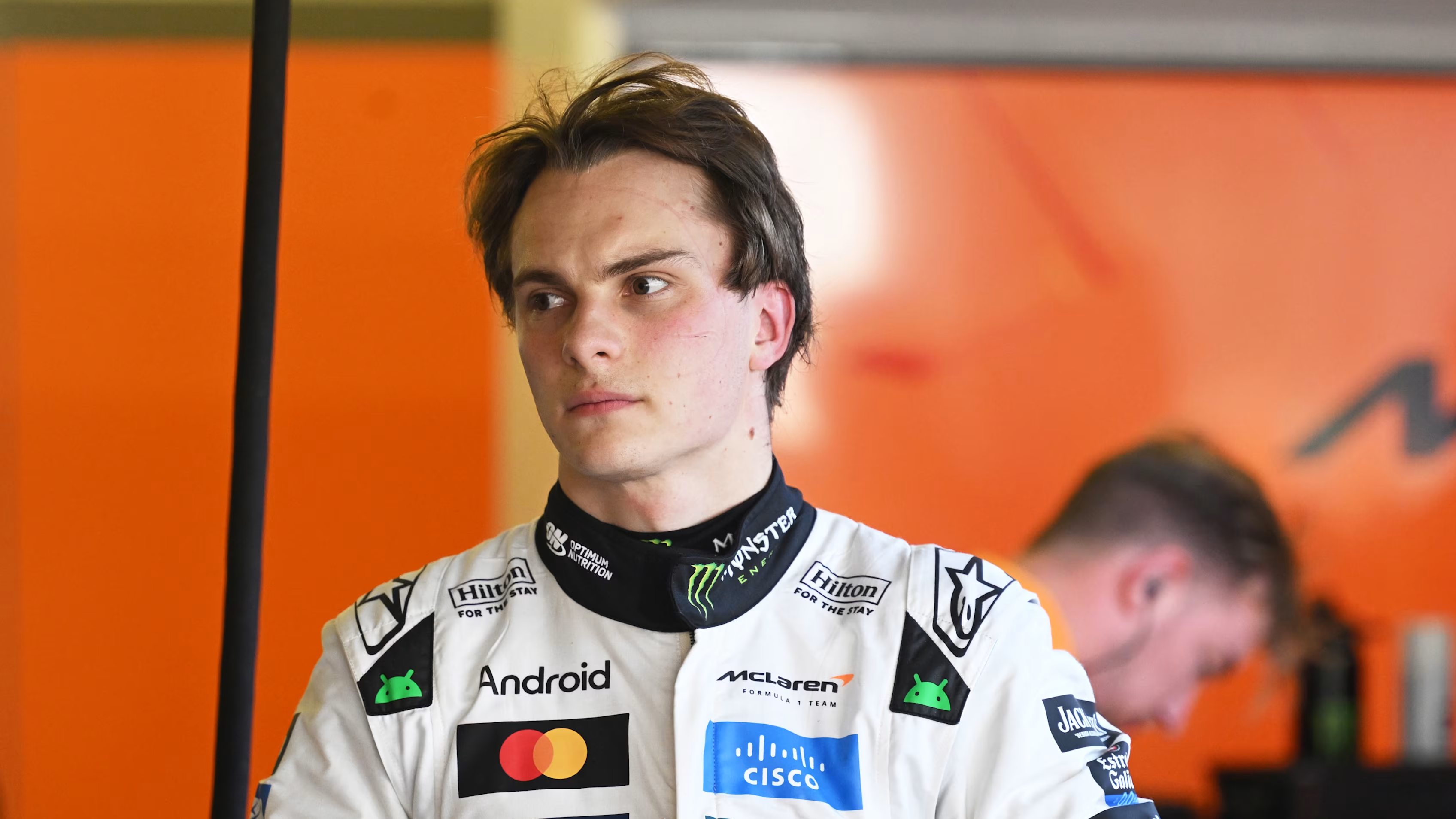
It all looked so good just five race weekends ago for Oscar Piastri. At the Dutch Grand Prix the Australian entered the exclusive Formula One drivers’ club – there Grand Chelm – by claiming pole position, fastest lap and leading from lights out to the chequered flag.
Jim Clarke leads this iconic group of drivers with eight Grand Chelms and of the current drivers Lewis Hamilton and Max Vertsappen each have six – Max’s latest in Baku this season – Fernando Alonso, Charles Leclerc and now Oscar Piastri have just one.
A Grand Chelm is particularly difficult to achieve as Lando Norris found out last weekend in Mexico. Although he claimed pole position and led every lap, it was George Russell who claimed the fastest lap of the race, by a whopping 7/10ths of a second from the McLaren driver who was clearly looking after his tyres.
McLaren boss warned about Red Bull after Monza
Yet since Piastri’s achievement in Zandvoort, the wheels have come off his championship challenge. Then 34 points ahead of his team mate Lando Norris and with McLaren looking each week as though they would finish 1-2, the title was surely all but in the bag for the Aussie.
Then came Monza. A genius Red Bull upgrade saw Max Verstappen romp to victory in Ferrari’s back year by a whopping twenty seconds. McLaren team boss Andreas Stella was immediately concerned and when asked was the world champion back in the title fight despite his 94 point deficit, he was adamant.
“I used the capital letters already… We’re talking about Max Verstappen, we’re talking about Red Bull. We have already seen in Monza that they improved. They seem to have made an improvement with their car, because the way they won Monza was something more for what was our assessment than simply a car that adapts well at low drag.
“They were fast in the corners, medium-speed and low-speed corners, fast in the straights, and we know that Max, when he has a competitive car, can deliver strong weekends. Conversely, we also knew that… Baku for us would have been a difficult circuit,” concluded the McLaren boss…READ MORE ON THIS STORY

Alex Stanton is a Formula 1 journalist at TJ13 with a focus on the financial and commercial dynamics that underpin the sport. Alex contributes reporting and analysis on team ownership structures, sponsorship trends, and the evolving business model of Formula 1.
At TJ13, Alex covers topics including manufacturer investment, cost cap implications, and the strategic direction of teams navigating an increasingly complex financial environment. Alex’s work often examines how commercial decisions translate into on-track performance and long-term competitiveness.
With a strong interest in the intersection of sport and business, Alex provides context around Formula 1’s global growth, including media rights, expansion markets, and manufacturer influence.
Alex’s reporting aims to explain the financial realities behind headline stories, helping readers understand how money, governance, and strategy shape the competitive order in Formula 1.
