
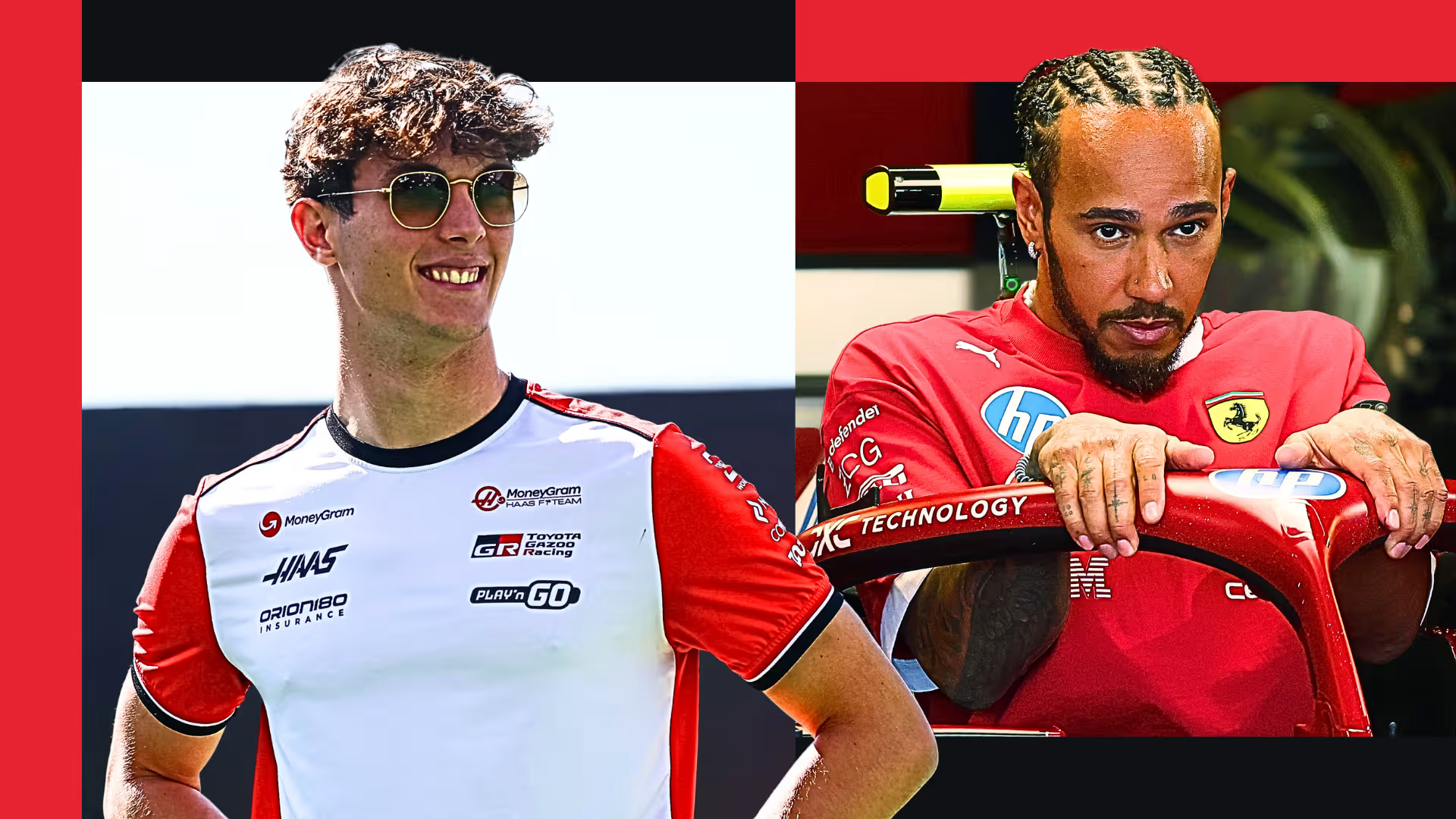
Ahead of the 2026 Qatar Grand Prix, Haas F1 have finally announced a contract extension for their lead driver, Ollie Bearman. The matter has been dragging on for weeks, with Bearman revealing some weeks ago at the US GP that he had no idea why the contract remained unsigned.
“It’s no secret that I’m delighted to be continuing with TGR Haas F1 Team into 2027,” said Ollie Bearman. “This team has played an integral role in my development, and I’ve felt a huge amount of belief and support from everyone here. We’ve got big ambitions to keep pushing forward, and I’m excited to lead that work, building on what we’ve achieved, and striving for even more together – we have unfinished business.”
Ferrari’s Role in Holding Up the Contract
Team boss Ayao Komatsu has been saying for weeks that the deal would finally get done, but it was the Ferrari involvement which held matters up. Bearman is a Ferrari academy driver, leaving school at sixteen to join the iconic red team. Unlike Charles Leclerc, he failed to win either of the FIA junior formulae, but grabbed his chance to debut for the Scuderia when Carlos Sainz fell ill during the Saudi Arabian Grand Prix.
With just one practice session under his belt, Bearman qualified in eleventh, and at the high-speed circuit in Jeddah,powered his way to finish the race in P7, ahead of Lando Norris and Lewis Hamilton. From then on, his future in F1 was secure.
Blocked From a Seat at the Scuderia
Much of the delay in finalising Bearman’s contract extension has been due to Ferrari’s involvement, something a frustrated Komatsu had revealed in Las Vegas. He said, “many parties [are] involved in the contractual situation” when asked about the delay last week.
And the problem is simple. Bearman knows he has the talent to compete in a front-running team, but with both seats at Ferrari being locked down by Lewis Hamilton and Charles Leclerc, there’s no room for him to progress.
TJ13 sources suggest that Bearman’s management team were originally fine with signing a two-year extension with Haas F1, on the basis that in 2029, Ollie gets his big break with the scarlet team. Further, if Ferrari wished to call up Bearman early for any reason, Haas would have released him. Money was not an issue, so why the delay?
‘Unmanageable’ Tensions Inside the Maranello Garage
In recent weeks, the atmosphere in the Ferrari garage has rapidly deteriorated, as Lewis Hamilton and Charles Leclerc have been harassing each other both on and off track. Incidents in Monza, Mexico, and Las Vegas, where the Scuderia drivers have either taken each other out or crashed into each other, had led Fred Vasseur going into Qatar to say the pair are quickly becoming “unmanageable.”
When asked what he would do if he now had the choice of pairing Hamilton and Leclerc, the Ferrari boss was candid:“Honestly not,” he tells Sky Italia. “If I’d known before, it would be different. Pressure is definitely growing; it’s much worse now than it was eighteen months ago. In the last two or three races, the situation is becoming unmanageable.”
Much of the recent criticism for Ferrari’s mishaps has been directed towards Leclerc, and Vasseur too is clearly frustrated over the incident in Las Vegas. “We passed the message to Charles to not overtake because in this kind of race, you have to overtake the cars in front of you or you are passed by the others,” Vasseur revealed.
“And Charles did clearly a mistake; it’s penalising the team a lot, and it’s completely unacceptable. Honestly, we are more than upset because that message was clear after Mexico. We had the chat together, all together in Brazil. Today we passed the message to think about the team when they were racing together and the outcome is this one. It’s mega-frustrating for all of us.”
How Hamilton’s Paddock Messaging Changed the Calculus
Yet the eagle-eyed F1 fans amongst us will have noticed that Lewis Hamilton has been playing mind games with his teammate this season. In some ways, it’s reminiscent of Hamilton’s time alongside Rosberg in 2014–16. This time last year, Hamilton was racked with self-doubt, even suggesting Ferrari should find a replacement for him, but a solid start in 2026 turned the British driver’s mental approach around.
This year, Lewis found himself able to compete with Leclerc week in and week out, and come Round 5 in Canada, the pair were separated by just three points. Next time out in Monaco, on Lap 65, Leclerc was in third place, just ahead of his teammate. He hit a patch of disintegrating asphalt and was sent crashing into the barrier at the final corner.
Hamilton went on to claim P2 after George Russell’s time penalty was added after the chequered flag—a net loss of 18 points for the Monegasque driver to his teammate. In Barcelona, Hamilton secured his first victory for Ferrari, whilst with less than five laps remaining, his teammate suffered a hydraulic failure and was forced to retire the car.
Hamilton’s Push for Number One Status
Next time out in Austria, neither of the Ferraris was particularly impressive, with Hamilton coming home in fifth, while Leclerc, struggling with braking issues, picked up just four points. Hamilton then engaged a narrative that ‘Ferrari needed to work more as a team,’ but the real call he was making was for them to make him their number one driver.
This agenda is clear from Lewis’s latest comments coming into Qatar, when he denied ever asking to become number one driver, although his subsequent words make plain this is exactly what he believed should happen.
“I’ve never asked to be the number one,” Hamilton said. “I genuinely haven’t. But there was a point in the season where I was 40 points ahead [of Leclerc] and at that point, the fight was with me and Kimi. I was the closest one to him. I was second for a long time in the year, and at that point I needed the backing to make sure we beat Kimi.
“There were a few instances in the season—where, with the support—I think we could have beaten Kimi in that battle.It’s not what I’ve asked for. But we shouldn’t have been able to come together [in Las Vegas]. It should just never happen.I’ve said everything I can on it. And the question now should be for Ferrari.”
The 2028 Escape Clause That Sealed the Deal
And this has been Hamilton’s messaging ever since that run of three races. Now, with Vasseur suggesting his drivers are “unmanageable,” it was clear Bearman’s management spotted an opportunity. Instead of just another two years at Haas F1, with a promise of a Ferrari drive should an opportunity arrive, the team led by Chris Harfield argued the resolution to Ferrari’s internal problems was to promote their driver to replace Hamilton when his contract expires at the end of 2027.
The detail which caused the extensive delays in finalising Bearman’s contract was that Harfield proposed a release clause option for his client from the Ferrari programme should Hamilton retain his seat into 2028.
Decision-making at Ferrari F1 is a complex matter, with the team principal, the group president, and the CEO all involved. Whilst Vasseur expressed his disappointment in Leclerc’s recent mistake, TJ13 sources suggest the Ferrari boss has been unhappy with Hamilton’s persistent public messaging to the team.
Given his latest comments, it is most likely Vasseur is looking forward to the expiration of Hamilton’s contract and backed Harfield’s call for Bearman to get his Ferrari seat for 2028. But at Ferrari, politics are never simple, with their group president having backed Lewis Hamilton publicly.
Ferrari’s infighting will most likely continue this week in Qatar and rumble on to the season finale next week. But for now, Oliver Bearman has his contract—and his escape clause should another top team come calling.
Would you like to see more TJ13 Formula 1 coverage? Add us to your favourites list on Google to receive trusted F1 news.

A.J. Hunt is Senior Editor at TJ13, where Andrew oversees editorial standards and contributes to the site’s Formula 1 coverage. A career journalist with experience in both print and digital sports media, Andrew trained in investigative journalism and has written for a range of European sports outlets.
At TJ13, Andrew plays a central role in shaping the site’s output, working across breaking news, analysis, and long-form features. Andrew’s responsibilities include fact-checking, refining editorial structure, and ensuring consistency in reporting across a fast-moving news cycle.
Andrew’s work focuses particularly on the intersection of Formula 1 politics, regulation, and team strategy. Andrew closely follows developments involving the FIA, team leadership, and driver market dynamics, helping to provide context behind the sport’s biggest stories.
With experience covering multiple seasons of Formula 1’s modern hybrid era, Andrew has developed a detailed understanding of how regulatory changes and competitive shifts influence the grid. Andrew’s editorial approach prioritises clarity and context, aiming to help readers navigate complex developments within the sport.
In addition to editorial duties, Andrew is particularly interested in how media narratives shape fan perception of Formula 1, and how reporting can balance speed with accuracy in an increasingly digital news environment.
