
Formula One achieved something rare last week: a unanimous agreement at the F1 Commission on the return to V8 power for 2030. The rules cycle was originally set to run until the end of 2031, but the unity amongst the teams and the manufacturers meant this could be shortened.
For many, it’s like, ‘the problematic 2026 engines issue is now solved.’ But it isn’t. This was an agreement in principle only; the details have yet to follow. What we do know is there will be a 2.1L V8 combustion engine, a smallish turbo, and some form of hybrid power. More than that has not been decided, but those parameters are pretty wide.
Las Vegas Drama and the 50/50 Hybrid Flaw
In bizarre fashion, the very race after the announcement, the much-hated 2026 turbo-hybrid powertrains put on a show like Las Vegas has never seen before. The good, the bad, and the ugly were all on show along the Strip, as fans enjoyed some 352 overtaking moves—up from 17 last year.
The 50/50 split of power of the current engines was an exercise in technical automotive engineering which failed to recognise a simple truth. Given that on average 75% of a lap is spent pushing the car forward, the 25% remaining was never going to be enough to produce a genuine 50/50 power split.
To this end, the all-new FIA division of AI and code writers has been put to work. Clever algorithms now ‘assist’ in managing the energy, and at times the combustion engine must resort to being a mere generator of electrical power. All of which is nonsensical, and more than ever, fans appreciate less and less the alleged technical innovations which F1 bridges to road car development.
George Russell Urges Caution Over Pure V8s
In the intervening week since the announcement, a number of senior paddock individuals have been sharing their thoughts on the new engine proposals. George Russell is one such driver, though from the get-go this year, the British racer has praised the current hybrid units.
“The purists will say take away all electrical power, but I think when you look at how a lot of these cars have evolved in recent years, and the power output from some of these electric motors these days, if Formula 1 is going to continue to be the fastest race cars on the planet, you need to have it. That’s just the reality,” he said on Wednesday in Las Vegas.
“You need to have some sort of hybrid because the power you get, you can’t reproduce that solely on internal combustion.So I think, if we go back to V8s, having some sort of electrical power as well to give you that extra 400, 500, 600 kilowatts to bring the cars to 1,000-plus horsepower, that’s what we want.”
In a nod to Mercedes’ success over the hybrid years, Russell issued a word of caution. “I think it’s worth remembering as well, actually, the final V8 era—it sounded awesome, but the cars weren’t actually very fast, and I don’t think many people realise that.”
Yet pure speed is not what drives F1 fans; it’s competitive racing on track, together with smaller, nimbler cars battling wheel to wheel. Whilst the current behemoths may be very fast, mostly they’re not very raceable and much too big for some historical circuits.
Further, George is way off the mark with his thinking that an extra 600Kw of hybrid will be added to the car. the latest from the FIA president was that there would be “very, very little electrification,” so clearly there’s work to be done.
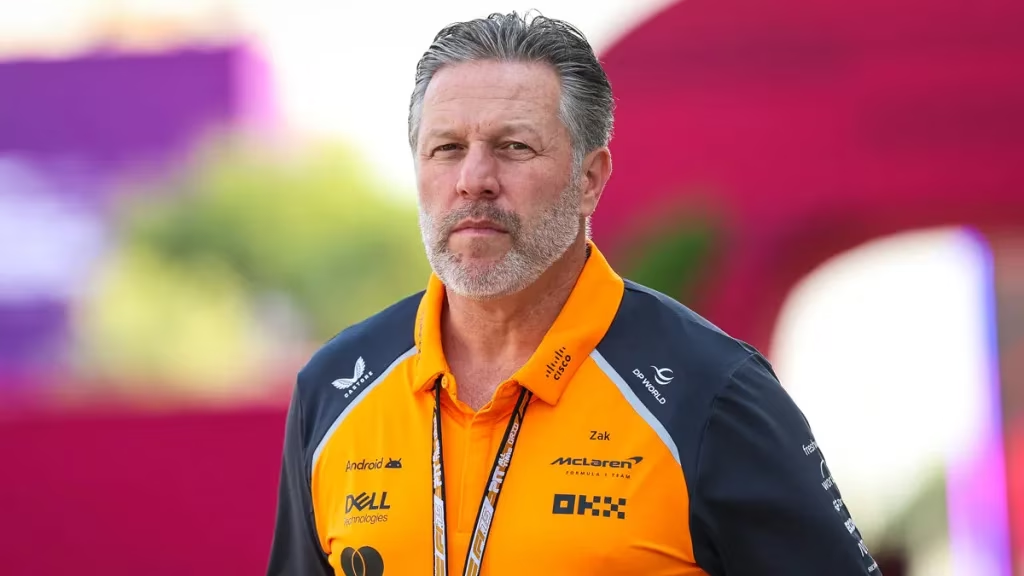
Zak Brown and Flavio Briatore Welcome the 2030 Direction
McLaren’s Zak Brown heralded the deal as follows: “Everyone is very excited. Now it’s about dotting the i’s and crossing the t’s,” he said on Thursday. He went on to praise the leadership of the FIA for a parallel announcement made, which was reported little.
“If you look at what the FIA has done, they’ve announced full-time stewards, so they are very proactive; they move quickly, they do what they say they’re going to do. The sport has never been healthier; the competition is amazing. I’ve got a lot of confidence in the future of the sport. Where it is today is great.
“I’m excited for the new engines; everyone will be. But there’s a lot more also going on to continue to evolve the sport.Between the FIA and F1, they’re doing a great job.”
As ever with the detail, Alpine’s Flavio Briatore was quick to point out a technicality. “It is not signed,” he insisted, “but it looks like everybody is agreed: 2030, V8s. I’m very happy; it’s the right way to go. We need an engine with a lot of noise, a simple engine, and we need racing with that. In the end, I believe what is best for the spectator, for everybody, is a very simple engine, a lot of noise.”
Cadillac Pivots Away From 2029 V6 Plans
One huge change little reported is the fact that Cadillac will now never build one of the V6 turbo-hybrid motors. This is something TJ13 has repeatedly suggested in recent times. Cadillac were slated to become an engine manufacturer in 2029 and now, of course, will continue as a Ferrari customer until the new V8s return.
Dan Towriss, Cadillac’s CEO, said in Vegas: “We’re glad to see the series coming together under the leadership of the FIA to set that direction for a V8 in 2030. We’re super happy with that. Our new power unit facility opens up on December 18th. So as a new manufacturer coming into the sport, the direction is obviously very helpful. We’re excited about the direction, and the crew is hard at work, getting ready.”
Which Veterans Will Still Be Around for 2030?
Of course, there will be drivers who realise their future will not see the return of the V8s. Fernando Alonso and Sergio Perez said as much in Las Vegas. Yet Lewis Hamilton is keen to race well into the 2030s—not just for the V8s’ return, but at the prospect of racing in the first African Grand Prix of the millennium.
Yet with relationships stretched to breaking point between the Maranello drivers, it’s difficult to see Lewis alongside Charles Leclerc for another four seasons. Hamilton will seduce Ferrari with the great marketing dream that despite their years in the wilderness, it would be the Scuderia which facilitates him lifting that much-cherished and record 8th drivers’ title.
Yet with Leclerc signed long-term, I fear time will run out for Lewis and the problems he causes Ferrari are not worth retaining him beyond 2027 when his contract expires. Zak Brown is right: F1 is in a good place and, better still, heading in a sensible direction. Cheaper engines and smaller cars are indeed the future for Formula One.
Would you like to see more TJ13 Formula 1 coverage? Add us to your favourites list on Google to receive trusted F1 news.

The Judge, a nom de plume of an experienced F1 journalist and site founder with long-standing sources across the paddock. With over 30 years of experience in Formula 1 as an insider journalist, I have built trusted connections across the paddock, from race engineers and mechanics to senior team figures. At The Judge 13, I and a handful of trusted colleagues share exclusive Formula 1 news, expert analysis and behind-the-scenes stories you will not find in mainstream motorsport media.

A.J. Hunt is Senior Editor at TJ13, where Andrew oversees editorial standards and contributes to the site’s Formula 1 coverage. A career journalist with experience in both print and digital sports media, Andrew trained in investigative journalism and has written for a range of European sports outlets.
At TJ13, Andrew plays a central role in shaping the site’s output, working across breaking news, analysis, and long-form features. Andrew’s responsibilities include fact-checking, refining editorial structure, and ensuring consistency in reporting across a fast-moving news cycle.
Andrew’s work focuses particularly on the intersection of Formula 1 politics, regulation, and team strategy. Andrew closely follows developments involving the FIA, team leadership, and driver market dynamics, helping to provide context behind the sport’s biggest stories.
With experience covering multiple seasons of Formula 1’s modern hybrid era, Andrew has developed a detailed understanding of how regulatory changes and competitive shifts influence the grid. Andrew’s editorial approach prioritises clarity and context, aiming to help readers navigate complex developments within the sport.
In addition to editorial duties, Andrew is particularly interested in how media narratives shape fan perception of Formula 1, and how reporting can balance speed with accuracy in an increasingly digital news environment.
