
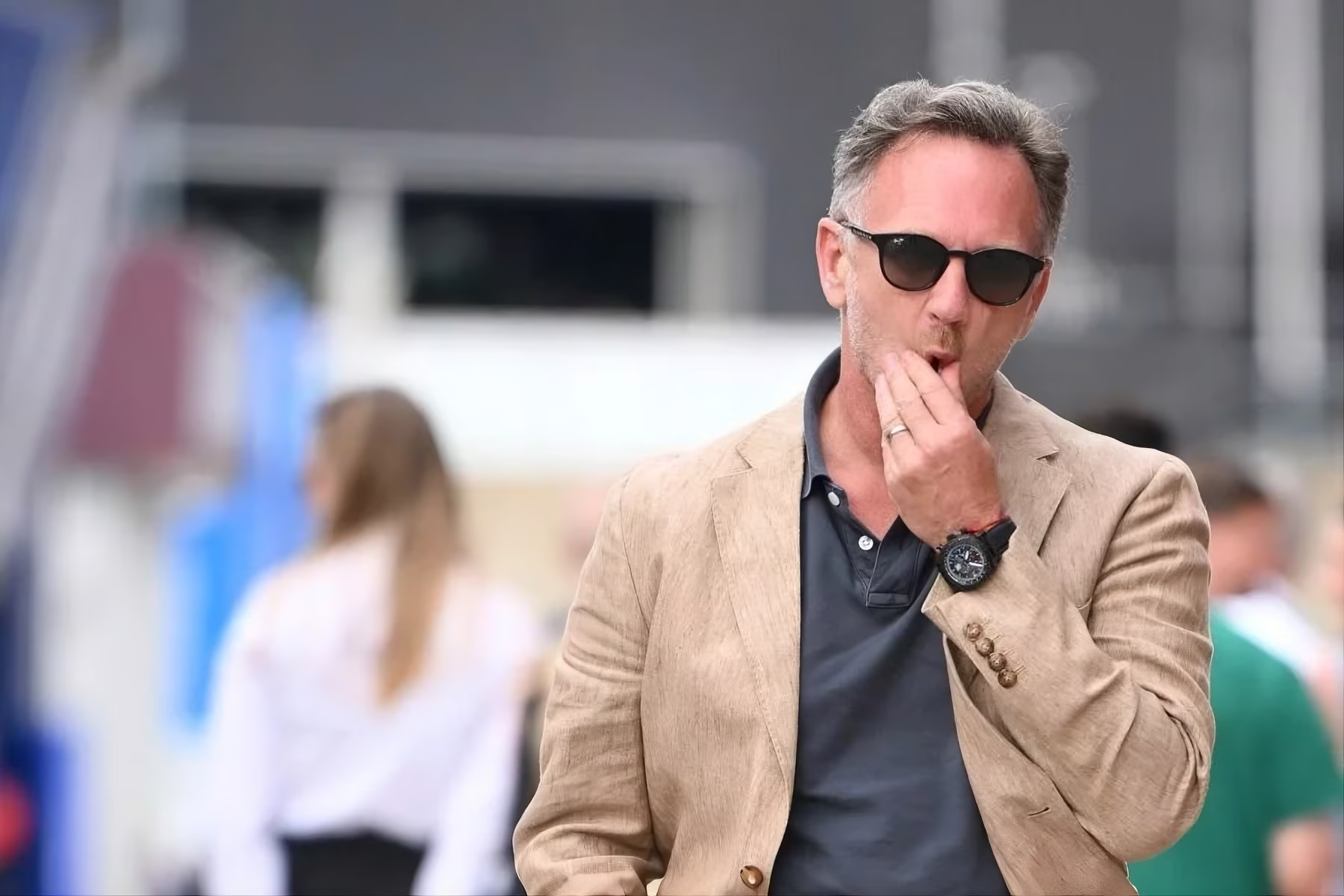
Christian Horner has always been a marmite character—people either love him or hate him. Yet his legacy is unbowed,having taken the catastrophe that was Ford’s F1 programme with Jaguar and building the first new championship-winning team for decades.
Having been evicted from his role as CEO and team principal of the Red Bull Racing organisation last season, Horner has been largely silent on the matters surrounding his dismissal until the recent publication of his memoirs, Drive. Prior to its general release, Horner arranged a speaking tour where he toured the country talking about his time in F1, taking questions and answers at each venue.
However, the publication of the book has significantly increased Horner’s media presence, with him giving several interviews to various publications answering questions on claims he made. One of his revelations included how he felt let down in 2014 when Red Bull faced a major hurdle at the start of the V6 hybrid era, where he claims: “At the first sign of adversity, Adrian wanted to abandon ship and enter serious discussions with Ferrari.”
The ex-Red Bull boss claims he felt their partnership was not what it had been, stating: “I stood behind him and believed that he stood behind me as well… I could no longer rely on him.”
Newey’s Response to 2014 Claims
Newey has now responded to Horner’s comments in a press conference where he admits he hasn’t read Drive but addresses the issues raised by the ex-Red Bull boss. “I think 2014, then, as a chassis designer, if the PU manufacturer has a bad year, that happens, and you accept it,” Newey said. “If the PU manufacturer has a bad year and doesn’t appear to have any intention of trying to address the problem, that’s altogether a different matter, and that’s quite bleak at that point.”
Adrian is addressing the relationship between Red Bull Racing and their engine partner Renault, which had won four consecutive constructors’ titles along with four drivers’ championships for Sebastian Vettel. The French manufacturer significantly underestimated the resources required for the new power unit era, leaving Red Bull languishing a long way behind Mercedes.
The Silver Arrows team racked up an unprecedented number of 1–2 Grand Prix finishes that season, with 11 from the 19 rounds on the calendar. Meanwhile, despite Red Bull’s demands that Renault invest more significantly in their F1 programme, the response from Viry-Châtillon was silence.
Newey refuses to be baited into a war of words with his former team boss, revealing: “Christian and I remain friends. As many of you know, I am the godfather to his daughter Olivia.”
Turbulent Dynamics with Helmut Marko
Other revelations from Horner include the at-times explosive relationship he had with Red Bull’s Dr. Helmut Marko. The Austrian was a personal friend of Didi Mateschitz, who founded the energy drinks empire, and was given a freelance role within the racing organisation along with heading up the Red Bull junior driver programme.
The relationship between Horner and Marko was turbulent, at times spilling out into the public domain. Following the 2023 Italian Grand Prix, as Sergio Pérez continued to struggle with his contribution to the team’s points, Marko made derogatory remarks about the Mexican driver.
The discriminatory remarks Marko made regarding Sergio Pérez’s heritage and background were sanctioned by the FIA,who handed him a formal written warning, explicitly reminding him of his responsibilities as a public figure in motorsport in line with the FIA Code of Ethics.
Christian Horner was repeatedly asked for his views on Marko’s behaviour, which he handled with delicacy, but when pressed to state if his colleague was being racist, he quipped: “Helmut is not a Red Bull Racing employee.”
Further revelations about disputes between Marko and Horner include a claim that the Austrian was not keen on signing Max Verstappen. According to Horner, Marko expressed major concerns about dealing with Max’s father, Jos Verstappen,allegedly calling him “a nightmare” and stating, “We don’t need this one.”
Horner also claimed Dr. Marko was reticent to move Max Verstappen up to the Red Bull team partway through the 2016 season. Helmut has since denied this recollection of events, stating it was he who recruited Verstappen.
In the section relating to his Red Bull dismissal, Horner accuses Marko of working behind the scenes to have him removed as CEO and Red Bull team boss. “It really got to me that he was so actively involved in getting me sacked,whilst my ex-partner and the mother of my daughter had passed away shortly before. He didn’t even offer his condolences,” he told German publication Bild.
Ralf Schumacher Cracking Down on Horner
Ralf Schumacher has lashed out at the former Red Bull boss, claiming his comments about his former colleague are “tasteless.” The former F1 driver goes on to state he believes by making such revelations Horner has tarnished his own legacy.
“Unfortunately, it’s nothing new with Christian Horner that one or the other time was a bit tasteless, I think that’s a shame,” reports Sky Deutschland. “He is ruining all his own work, because he was very successful together with the team.
“He played a major role in influencing the engine with which Red Bull won races here. He got the people and then did something like that. That’s just a shame and sad,” Schumacher concludes.
A Lasting Legacy at Milton Keynes
Yet Horner’s legacy is still being written. At recent Grands Prix, Red Bull Powertrains won. Never in F1 history has a customer team gone on to produce its own engines—and in particular, the rocket science required for the latest iteration of F1’s PU complexity.
It was Horner who persuaded Didi Mateschitz to cancel the proposal to partner with Porsche—who would have built their F1 engine—when Honda declared in 2020 they were quitting the sport. Late that year, the foundations were dug at the Milton Keynes base, and now there stands a state-of-the-art racing engine production facility, which the FIA has declared is the class of the field in 2026.
Considering the nickname given to the upper echelons of F1 senior personnel—the Piranha Club—Horner’s book is relatively benign in terms of the explosive revelations he could have made. Yes, he airs some of his grievances, like feeling let down by his friend Adrian Newey, along with mild episodes in the turbulent relationship he and Dr. Helmut Marko endured.
However, Drive appears a reasonable journey describing Horner’s appointment to oversee the Red Bull Racing programme and many of the controversies they have enjoyed along the way. He led the team from being the noisy upstarts who played loud music in their garage to a perennial F1 giant winning eight drivers’ titles and six constructors’ championships—in an era when Ferrari has won just two in total.
Would you like to see more TJ13 Formula 1 coverage? Add us to your favourites list on Google to receive trusted F1 news.

The Judge, a nom de plume of an experienced F1 journalist and site founder with long-standing sources across the paddock. With over 30 years of experience in Formula 1 as an insider journalist, I have built trusted connections across the paddock, from race engineers and mechanics to senior team figures. At The Judge 13, I and a handful of trusted colleagues share exclusive Formula 1 news, expert analysis and behind-the-scenes stories you will not find in mainstream motorsport media.

A.J. Hunt is Senior Editor at TJ13, where Andrew oversees editorial standards and contributes to the site’s Formula 1 coverage. A career journalist with experience in both print and digital sports media, Andrew trained in investigative journalism and has written for a range of European sports outlets.
At TJ13, Andrew plays a central role in shaping the site’s output, working across breaking news, analysis, and long-form features. Andrew’s responsibilities include fact-checking, refining editorial structure, and ensuring consistency in reporting across a fast-moving news cycle.
Andrew’s work focuses particularly on the intersection of Formula 1 politics, regulation, and team strategy. Andrew closely follows developments involving the FIA, team leadership, and driver market dynamics, helping to provide context behind the sport’s biggest stories.
With experience covering multiple seasons of Formula 1’s modern hybrid era, Andrew has developed a detailed understanding of how regulatory changes and competitive shifts influence the grid. Andrew’s editorial approach prioritises clarity and context, aiming to help readers navigate complex developments within the sport.
In addition to editorial duties, Andrew is particularly interested in how media narratives shape fan perception of Formula 1, and how reporting can balance speed with accuracy in an increasingly digital news environment.
