
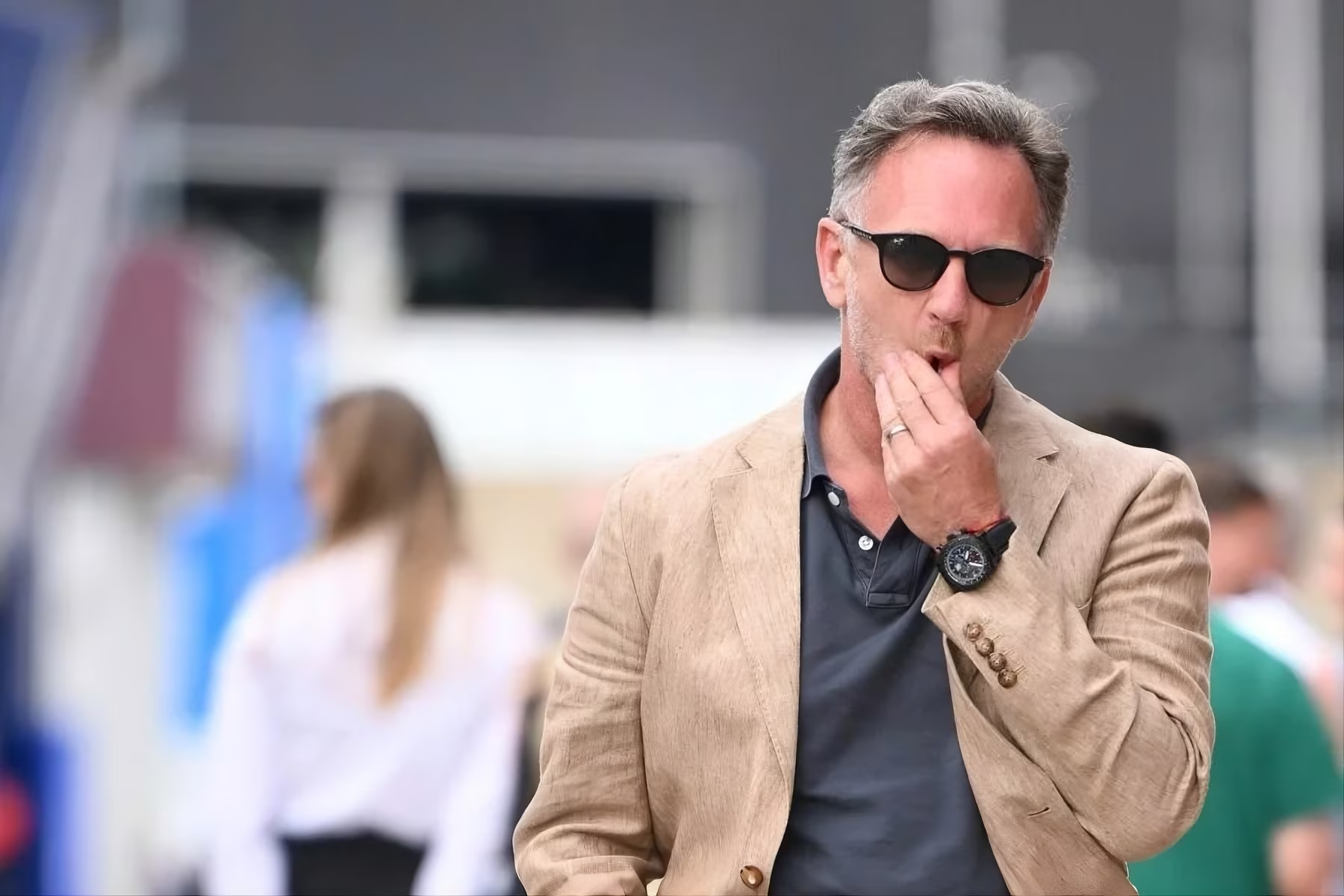
One of the most successful F1 team bosses of all time was unceremoniously sacked just two days after the 2025 British Grand Prix. Christian Horner was removed from his role as Red Bull team principal by the men in grey suits who run the Austrian parent company which owns the racing team.
Horner has been touring the UK promoting his new book Drive, which will go on general sale to the public on October 22nd. Yet a number of copies are in circulation for preliminary reviews to be written, and this, together with an interview Christian has given to The Guardian, has revealed a number of telling matters from his twenty years at the pinnacle of motorsport.
Paddock Politics and Personal Toll
Despite being known for his outgoing personality and attack-dog characteristics when it came to paddock politics, Horner reveals he suffered from anxiety attacks. Describing the first time this happened he says, “I didn’t know what it was. You suddenly feel dizzy and conscious of your breathing, and you think there’s something strange going on. I put it down to having had too much coffee on an oppressive, muggy, thundery day.”
Following a second episode, the Red Bull boss sought medical attention only to be told it was not a physical problem but a psychological issue which was the root cause of his symptoms. “I got checked out, and there was nothing physically the matter,” Horner revealed. “They said, ‘We think you have anxiety. Your breathing’s very shallow.’ It was my body telling me you’re pushing pretty hard here. I’m able to recognise the symptoms now and let it go, and breathe,” Horner says.
Yet further mental stresses were also to take their toll on the Red Bull boss when out of the blue he was sacked following the 2025 British Grand Prix. He reflects on how Toto Wolff had previously spoken of his battles with depression and the therapy he received. “Toto was very brave to talk openly about such a factor for people our age,” Horner acknowledged. “I hadn’t experienced those issues, but I had an appreciation during this period of how people could [suffer].”
He goes on to describe how men in high-profile roles often find their identity in what they do. When this is stripped away, Horner reveals he asked: “Who are you? What are you? What is your purpose? You either curl up into a ball or brush yourself down and get up.”
Shifting Power Dynamics at Red Bull
In terms of his dismissal from Red Bull, Christian Horner admits he has never been given a full explanation for his sacking. However, he believes the politics in the Red Bull energy drinks parent company shifted like sand following the death of its founder, Dietrich Mateschitz.
“I think it was a feeling there was too much control in my hands. But I wasn’t really given a reason,” says Horner. Despite not owning a share of the racing team, Christian had been given free rein by Mateschitz to manage the F1 team as he saw fit.
This included rejecting overtures from Porsche to partner with Red Bull in the new power unit era beginning in 2026. Speaking at the Italian Grand Prix after the discussions were abandoned, Horner told assembled media he felt that Porsche “were slightly getting a little bit ahead of themselves. It was felt that the fit just isn’t quite right for where we’re going and the journey we’re on.”
Horner added: ”We are a race team fundamentally and that enables us to make quick decisions and react very quickly. I think we’ve seen on so many occasions manufacturers have been less autonomous in their decision-making. That was a key aspect of protecting what we have and how we operate, which has proved to be reasonably successful.”
Yet as TJ13 has previously reported, this sowed the seeds for Horner’s eventual dismissal, given that Austrian company director Oliver Mintzlaff had been the one to promote the partnership with Porsche. When Mateschitz died, Mintzlaff became responsible for all F1 activities.
Horner reveals the mentality from Austria was expressed by Dr. Helmut Marko when he quipped one day that the team had become “Christian Horner Racing, not Red Bull Racing.”
Vindicated on the Track
However, at the Bahrain GP hosted in Malaysia, Horner’s belief that Red Bull could build their own power unit and have it be competitive and successful came to fruition. Max Verstappen won his and Red Bull’s first race of the season, then in Singapore dominated with pole position in the Sprint and the Grand Prix and wins in both races.
Horner sent congratulations to the Red Bull Powertrains Division, but admits, “I felt particularly hurt and robbed I didn’t have the opportunity to see that Powertrains engine win. I felt very proud seeing what it meant to everybody and that they sent the Powertrains representative on to the podium,” Horner added.
“I had messages throughout the team and I texted Max after the race. He was very magnanimous and it was a landmark moment to see that engine win.”
Speculation Over an F1 Comeback
In terms of a return to F1 there have been several rumours, including taking control at Aston Martin or even leading a buyout of the Alpine team. More recently, Horner set the cat amongst the pigeons on his speaking tour when he said the only team he would join without having equity would be Ferrari.
Such was the furore in the Italian media, Ferrari took the unusual step of holding an ad hoc press conference to deny they were talking to Horner. Christian also confirmed people were putting two and two together and coming up with seven.
Horner has offered a hint of his next F1 move and paddock comeback when he commented: “From my perspective, there’s 11 teams in Formula 1. There’s potentially a 12th entry. But I’m not in a rush to do anything.”
Horner in effect built Red Bull Racing from scratch as Ford finally bailed out on the ashes of the Jaguar F1 team failure. If anyone knows how to build an F1 team up from the ground, it is Christian Horner.
Would you like to see more TJ13 Formula 1 coverage? Add us to your favourites list on Google to receive trusted F1 news.

A.J. Hunt is Senior Editor at TJ13, where Andrew oversees editorial standards and contributes to the site’s Formula 1 coverage. A career journalist with experience in both print and digital sports media, Andrew trained in investigative journalism and has written for a range of European sports outlets.
At TJ13, Andrew plays a central role in shaping the site’s output, working across breaking news, analysis, and long-form features. Andrew’s responsibilities include fact-checking, refining editorial structure, and ensuring consistency in reporting across a fast-moving news cycle.
Andrew’s work focuses particularly on the intersection of Formula 1 politics, regulation, and team strategy. Andrew closely follows developments involving the FIA, team leadership, and driver market dynamics, helping to provide context behind the sport’s biggest stories.
With experience covering multiple seasons of Formula 1’s modern hybrid era, Andrew has developed a detailed understanding of how regulatory changes and competitive shifts influence the grid. Andrew’s editorial approach prioritises clarity and context, aiming to help readers navigate complex developments within the sport.
In addition to editorial duties, Andrew is particularly interested in how media narratives shape fan perception of Formula 1, and how reporting can balance speed with accuracy in an increasingly digital news environment.
