
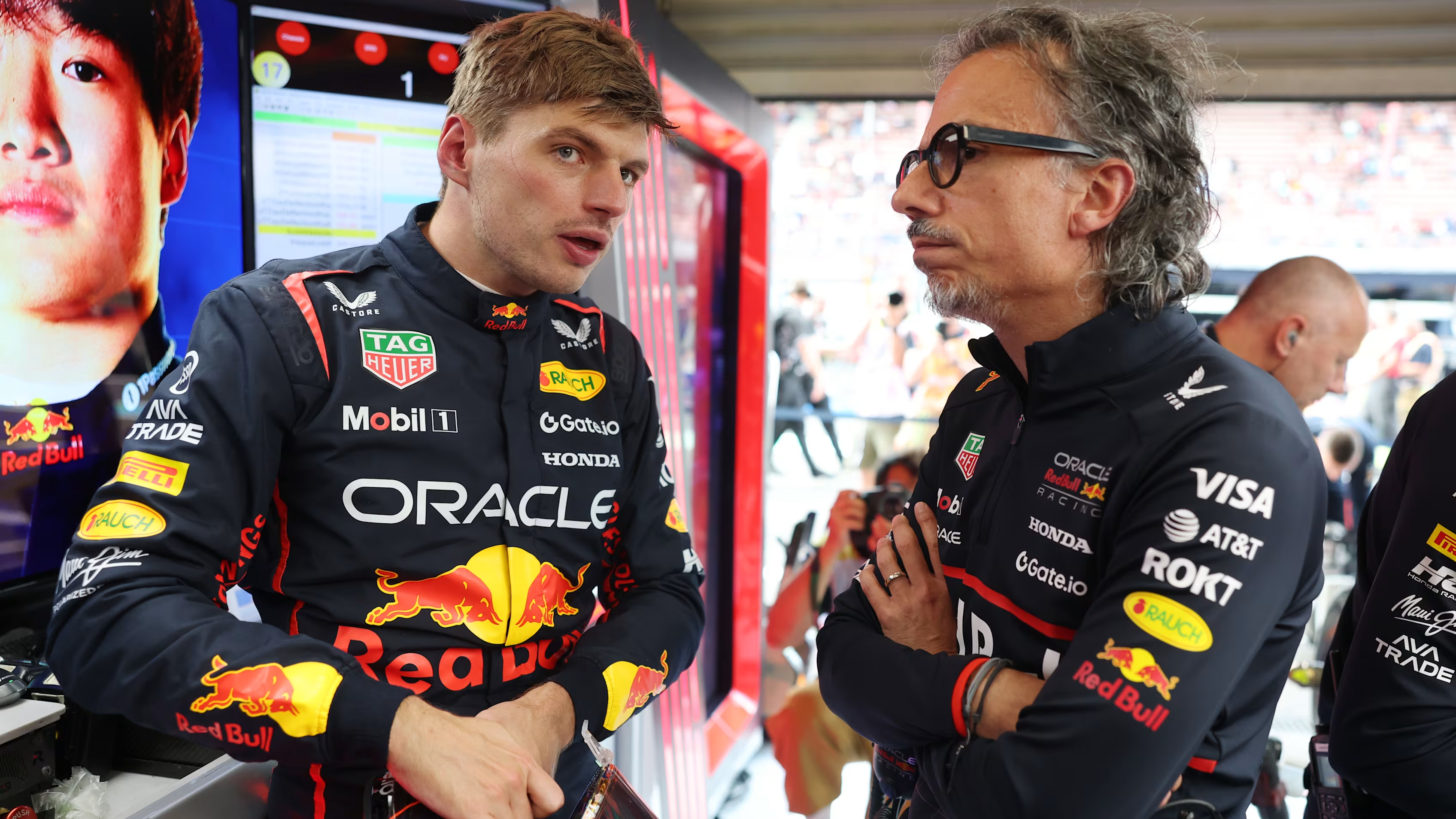
Max Verstappen’s technical feedback has played a crucial role in Red Bull’s recent Formula 1 revival, with team principal Laurent Mekies praising the Dutchman’s exceptional ability to identify the car’s performance limitations.
Back-to-back victories in Malaysia and a podium finish in Singapore have highlighted the team’s progress, although Red Bull still faces a significant challenge to Mercedes in the championship battle.
Mekies praises Verstappen’s exceptional technical understanding
Verstappen finished on the podium at the Singapore Grand Prix, ahead of Ferrari’s Charles Leclerc and Mercedes rookie Kimi Antonelli. The result followed his victory at the Malaysian Grand Prix a week earlier, marking a significant improvement in Red Bull’s recent form.
According to GPblog, Mekies highlighted Verstappen’s technical knowledge and the value of his feedback during a media briefing following the Singapore race.
“His contribution is enormous. You are absolutely right when you say that his technical understanding is outstanding, probably even unique. And that’s why he actually has the ability to pinpoint exactly what is limiting performance,” the Frenchman said.
Although Red Bull cannot immediately resolve every weakness in its car, Mekies believes Verstappen’s ability to identify specific problems gives the team a valuable advantage when developing improvements.
“This is an enormous help for the team,” Mekies added.
Red Bull relies on open communication to improve performance
Mekies also emphasised the importance of maintaining direct and constructive communication between Verstappen and the engineering team, even when frustrations arise.
“As we have already said, we proceed in such a way that we always deal with each other very directly and transparently and constructively, even if emotions are sometimes involved,” Mekies explained.
That approach is particularly important when a driver struggles with an unpredictable car. Detailed feedback allows engineers to understand where performance is being lost and which changes are most likely to deliver improvements.
Verstappen’s experience and ability to communicate the car’s behaviour have therefore become important assets as Red Bull attempts to maintain its momentum during the second half of the season.
Ralf Schumacher identifies the changes behind Red Bull’s revival
Former Formula 1 driver and Sky analyst Ralf Schumacher also highlighted the progress Red Bull has made in addressing the handling problems that previously affected Verstappen.
Before the Singapore Grand Prix, Schumacher pointed to Mercedes’ strong start to the season while explaining why Red Bull had struggled to match its rival consistently.
“They had a good engine from the start. But the car was sometimes undriveable for Max Verstappen. They had problems with the wing, and there was also some inconsistency at the rear. They’ve got that under control now. Something must have changed at the rear in the last three races. Apparently, there’s more downforce and more stability. That helps Max Verstappen, and not just him, but also his teammate,” Schumacher said, according to the original report.
Improved rear-end stability and increased downforce would help Verstappen maintain confidence through corners, allowing him to extract more performance from the car. Such improvements can also benefit his team-mate by making the car more predictable across different circuit conditions.
While the precise contribution of individual upgrades remains unclear, Red Bull’s recent results suggest that the team has made progress in addressing some of its previous weaknesses.
Can Verstappen secure a third consecutive victory in the United States?
Despite the resurgence, Red Bull is not considered the favourite for the Formula 1 world championship, with Mercedes having established a strong position through its early-season performance.
However, Verstappen’s consecutive wins and Singapore podium have given Red Bull renewed momentum heading into the next round in the United States.
The Dutchman will have the opportunity to claim a third consecutive victory, extending his recent run of form and potentially putting further pressure on his championship rivals.
Whether Red Bull can sustain that pace will depend on its ability to continue improving the car. Mekies’ comments underline why Verstappen’s technical contribution remains central to that effort: identifying the weaknesses is one thing, but turning that understanding into consistent performance is what could determine how far the team’s recovery goes.
Would you like to see more TJ13 Formula 1 coverage? Add us to your favourites list on Google to receive trusted F1 news.

Craig Alderson is Senior Editor at TJ13, where Craig oversees newsroom operations and coordinates editorial output across the site. With a background in online sports reporting and motorsport magazine editing, he plays a key role in maintaining consistency, speed, and accuracy in TJ13’s coverage.
During race weekends, Craig acts as desk lead, directing contributors, prioritising breaking stories, and ensuring timely publication across a fast-moving news cycle.
Craig’s work focuses heavily on real-time developments in the paddock, including team updates, regulatory decisions, and emerging controversies. This role requires a detailed understanding of Formula 1’s operational flow, from practice sessions through to race-day strategy and post-race fallout.
With experience managing editorial teams, Craig ensures that TJ13 delivers structured, reliable coverage while maintaining the site’s distinctive voice.
Craig has a particular interest in how information moves within the paddock environment, and how rapidly developing stories can be accurately translated into clear, accessible reporting for readers.
