
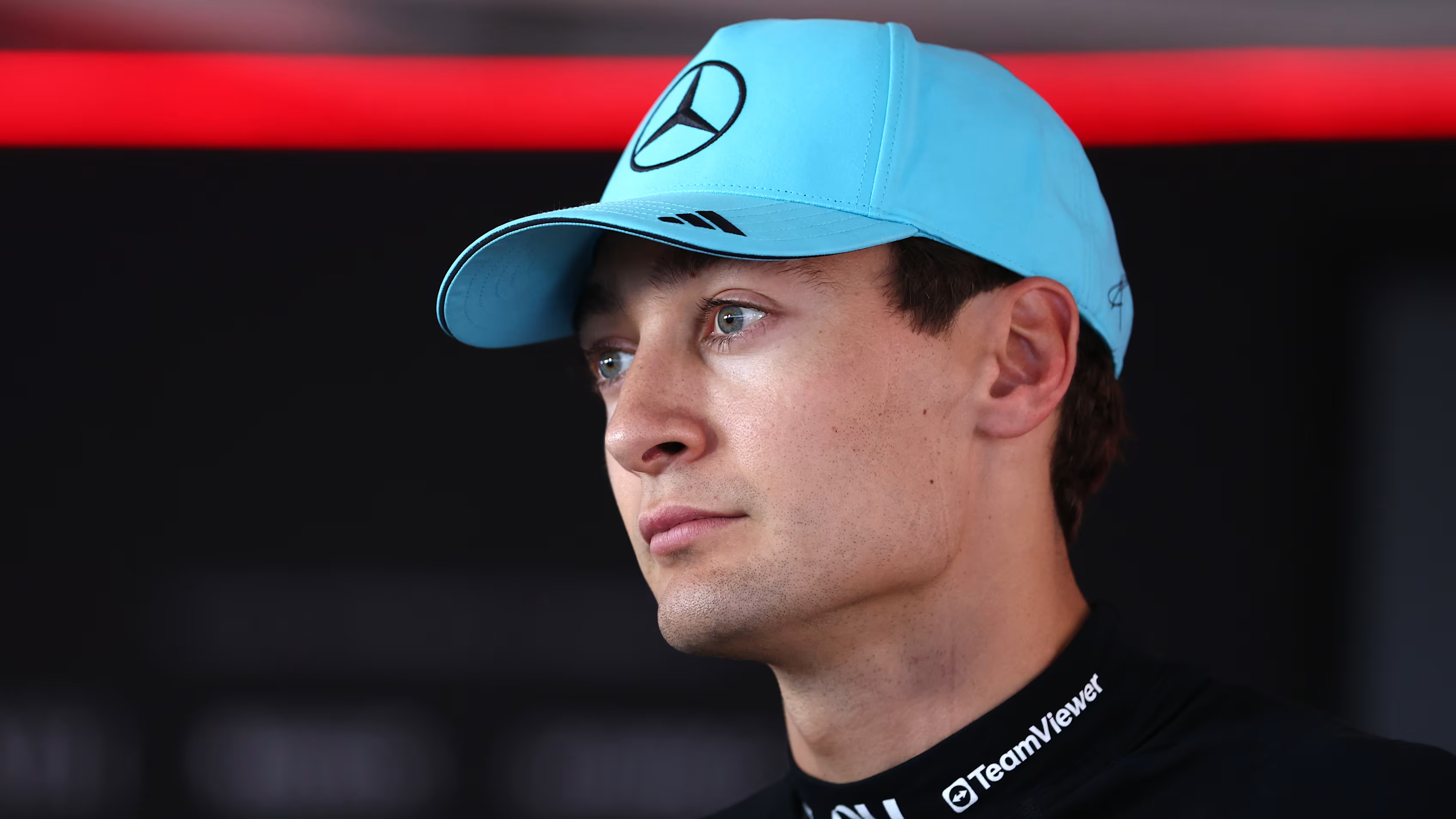
Malaysia upgrades fail Mercedes
Mercedes introduced their second and final large upgrade to their W17 Formula One car in Malaysia last time out and it proved to be fairly disastrous for the team. Yes Kimi came home in P2 come the chequers flag but was a massive 10 seconds behind race leader Max Verstappen when a late safety car was called.
Championship leader Kimi Antonelli had qualified behind both Red Bull cars and Lewis Hamilton’s Ferrari, although due to a grid drop for Isack Hadjar he started in P3. George Russell fared even worse as he started the race even further back behind the other Ferrari and both McLaren drivers.
The silver arrows were bullish about their incoming upgrade the previous weekend in Baku, with some suggesting it could bring as much as a 0.5 second improvement on lap times. Rather, as Toto Wolff openly admitted it proved to be as bad as a 0.5 second loss of time over a flying lap.
What went wrong? Mercedes admit they don’t really know. Speculation surrounds the nature of the ageing asphalt and the high temperatures seen during the weekend in Sepang. Yet in reality the team are at a loss as to why their new and improved components failed to deliver.
Gung-Ho Introduction and Split Configurations
Yet part of the reason for the failure was due to the fact that Mercedes were somewhat gung-ho over how they introduced this upgrade. It is more usual for the F1 teams to benchmark their upgrades against the baseline of the old specification. Simply put during practice sessions one driver fits the new components while the other runs the older specification and the data is collected and compared.
McLaren even brought their new specification rear wing to Monaco but decided the concept required more work. Again in Austria the rear wing was tested but not fitted to the car. It finally made its debut some four race weekends after the first iteration of the wing was taken to the track.
By comparison Mercedes upgrades are far more complex, including both mechanical and aerodynamic upgrades to the car. To believe these could be fitted all at once and deliver a positive impact was potentially a little naive for the Brackley based squad.
The Singapore Test and Sprint Weekend Pressures
This coming weekend in Singapore, George Russell will be forced to start from the back of the grid following his fourth engine of the year melting down in the closing laps in Malaysia. The team have decided that given this unfortunate blow, Russell will also return to the older specification W17 which ran in Baku.
The British driver will be the test mule for the team as they benchmark the upgrades on Antonelli’s car, as maybe they should have done in the first place. Images from the pit lane confirm the team are preparing both race cars differently, with Antonelli receiving the new profiled floor and reshaped side pods which are meant to deliver incremental downforce.
The problem for Mercedes ill timed benchmark test is this weekend is the final Sprint event of the year. So instead of having three hours of practice FP1-FP3 to make continual adjustments to the new package as the data evolves, the team have just one hour of FP1 before the cars are locked into parc ferme where no changes can be made after Sprint qualifying.
Of course following the Sprint on Saturday morning, the cars come out of parc ferme and Mercedes can again try out one more configuration on Antonelli’s car, before again the cars come under FIA lockdown before Grand Prix qualifying in the afternoon.
In reality, Mercedes may be able to try out three configurations across the weekend of their new specification, rather than the several available when there are three practice sessions. Were this Ferrari to find themselves in such a predicament, the Italian media would be slating them for a lack of preparation and forethought.
To add to Mercedes woes, the next round following the night race in Singapore is the US Grand Prix in Austin, Texas. There the team have planned to introduce their engine upgrade under the ADUO programme. Despite having three practice sessions in COTA, the data collection will now become much more complex given the new set of variables introduced by the upgraded power unit.
Of course the silver arrows have almost got two hands on the constructors’ championship this season and Kimi Antonelli is world champion elect. Yet should Red Bull continue their upward trajectory which began back in Monza, the run in to glory might be somewhat dampened should their rivals finish the season on top at each race weekend.
Cooling Vests and the Cost Cap Dilemma
In the heating humidity of Singapore, neither Mercedes driver will be wearing the active cooling vest during the Grand Prix. In Malaysia George Russell revealed the team had decided to spend the development budget on bringing performance to the car rather than develop the driver heat aid.
The FIA awarded the teams this season with an allowance of $50,000 extra over and above the cost cap if they created a cooling system which could last the race distance. Should they produce a cooling vest which solved the driver comfort issue where the tubes can irritate the driver rubbing against the seat, another $75,000 spending allowance would be awarded.
The problem with cooling vests previously is that they last for some 30-40 minutes then the water being pumped around the system becomes warm. When asked about Mercedes decision not to invest in a cooling vest for the drivers, deputy team principal Bradley Lord stated: “There was a small allowance that was made [By the FIA]. We didn’t believe that allowance was sufficient for us to be able to develop a solution that would be robust enough to last for the entire race.”
Aston Martin’s Dry Ice Solution
Yet in Malaysia where the temperatures and humidity were also high, Aston Martin were showing off their cooling vest which appeared spiky yet effective. The team’s global ambassador, Pedro de la Rosa showed Sky F1 their driver cooling system, which includes a simple water pump, a container for dry ice and a vest with much smaller tubes within it to improve driver comfort.
He claimed at the race start the temperature of the water pumping around would be some 10 degrees celsius, whilst at the end of the Grand Prix this would rise to just 28 degrees – still way below the body temperature of their drivers.
This is an improvement on previous iterations of cooling vests where the water exceeded the body temperature of the driver come the end of the Grand Prix.
Would you like to see more TJ13 Formula 1 coverage? Add us to your favourites list on Google to receive trusted F1 news.

The Judge, a nom de plume of an experienced F1 journalist and site founder with long-standing sources across the paddock. With over 30 years of experience in Formula 1 as an insider journalist, I have built trusted connections across the paddock, from race engineers and mechanics to senior team figures. At The Judge 13, I and a handful of trusted colleagues share exclusive Formula 1 news, expert analysis and behind-the-scenes stories you will not find in mainstream motorsport media.
A.J. Hunt is Senior Editor at TJ13, where Andrew oversees editorial standards and contributes to the site’s Formula 1 coverage. A career journalist with experience in both print and digital sports media, Andrew trained in investigative journalism and has written for a range of European sports outlets.
At TJ13, Andrew plays a central role in shaping the site’s output, working across breaking news, analysis, and long-form features. Andrew’s responsibilities include fact-checking, refining editorial structure, and ensuring consistency in reporting across a fast-moving news cycle.
Andrew’s work focuses particularly on the intersection of Formula 1 politics, regulation, and team strategy. Andrew closely follows developments involving the FIA, team leadership, and driver market dynamics, helping to provide context behind the sport’s biggest stories.
With experience covering multiple seasons of Formula 1’s modern hybrid era, Andrew has developed a detailed understanding of how regulatory changes and competitive shifts influence the grid. Andrew’s editorial approach prioritises clarity and context, aiming to help readers navigate complex developments within the sport.
In addition to editorial duties, Andrew is particularly interested in how media narratives shape fan perception of Formula 1, and how reporting can balance speed with accuracy in an increasingly digital news environment.
