
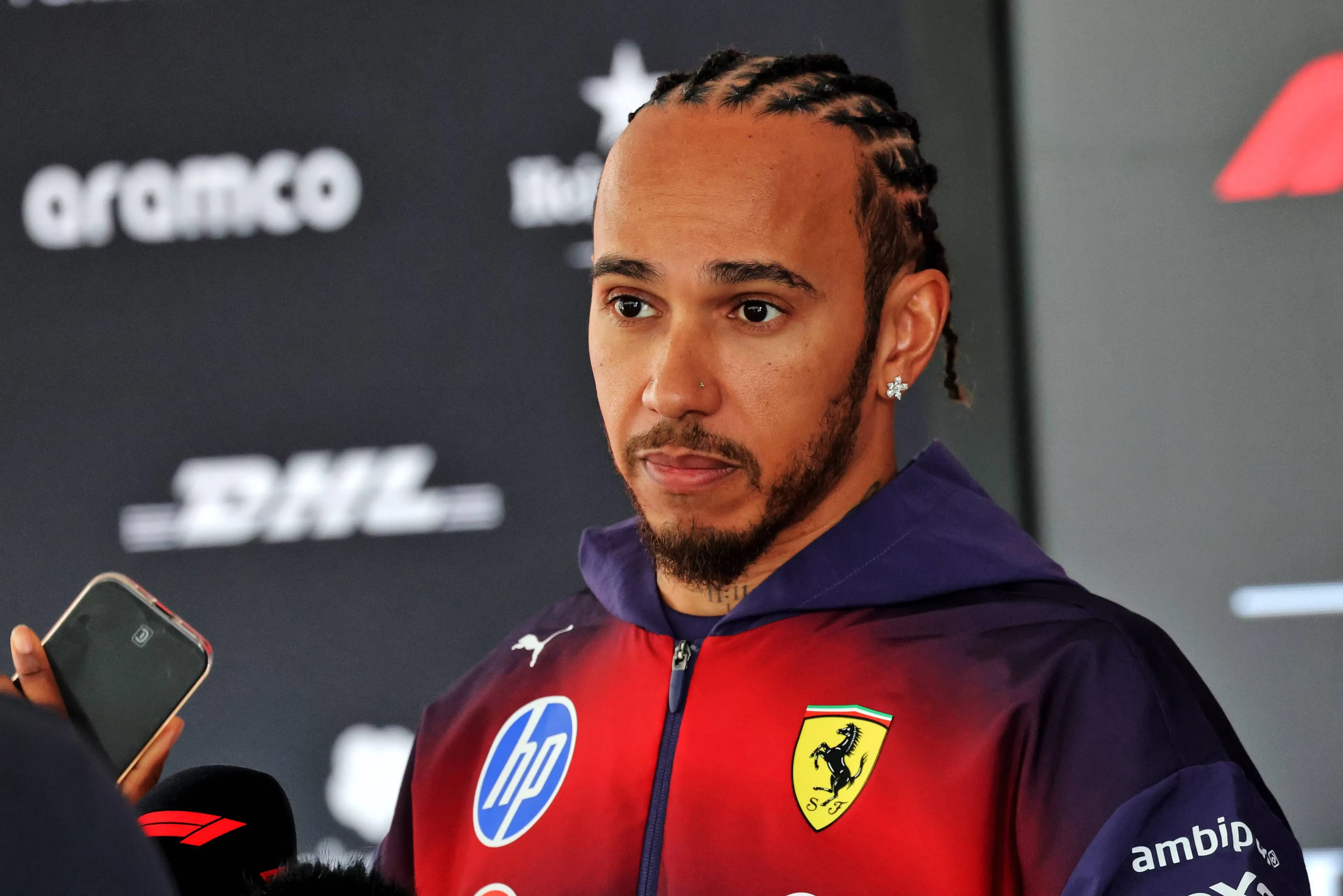
A High-Stakes Public Denial – Lewis Hamilton made a brave decision when he took to social media to deny reports made by an Italian journalist that he had requested a change of personnel in the Ferrari race team.
A number of senior F1 writers and news outlets had recently suggested that Hamilton had asked Fred Vasseur to replace a number of his race engineers and, as a result, relations between Hamilton and Vasseur were no longer as strong as they had been previously.
The seven-time world champion is playing a dangerous game with the Italian media, as he clearly failed to understand the relationship between them and Ferrari. The Scuderia is treated by them like a national Italian team, which is glorified when winning and lambasted when not.
The Agnelli Legacy and Press Influence
There has always been an uneasy relationship between the Ferrari Formula One team and the Italian media, with the latter having significant influence over whether the principal of the Scuderia remains or goes. In part, this includes a historic relationship between the Agnelli family—who own the Turin-based newspaper La Stampa—and the Ferrari family icon that was Enzo.
Back in 1969, Enzo Ferrari needed financial backing and stability to keep his racing team and road car company afloat. So he turned to the Agnellis, who owned Fiat, and who purchased a 50% stake in Ferrari, which was later increased.
This partnership gave Ferrari the industrial backing it required to succeed and expand. Their current group president, John Elkann, is the grandson of Gianni Agnelli, who struck the deal with Enzo. If the Agnelli family were unhappy with the goings-on in Maranello, their motorsport journalists would ramp up the pressure through the sports columns in La Stampa.
Today, most Italian publications are critical of Ferrari when all is not well, with scathing editorials often emanating from Gazzetta dello Sport, Corriere dello Sport, and Corriere della Sera. All have contributed to the demise of a number of Ferrari F1 team bosses and drivers.
Past Bosses Under the Microscope: Domenicali, Arrivabene, and Binotto
Formula One’s current CEO, Stefano Domenicali, was the last team principal to earn long-term favor with the Italian media. Taking over from the most successful of Ferrari bosses, Jean Todt, in 2008, he was the last individual to preside over a Ferrari F1 championship.
However, as it became evident Mercedes had aced the new V6 hybrid turbo regulations in 2014 and Ferrari were way off the pace, Domenicali faced a brutal backlash from the Italian press. As front-page headlines pilloried the team’s lack of performance and internal direction, Domenicali chose to resign voluntarily, stating he wanted to take responsibility for the team’s struggles.
Another facing the wrath of the Italian media was Maurizio Arrivabene (2018–2019). He had a notoriously prickly relationship with the Italian media, often calling out journalists or dismissing reports. In response, outlets relentlessly amplified rumors of an internal civil war between Arrivabene and then-technical director Mattia Binotto. The constant press pressure regarding missed championship opportunities and a perceived “culture of fear” culminated in Ferrari’s top management replacing him.
Mattia Binotto himself was to benefit from Arrivabene’s demise. A lifelong Ferrari engineer, he was promoted to the top spot in Maranello. Although he showed early promise with an improved Ferrari engine, come 2022 he faced the night of the long knives.
A string of high-profile strategic blunders and reliability failures invited daily post-mortems from Italian pundits. The media heavily scrutinized Binotto’s apparent calm, corporate demeanor, framing it as lacking ruthless accountability. Yet bizarrely, it was him caught on camera wagging his finger at golden boy Charles Leclerc, who had spoken candidly to the media, which defined his demise.
Alain Prost and the “Truck Driver” Fallout
Alain Prost, considered one of the finest F1 drivers of all time and a triple world champion, joined Ferrari in 1990. He almost won the world championship for the Italian team that year, narrowly losing out to Ayrton Senna after their infamous collision in Suzuka. Because of this, Prost was treated like a hero by the Italian press and the tifosi.
However, the 1991 car (the Ferrari 643) was a massive step backward—unreliable, difficult to handle, and completely uncompetitive against McLaren and Williams. As the results went from bad to worse, the Italian media ramped up the pressure on both Prost and the Ferrari team.
Prost then committed what is considered the cardinal sin for a Ferrari driver—he openly criticized his team and the car to the press. Following a difficult weekend near the end of the season, Prost famously remarked: “I’ve never driven such a bad car… A good truck driver with big arms could have done just as well.”
The Italian media then massively amplified the feud between Prost and Ferrari, framing the French driver as ungrateful and damaging to the Scuderia’s brand. Immediately following the Japanese Grand Prix, Ferrari fired Prost, effectively ending his contract a race early and replacing him with Gianni Morbidelli—an Italian driver.
Years later, Alain Prost revealed that Ferrari’s internal strategy meetings were often paralyzed by what the papers would say. For instance, at the 1991 Spanish Grand Prix, Prost wanted to gamble on slick tires on a drying track because they had nothing to lose against dominant rivals. The team initially refused because they were terrified of making a bold call, looking foolish, and getting torn apart by the Italian press if it didn’t pay off.
Prost later remarked on the unique political landscape of dealing with the Italian press and public opinion, noting how a driver in Maranello always had to carefully navigate what they said. It remains one of the most explosive driver-team splits in F1 history.
Alonso, Vettel, and the Weight of Expectation
Fernando Alonso and Sebastian Vettel both joined Ferrari already as world champions and were to suffer the full force, proving the pen is mightier than the sword. During qualifying at the 2013 Italian Grand Prix at Monza, Alonso was frustrated after missing out on a slipstream from teammate Felipe Massa. Over the team radio, he muttered in Italian, “You’re really idiots! Mamma mia guys…” The Italian media seized on the outburst, dissecting it as a sign of disrespect toward the Maranello workforce.
When Vettel arrived in Maranello, the Italian press welcomed him warmly, hoping he would emulate his childhood hero, Michael Schumacher. Early on, when he overperformed in uncompetitive cars, the journalists were full of praise for the German driver.
Yet when Ferrari built championship-capable cars in 2018 and 2019, Vettel began pushing to the absolute limit—leading to high-profile mistakes. When he crashed from the lead in the wet at his home German Grand Prix in 2018, media outlets like La Gazzetta dello Sport and La Stampa did not hold back. Headlines famously labeled his errors “devastating” and stated that “the swan turned into an ugly duckling.”
Why Hamilton Is Still Walking a Tightrope
So Lewis Hamilton is playing a dangerous game. He clearly was talking down Ferrari going into the team’s home race in Monza. He criticized the team for not pulling together as one, although his clear intent was pressuring Fred Vasseur to name him number one driver in the chase for the championship.
As of yet, the Italian media have not turned on Hamilton. Their focus has been on Ferrari and why the car is, for a 19th season, not going to win a championship. More recently it is Fred Vasseur who has been the focal point for their unrest, with journalist Giorgio Terruzzi suggesting the team boss’s nickname among the staff in Maranello is “Napoleon.” According to his report, some engineers back at Ferrari HQ are using the name in an ironic fashion, which suggests that the famous French General was in the end a failure, banished by his own kind into obscurity.
For now, if Vasseur is the butt of the Italian media’s jokes, Hamilton is relatively safe. Furthermore, he currently sits ahead of Ferrari’s golden boy Charles Leclerc. Should either change, Lewis could easily become the focus of the Italian media, who will deride his every move and amplify every issue he has.
Would you like to see more TJ13 Formula 1 coverage? Add us to your favourites list on Google to receive trusted F1 news.

The Judge, a nom de plume of an experienced F1 journalist and site founder with long-standing sources across the paddock. With over 30 years of experience in Formula 1 as an insider journalist, I have built trusted connections across the paddock, from race engineers and mechanics to senior team figures. At The Judge 13, I and a handful of trusted colleagues share exclusive Formula 1 news, expert analysis and behind-the-scenes stories you will not find in mainstream motorsport media.

A.J. Hunt is Senior Editor at TJ13, where Andrew oversees editorial standards and contributes to the site’s Formula 1 coverage. A career journalist with experience in both print and digital sports media, Andrew trained in investigative journalism and has written for a range of European sports outlets.
At TJ13, Andrew plays a central role in shaping the site’s output, working across breaking news, analysis, and long-form features. Andrew’s responsibilities include fact-checking, refining editorial structure, and ensuring consistency in reporting across a fast-moving news cycle.
Andrew’s work focuses particularly on the intersection of Formula 1 politics, regulation, and team strategy. Andrew closely follows developments involving the FIA, team leadership, and driver market dynamics, helping to provide context behind the sport’s biggest stories.
With experience covering multiple seasons of Formula 1’s modern hybrid era, Andrew has developed a detailed understanding of how regulatory changes and competitive shifts influence the grid. Andrew’s editorial approach prioritises clarity and context, aiming to help readers navigate complex developments within the sport.
In addition to editorial duties, Andrew is particularly interested in how media narratives shape fan perception of Formula 1, and how reporting can balance speed with accuracy in an increasingly digital news environment.

Feisty fool having dug himself unwisely deep into hole in notorious foreign field decides to resume digging.
Charles Leclerc must be laughing all the way to his Monaco bank in silent glee.