
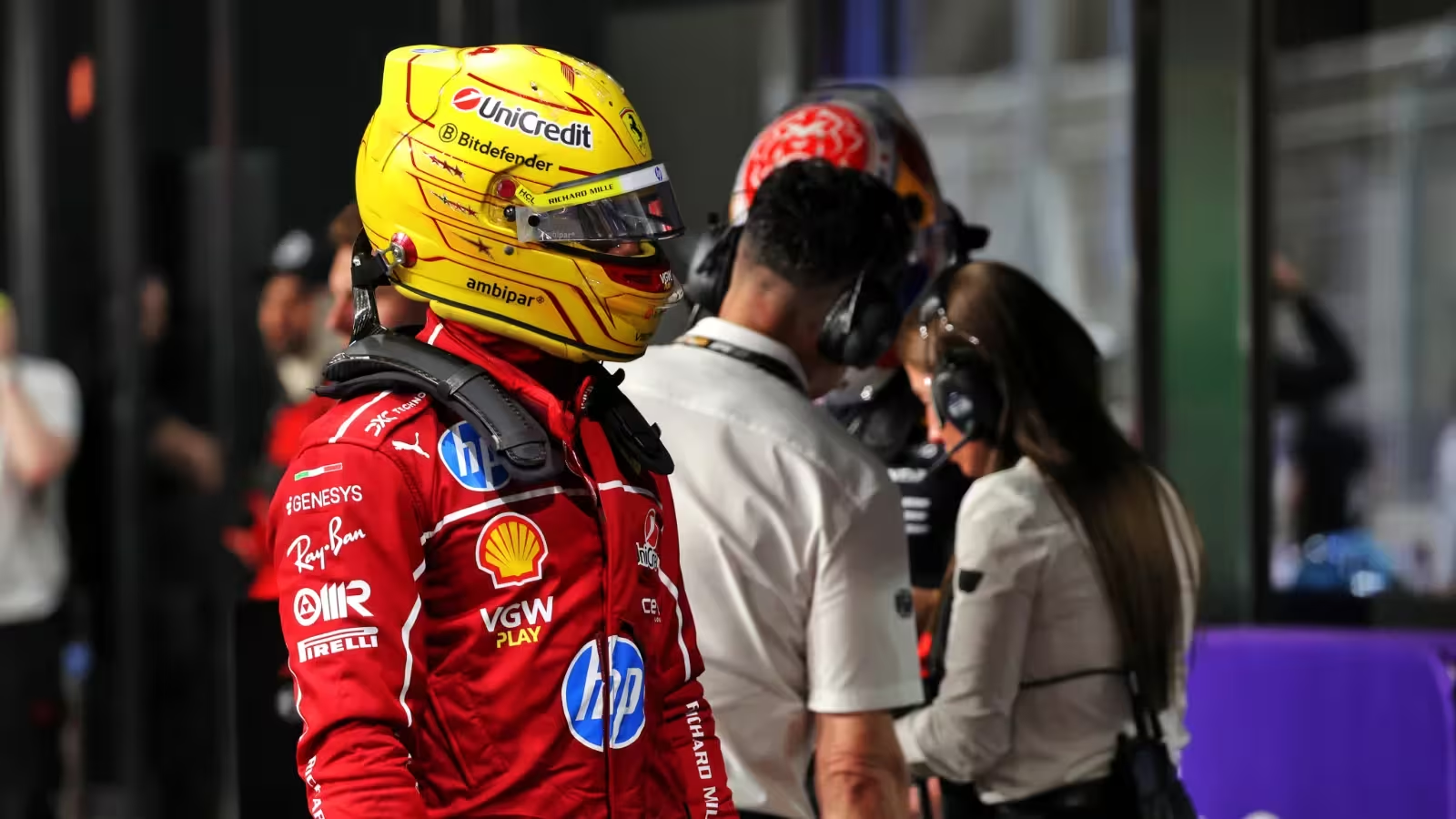
The headlines from the 2026 Singapore Grand Prix were that after ten attempts, Max Verstappen finally broke his duck winning in the city state. Yet much of the back story of the race was again about Ferrari and the strategy and communications to their drivers.
With Singapore this year being a Sprint weekend, the teams had no idea of how the long runs would fare on the various tyre compounds. To a man the hard tyre was deemed not to be a suitable for the Grand Prix, with teams opting for the soft or medium tyre at lights out.
Ferrari are known for the strategy blunders, but it seemed common sense reigned within the Italian squad as they split their strategy for their drivers starting second and third behind pole sitter Max Verstappen. Charles Leclerc who started P2 was on the faster soft tyre, hoping to take advantage of the recent Red Bull poor starts.
Lewis Hamilton in third started on the medium tyre. This gave Ferrari potential strategic options with the seven times champion expected to go longer on his first stint than his team mate and Verstappen before changing his tyres for what was expected to be a one stop race.
Early Struggles and the Two-Stop Pivot
Yet it quickly became clear the medium tyre was not the preferred race tyre and following the opening skirmishes, Hamilton was falling behind his team mate at almost half a second per lap. Other medium tyre runners were also struggling and Ferrari made the smart strategy call to switch Lewis early on to a two stop strategy which would see him go medium-red-red.
On his soft tyres, Lewis was lightning quick, disposing quickly of the midfield runners he found himself behind after the stop. Yet being delayed by the midfield runners meant he found himself behind team mate Charles Leclerc.
For some reason only Ferrari knows, they then called in Leclerc to switch to the medium tyre to run to the end of the race. But the call was a lap early and meant he came out ahead of Hamilton who was planned to stop again regardless.
Team Orders and Silent Communications
With their drivers on different tyre strategies, the call should have come from the pit wall for Leclerc to let Hamilton through. His first lap behind his team mate was two seconds slower than his previous lap in clear air.
Lewis petitioned the team several times to allow him through, suggesting if he failed to make progress they could reverse the positions meaning he would allow Leclerc back through. Silence was the response of the team, leaving Hamilton trailing around destroying his tyres behind his team mate.
Hamilton having switched tyres was half a second quicker than race leader Verstappen who was on his starting set of soft tyres. Yet behind his team mate he toiled almost half a second slower than the Red Bull driver as Ferrari fiddled whilst Rome burned.
Faulty Data and the Virtual Safety Car
With 21 laps to go, a virtual safety car was deployed to ensure the safe removal of Lance Stroll’s Aston Martin. In the laps prior to this, Lewis had been asking his race engineer for the pace of the soft starter drivers at the end of their stints before fitting the medium tyres.
Ferrari and Carlos Sanchez his race engineer replied giving Lewis apples and pears information. They told him the lap times of the current soft runners instead, leaving him to believe his tyres would perform better than they eventually would.
This clearly led to Hamilton’s decision when the virtual safety car was deployed to believe he would have better pace by remaining on his soft tyres than he did come the end of the race. The team instructed him to pit for a second set of soft rubber, but Hamilton decided to stay out and take his chance to the end of the race.
A Costly Finish and Constructor Pressure
Leclerc stopped for a second time under the VSC and quickly made up the deficit to his team mate, passing him easily. In those final fifteen laps, Lewis was in fact 2-3 seconds slower than the front six runners. As the chequered flag fell, Hamilton was passed on the final lap by McLaren’s Oscar Piastri who had made an extra pit stop for a slow puncture. Embarrassing for Lewis and Ferrari.
Ferrari’s decision not to instruct Leclerc to allow Hamilton through when he first stopped for fresh rubber and was on a two stop versus his team mates one stop strategy was the root of all evil which the Scuderia suffered in Singapore.
Once again their strategy calls have been found wanting and clearly Hamilton does not trust his team to make the right calls. He was deceived by the information he was given just prior to the safety car, as Ferrari bungled their communications for the umpteenth time this season.
Despite the poor information Hamilton received it’s probably fair to say he stayed out when the VSC was deployed due to pure devilment. He must have felt Ferrari had failed him when deciding he would operate a two stop race and caught his team mate at around 2 seconds a lap – but refused to tell Leclerc to move aside.
When the team has called a strategy this year Hamilton has questioned it, but to date he had always followed their instructions. He did take full responsibility on the cool down lap, stating over team radio: “Sorry boys. I let you down today with that strategy. My call, and I lost us valuable points. I’ll try and make up for it in the next one.”
Yet Ferrari’s dithering when their drivers found themselves on the same piece of asphalt, cost the team a certain 2-3 finish, although it was likely it would have been Hamilton ahead of Leclerc on the podium.
The Scuderia need to get their act together, given Max Verstappen and Red Bull now look the strongest team on the grid. Had Isack Hadjar not suffered from multiple engine problems in Singapore, the gap between Red Bull and Ferrari may well have been significantly reduced.
Should Red Bull overhaul Ferrari’s 112 point advantage in the remaining six races to finish second in the constructors’ title race, the calls for Fred Vasseur to be sacked will reach fever pitch in Italy
Would you like to see more TJ13 Formula 1 coverage? Add us to your favourites list on Google to receive trusted F1 news.

A.J. Hunt is Senior Editor at TJ13, where Andrew oversees editorial standards and contributes to the site’s Formula 1 coverage. A career journalist with experience in both print and digital sports media, Andrew trained in investigative journalism and has written for a range of European sports outlets.
At TJ13, Andrew plays a central role in shaping the site’s output, working across breaking news, analysis, and long-form features. Andrew’s responsibilities include fact-checking, refining editorial structure, and ensuring consistency in reporting across a fast-moving news cycle.
Andrew’s work focuses particularly on the intersection of Formula 1 politics, regulation, and team strategy. Andrew closely follows developments involving the FIA, team leadership, and driver market dynamics, helping to provide context behind the sport’s biggest stories.
With experience covering multiple seasons of Formula 1’s modern hybrid era, Andrew has developed a detailed understanding of how regulatory changes and competitive shifts influence the grid. Andrew’s editorial approach prioritises clarity and context, aiming to help readers navigate complex developments within the sport.
In addition to editorial duties, Andrew is particularly interested in how media narratives shape fan perception of Formula 1, and how reporting can balance speed with accuracy in an increasingly digital news environment.
