
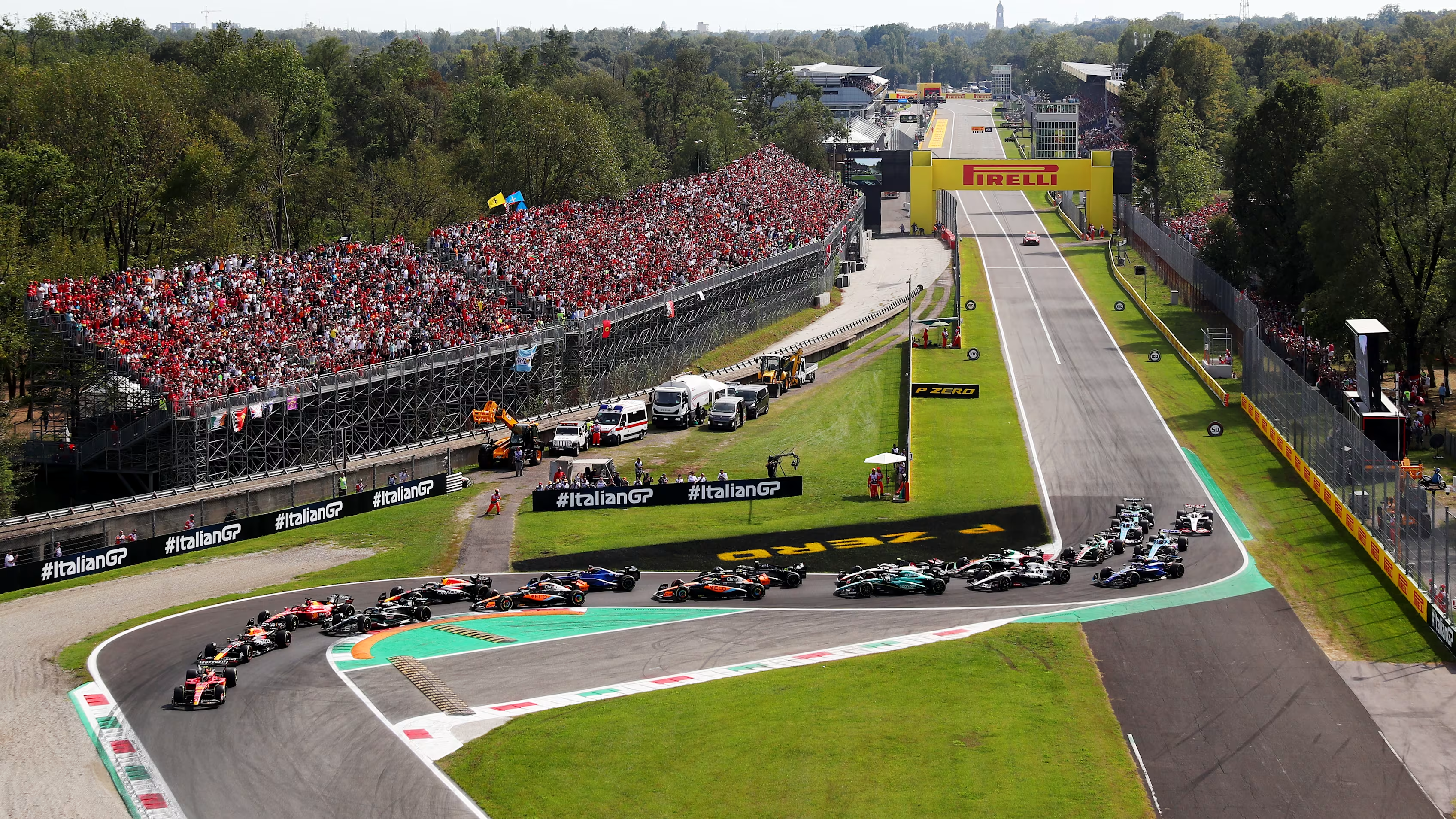
Formula One’s monumentally disastrous decision to introduce the so-called 50/50 hybrid engines for 2026 will be tested to the limit this weekend in Monza. The circuit is described in modern parlance as “energy poor” in terms of the car’s ability to harvest electrical power, dominated by long, flat-out straights connected mostly by slow chicanes and medium-speed corners.
Relying heavily on braking events to produce charge for the battery, this will be particularly difficult at the upcoming Italian Grand Prix, given the average amount of time on the brakes is just 11-14% of the entire 80-second lap.
The Warning Signs and Horner’s “Frankenstein” Warning
Way back in 2023, Red Bull Racing simulated the performance of the proposed all-new engines, with Christian Horner then raising the alarm that the cars would run out of battery in places like Monza. Bild reported earlier this year that an unnamed team boss said: “I still remember the first meeting about the new regulations around four years ago in London. Suddenly, Red Bull team principal Christian Horner stood up and said: ‘Guys, listen, we’re creating a technical Frankenstein.’ I’m not so optimistic.”
Verstappen, who had run the simulation, added that the cars would look ridiculous in Monza as they ran out of battery halfway along the straights, with the cars visibly slowing as the internal combustion engine not only propelled the car but acted as a generator of electrical energy.
Just as Red Bull did in Spa this year, where Isack Hadjar gave his teammate Max Verstappen a tow, this will be a trick used widely in qualifying, given it could improve the driver behind’s lap time in the region of half a second.
Domenicali Defends the Show Amid Driver Backlash
F1 supremo Stefano Domenicali has been robust in his defense of the all-new cars despite heavy criticism from drivers and fans alike, pointing to the sell-out circuits this season—although many of the fans will have bought tickets before the all-new cars debuted in pre-season testing.
“There is a lot of action on the track,” F1’s CEO recently told the BBC. “People are loving it. They are focused on what is happening on the track. They don’t understand our technology, definition of ‘clipping’, or whatever it is, because it’s too technical for the wider base that we have. Therefore, the effect on the track has been widely super-positive among the fans.”
However, the fans at the circuit will definitely see the “yo-yo” overtakes this weekend and the dramatic slowing of the cars long before the braking zones, while F1 TV will do its best to cover up this spectacle. They will cut to in-car shots as the drivers proceed along the straights, along with TV angles that fail to show how much the cars actually slow down.
Oscar Piastri has described this as a “crap way to go racing,” and Lando Norris hit the nail on the head when he blamed the sport for allowing this just to attract new manufacturers. Max Verstappen explained how he “started laughing” during his first experience in the simulator under the 2026 new rules, and Fernando Alonso said that in sector 2 at the Belgian Grand Prix, his car would be less powerful than an F2 junior.
Compromise, Audi’s Resistance, and the ICE Battle
After pleading with the drivers to be “constructive” whilst denying they were being censored, Max Verstappen explained the “minimum” that was needed to return the racing spectacle from one of being a farce.
As proposals were tabled to shift the power balance to 60% in favor of the internal combustion engine, Max Verstappen said of the idea, “It’s definitely heading into a very positive direction. I think it’s the minimum I was hoping for.”
Yet once again the manufacturers, Audi in particular, refused to move that quickly. Their explanation was that this would require significantly larger fuel cells and a redesign of the chassis they were planning to roll over into 2027.
A compromise was finally agreed, which will see some increase in the importance of the ICE next season, but it will be 2028 before the balance is improved to 60/40. Red Bull were this week confirmed once again by the FIA to have the most powerful of the internal combustion engines.
Whilst this means they cannot develop their power unit at all—like each of the manufacturers—it could be a blessing for the Monza weekend. With the effect of the hybrid system to be significantly diminished in Italy, the Red Bull Powertrain will suffer less than at a circuit like Zandvoort.
The Measurement Debate and the Ultimate Test
Ex-McLaren and Red Bull race driver David Coulthard was speaking this week about the “joke” which is the method the FIA uses to measure the most powerful new engine. “A power unit as a whole isn’t just about the combustion engine. It’s also about the electrical energy. For me, that’s really the point. It doesn’t seem like the fairest mechanism to assess a power unit’s performance, because it focuses only on the combustion engine,” he said on the Up to Speed podcast.
The FIA blame the manufacturers again for the system of measurement for power unit performance, claiming they wanted a more sophisticated system which reflected the power output of the entire powertrain. Yet based on predictions from Adrian Newey that this era of F1 would be defined by combustion engine capabilities, the manufacturers doubled down, insisting on just measuring the power of the ICE.
This weekend in Monza will be the biggest challenge for the new F1 engines. The key to Domenicali’s claims that the fans don’t care about the new F1 powertrains will be tested to the extreme, and maybe ticket sales for 2027’s event will eventually reflect this.
Would you like to see more TJ13 Formula 1 coverage? Add us to your favourites list on Google to receive trusted F1 news.

A.J. Hunt is Senior Editor at TJ13, where Andrew oversees editorial standards and contributes to the site’s Formula 1 coverage. A career journalist with experience in both print and digital sports media, Andrew trained in investigative journalism and has written for a range of European sports outlets.
At TJ13, Andrew plays a central role in shaping the site’s output, working across breaking news, analysis, and long-form features. Andrew’s responsibilities include fact-checking, refining editorial structure, and ensuring consistency in reporting across a fast-moving news cycle.
Andrew’s work focuses particularly on the intersection of Formula 1 politics, regulation, and team strategy. Andrew closely follows developments involving the FIA, team leadership, and driver market dynamics, helping to provide context behind the sport’s biggest stories.
With experience covering multiple seasons of Formula 1’s modern hybrid era, Andrew has developed a detailed understanding of how regulatory changes and competitive shifts influence the grid. Andrew’s editorial approach prioritises clarity and context, aiming to help readers navigate complex developments within the sport.
In addition to editorial duties, Andrew is particularly interested in how media narratives shape fan perception of Formula 1, and how reporting can balance speed with accuracy in an increasingly digital news environment.

Monza is certainly the least harvesting-friendly circuit; hence, the whole event will be a struggle unless the FIA is very conservative with MJ limits.
Both Horner’s & Max’s warnings from 2023 still haunt & Domenicali has been excessively arrogant ever since April by being unbothered to accept reality, even though everyone can see through anyone & that FIA admitted already in April that F1 isn’t in the best possible shape, or they wouldn’t have resorted to any short-term tweaks if zero room for improvement existed.
The claims about fuel tank have been misleading this whole time because a larger portion of the absolute tank capacity can simply be permitted for the races without increasing the total size, like in 2017 & 2019 with the separate 5 kg increases in race allowance, so the planned 60:40 split for 2028 should logically be achievable with the current tank size.
Domenicali hasn’t done himself nor those closest to him any favors with his repetitive arrogance & out-of-touch-with-reality remarks in public; hence, he should just resign for his sake & those closest to him.
The claim that people don’t understand clipping or care about the more technical aspects is also strongly misleading, not to mention he doesn’t even have any actual evidence of this, nor has he asked everyone individually, & the lost of track action has happened this season, not all of it has happened for all the right reasons.