
The Formula One calendar now stretches from the first pre-season test in Bahrain—typically around week two of February—to the finale in Abu Dhabi, now held on the first weekend in December. With 24 scheduled rounds, this means typically there is an F1 event (including testing) statistically every 1.7 weeks.
The schedule relies on traveling the world to regions where the weather is generally benign for racing, with Europe being out of the question during the winter and early spring months. One-sixth of the races are now held in the Middle East, with next year the season opener returning to Bahrain and followed by the Saudi Grand Prix.
The calendar is bookended by all the Middle Eastern races, given the weather conditions at this time of year are suitable. Just two race weekends are held in the Southern Hemisphere, meaning many of the venues in the north are unsuitable for winter and spring.
Middle East Instability Forces F1 Schedule Crisis
Hostilities have resumed between the US and Iran, and Formula One is imminently to take the decision to cancel the Qatar and Abu Dhabi double-header weekends to conclude the 2026 season. It’s around now that the F1 calendar is published for the following year, but the crisis in the Middle East is even delaying this announcement.
It was expected next year would kick off in Bahrain, with back-to-back weekend racing coming at the Saudi Grand Prix. The loss of the four Middle East events for F1 is hugely problematic. There must remain 22 F1 events or the commercial rights holder must start issuing significant refunds to the global broadcasters.
Finding venues which can host F1 in early March and late November/December is problematic for the sport, not because there is a lack of availability of hosts—but due to the fact they are predominantly European-based. When F1 finally announces next week the cancellation of the Qatar and Abu Dhabi weekends, it is widely expected that Imola will step up and host the 2026 season finale.
The Imola Gamble: Weather Risks and Winter Logistics
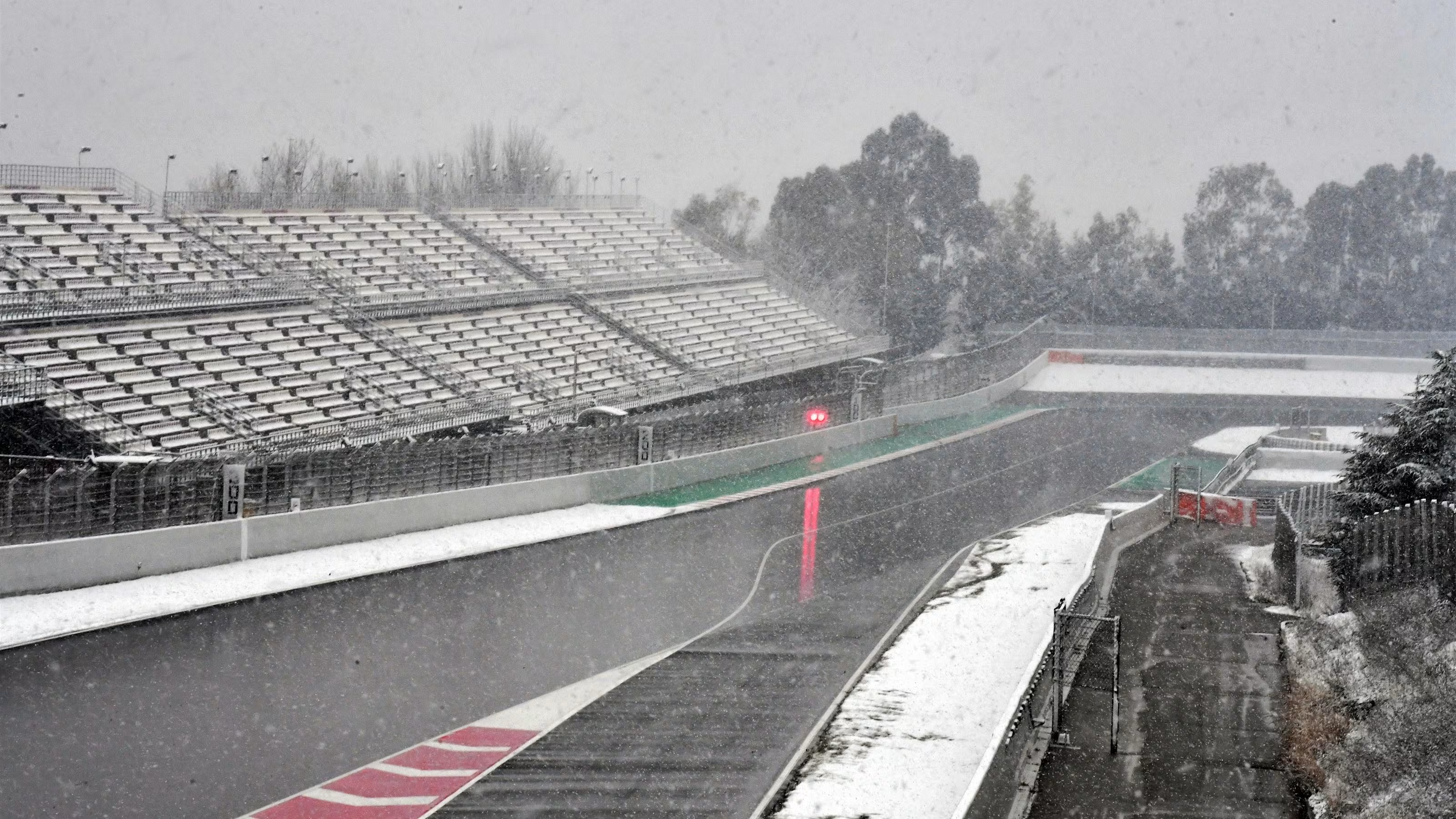
However, there are risks with this plan given the Emilia-Romagna region of Italy enjoys daytime high temperatures of around 8°C with an average in the region of 3°C to 5°C. Frost and snow are not uncommon, which would throw the entire weekend into jeopardy.
With the F1 season now spanning some 46 weeks from pre-season testing to the finale, it may be time to reconsider how the schedule is put together. F1 presently loses four weeks of racing in July/August since the mandated summer shutdown of the F1 factories.
Understanding the Mandatory Factory Shutdown Rules
The teams in fact only close for 14 consecutive days, but the extended period of no racing was initially set to allow flexibility for the teams to decide exactly when their shutdown took place. Activities which must cease include car development and manufacturing, along with the closure of the wind tunnel and shutdown of all CFD testing. Included are all simulator and engineering meetings with the drivers, which are also forbidden.
Only non-performance activities are permitted, such as routine factory building maintenance, IT system upgrades, financial stocktaking, and basic logistics planning for upcoming long-haul freight.
The F1 summer break was first instigated in 2009 when the Formula One Teams Association (FOTA) voluntarily agreed to introduce a two-week summer shutdown as a cost-cutting measure and to give team personnel a guaranteed rest during expanding race calendars.
Following the initial voluntary agreement, the 14-day mandatory factory closure was formally written directly into the FIA Formula 1 Sporting Regulations to make it legally binding and enforceable for all teams.
How Team Operations Have Evolved Since 2009
Back in 2009, there were just seventeen race weekends and the season began late March/early April and finished the first weekend of November, and more than half of the races were held in Europe. Also back then, teams had just one race weekend group of personnel who traveled the world to each and every F1 event.
With the calendar ever-expanding and now set for 24 races, the teams evolved their race weekend personnel from a rotating pool of personnel. Few now attend all the races, and those who do spend only around three and a half days on location, flying in after the bulk of the staff and away on the evening of the race.
By ending the summer shutdown, more races could be scheduled during the Northern Hemisphere’s summer. Even cutting the break in racing to two weeks would offer the sport some F1 flexibility.
The Case for Ditching the Mandated Shutdown
Given the President of the United States’ intransigence over the war in Iran together with the Islamist regime’s determination to outlast whatever can be thrown at them, unrest in the region may continue for some years. It is impossible with ballistic missiles and drones being fired daily for F1 to go racing there, and so alternatives must be explored, and more quickly than it usually takes for a circuit to join the F1 schedule.
Mid-grid teams are now twice the size they were in 2009, and the bigger teams have expanded their workforce by around 60–70%. It’s surely time to drop the mandated shutdown of the multibillion-dollar global sport of F1 and instead schedule races in its homeland of Europe, rather than scramble around in December looking for somewhere warm enough for the tyres to actually work.
Would you like to see more TJ13 Formula 1 coverage? Add us to your favourites list on Google to receive trusted F1 news.

The Judge, a nom de plume of an experienced F1 journalist and site founder with long-standing sources across the paddock. With over 30 years of experience in Formula 1 as an insider journalist, I have built trusted connections across the paddock, from race engineers and mechanics to senior team figures. At The Judge 13, I and a handful of trusted colleagues share exclusive Formula 1 news, expert analysis and behind-the-scenes stories you will not find in mainstream motorsport media.

A.J. Hunt is Senior Editor at TJ13, where Andrew oversees editorial standards and contributes to the site’s Formula 1 coverage. A career journalist with experience in both print and digital sports media, Andrew trained in investigative journalism and has written for a range of European sports outlets.
At TJ13, Andrew plays a central role in shaping the site’s output, working across breaking news, analysis, and long-form features. Andrew’s responsibilities include fact-checking, refining editorial structure, and ensuring consistency in reporting across a fast-moving news cycle.
Andrew’s work focuses particularly on the intersection of Formula 1 politics, regulation, and team strategy. Andrew closely follows developments involving the FIA, team leadership, and driver market dynamics, helping to provide context behind the sport’s biggest stories.
With experience covering multiple seasons of Formula 1’s modern hybrid era, Andrew has developed a detailed understanding of how regulatory changes and competitive shifts influence the grid. Andrew’s editorial approach prioritises clarity and context, aiming to help readers navigate complex developments within the sport.
In addition to editorial duties, Andrew is particularly interested in how media narratives shape fan perception of Formula 1, and how reporting can balance speed with accuracy in an increasingly digital news environment.

The traditional summer break could be abandonly only by reverting to around 17-18 rounds.
The task with 22-24 rounds, particularly without the mandatory shutdown period would simply be impossible for the teams, so zero chance.
All Southern European circuits are typically warmer or at least no cooler in the daytime than Las Vegas in the evening at that time of year on average.
However, maximizing temperatures by making a one-off return to Jerez (since Algarve seems unviable due to facility renovations) or Montmelo would still be wise.
I don’t really get what’s wrong with the Jerez circuit since it seemingly hasn’t been a strong contender for a Middle East location stand-in purposes at any point, just like it seemingly wasn’t a strong contender for COVID stand-in purposes early this decade.
As for Montmelo, just because F1 has already raced there this season doesn’t mean a separate visit couldn’t be made, particularly as visiting the same circuit twice separately in the same season isn’t excessive within Europe, as opposed to making separate trips to a non-European location, so this circuit should definitely be a priority as it’s the most favorable option after the South Iberian circuits & Valencia at that time of year.