
Much has been written and said about the all-new and generally despised F1 engines introduced this season. The so-called 50/50 split of power between the internal combustion engine (ICE) and the hybrid systems has been widely criticised for encouraging “yo-yo” racing and, at times, dangerous closing speeds.
The FIA revisited its call from March 2025 for manufacturers to agree to a shift in the balance of power to 60/40 in favour of the ICE, but was thwarted by Audi and Honda. So now, an agreed step change will occur, with the balance of power becoming 58/42 for 2027 before reaching 60/40 in 2028.
This, it is hoped, will mean that at tracks where braking is limited—like Monza—the cars will be less energy-starved, given their dependence on electrical power will be reduced. Yet there are also significant aerodynamic changes coming in 2027, which should provide new challenges for the teams.
The Rule-Making Process for 2027
For routine technical or aerodynamic regulation updates intended for 2027, the FIA was able to introduce and enforce them provided they followed the standard governance timeline. Typically, this requires approval and publication before June 30th for changes affecting the following season. Proposed changes must pass the F1 Commission, which consists of the FIA, Formula 1 Management (FOM), and the ten team principals. To pass, a proposal generally requires a supermajority vote (28 out of 30 votes).
The teams were largely in agreement over the following changes proposed by the FIA for 2027. These were intended to reduce downforce and drag while promoting closer racing by eliminating some of the aerodynamically created vortices coming from the rear of the cars.
Outlawing Ferrari’s Exhaust Loophole
First up was the banning of Ferrari’s clever interpretation of the rear structure of the car. This year, beam wings were banned, but Ferrari introduced a clever FTM (Flick Tail Mode) system, which centered on a loophole delivering a large performance gain that rivals could not easily copy.
When the 2026 regulations were introduced, Ferrari noticed a gap in the chassis volume definitions. By positioning their differential as far rearward as possible under the crash structure, they opened up space directly above the exhaust tailpipe.
The Maranello engineers then mounted small, specifically angled winglets directly on top of the exhaust. This redirected high-velocity exhaust gases upward to act like a mini “blown diffuser,” pulling air out from under the car and significantly boosting rear downforce—worth an estimated half-second per lap on certain circuits.
The FIA declared the system legal, but because the Scuderia had designed their entire SF-26 gearbox casing, rear suspension, and chassis architecture around this differential layout, rival teams couldn’t easily bolt a copy onto their own cars without a massive, costly redesign.
Rivals argued this system violated the spirit of the FIA’s ban on exhaust-blown aerodynamics, claiming the dirty air/wake turbulence created by the hot exhaust plume made trailing cars much harder to follow—something the FIA is keen to prevent.
To close the loophole, the technical regulations for 2027 were updated to establish an absolute exclusion zone for aerodynamic-related parts within 20 mm of the exhaust tailpipe. Ferrari was the only manufacturer to vote against the ban.
The Floor Revisions and the Resurgence of Rake
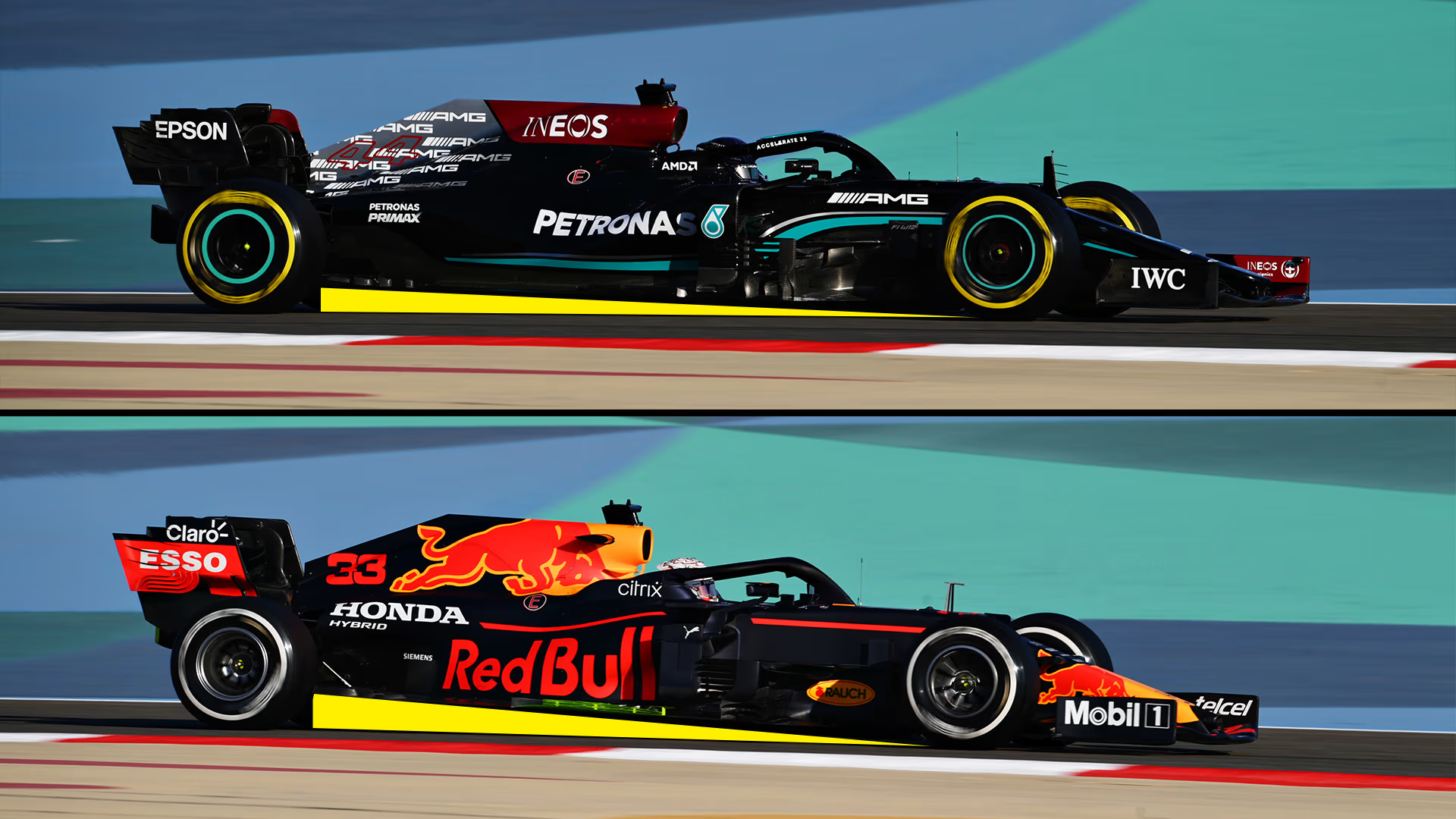
The other technical changes relate to the floor of the cars. The front section of the floor will be pulled back by some 30 cm, along with a corresponding 30 cm reduction in the length of the plank. This is to allow cars to run lower at the front and reintroduce the much-loved Adrian Newey concept of ‘rake’ to new car designs.
Lowering the front and raising the rear of the car artificially increases the distance between the floor and the ground. This expands the physical volume of the diffuser. A larger volume expansion extracts air faster from beneath the floor, creating a steeper pressure drop and producing vastly more underbody downforce.
Because a high-rake car pitches forward, the nose and front wing sit significantly closer to the track surface. Operating closer to the asphalt intensifies the ground-effect phenomena under the front wing. The air accelerates in the tiny gap between the wing elements and the track, significantly increasing front-end downforce and improving turn-in sharpness.
Curbing Vortices for Cleaner Air
In a move that takes cars back toward the pre-2022 ground-effect era, the maximum number of leading-edge floor devices/vanes will be cut from five to three. This reduces the ability to create ground-effect suction on the track that teams are currently exploiting, shifting car design back toward pre-2022 flat-floor aerodynamic concepts.
These vanes also create vortices that disturb the air in front of a following car, making close racing and overtaking more difficult. However, vanes are important for delivering a high-rake aerodynamic design, as they seal the floor edges from the higher-pressure ambient air outside.
By angling the entire floor relative to the track—a concept akin to a drag racing car—the gap between the underside of the car and the ground expands continuously from the front splitter all the way to the rear wheels. The entire floor acts as an extended expansion chamber rather than relying solely on the rear diffuser box. This generates a much larger surface area of negative air pressure underneath the chassis.
Advantage Newey and Verstappen?
A return to greater front-end aerodynamic grip will certainly please Max Verstappen and other drivers who prefer their cars ‘on the nose’. Adrian Newey has already admitted he is redesigning the suspension system for Aston Martin’s 2027 car to take advantage of the greater rake angle now permitted.
Much of Newey’s early success with Red Bull and Sebastian Vettel was based on aerodynamic car designs with a high-rake look and feel. In fact, the championship-winning cars from 2010–2013 were the defining high-rake cars of that era.
Adrian Newey and Red Bull essentially pioneered the extreme high-rake philosophy during this period, setting the trend that dictated F1 aerodynamic design for over a decade.
Would you like to see more TJ13 Formula 1 coverage? Add us to your favourites list on Google to receive trusted F1 news.

The Judge, a nom de plume of an experienced F1 journalist and site founder with long-standing sources across the paddock. With over 30 years of experience in Formula 1 as an insider journalist, I have built trusted connections across the paddock, from race engineers and mechanics to senior team figures. At The Judge 13, I and a handful of trusted colleagues share exclusive Formula 1 news, expert analysis and behind-the-scenes stories you will not find in mainstream motorsport media.

A.J. Hunt is Senior Editor at TJ13, where Andrew oversees editorial standards and contributes to the site’s Formula 1 coverage. A career journalist with experience in both print and digital sports media, Andrew trained in investigative journalism and has written for a range of European sports outlets.
At TJ13, Andrew plays a central role in shaping the site’s output, working across breaking news, analysis, and long-form features. Andrew’s responsibilities include fact-checking, refining editorial structure, and ensuring consistency in reporting across a fast-moving news cycle.
Andrew’s work focuses particularly on the intersection of Formula 1 politics, regulation, and team strategy. Andrew closely follows developments involving the FIA, team leadership, and driver market dynamics, helping to provide context behind the sport’s biggest stories.
With experience covering multiple seasons of Formula 1’s modern hybrid era, Andrew has developed a detailed understanding of how regulatory changes and competitive shifts influence the grid. Andrew’s editorial approach prioritises clarity and context, aiming to help readers navigate complex developments within the sport.
In addition to editorial duties, Andrew is particularly interested in how media narratives shape fan perception of Formula 1, and how reporting can balance speed with accuracy in an increasingly digital news environment.
