
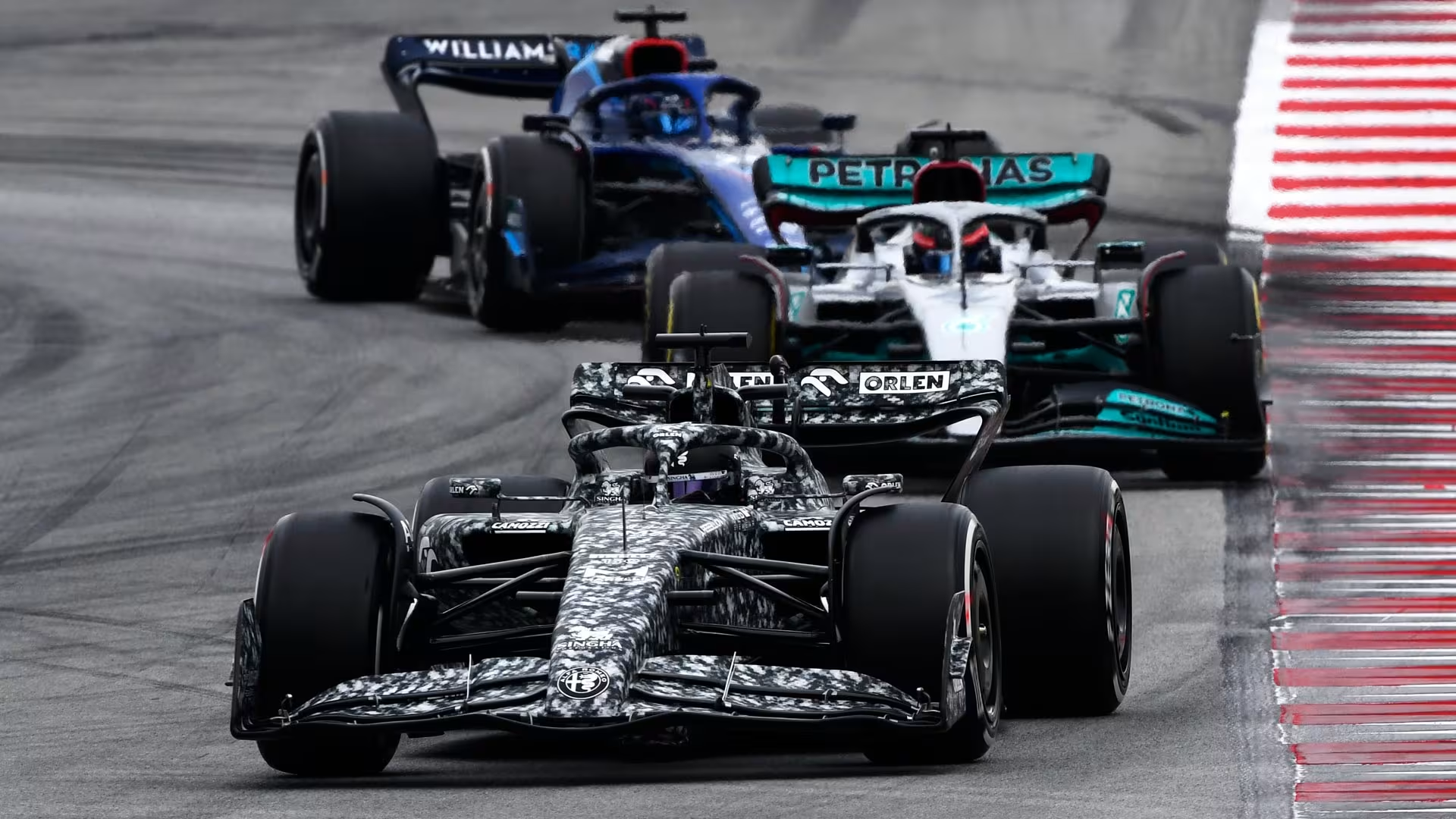
While one thing remains constant—Mercedes has dominated with seven out of nine Grand Prix wins since the start of the season—there is a significant amount of yo-yoing going on in terms of the F1 teams’ relative performance gaps to each other.
Ferrari’s Front-Loaded Development Gamble
Ferrari brought some minor tweaks last time to Silverstone, although their main focus had been on improving their deployment strategy for the hybrid power. Their expectations were minimal on the energy-starved Northamptonshire circuit, but the team was surprised at how competitive Lewis Hamilton was, claiming pole position in the Sprint.
Even to his own surprise, Charles Leclerc won the Grand Prix following a mechanical issue for Kimi Antonelli, who was tracking to catch the Ferrari driver with a handful of laps remaining. The Scuderia has been bringing regular small upgrades to their SF-26, something which prompted Toto Wolff to question the integrity of their cost cap commitments.
The response from the Ferrari boss was that they were front-loading the development of their car to ensure they received the most benefit from it across a wider number of race weekends.
McLaren Playing Catch-Up in the Aero War
This weekend in Spa, McLaren will bring their version of the 180-degree rotating ‘Macarena Wing.’ The team did not have it ready for the Austrian Grand Prix, and decided against testing it there due to concerns over its technical integrity.
McLaren admits they are two to three months behind their Mercedes rivals in terms of developing the aerodynamics of their car. Much of the reason for this was the ever-tightening race for last season’s Drivers’ Championship, with Verstappen ever-closing in on Norris race by race in the closing stages of the season.
“Definitely, I would say that having been in the championship so tight with Red Bull, and Verstappen in particular, in the Drivers’, needed some of our attention in terms of continuing to work on the car,” McLaren team principal Andrea Stella said.
“Even if we didn’t bring big upgrades, we definitely needed to keep paying attention from a technical point of view at the MCL39 because we needed to make sure that we maximised our performance race by race, because the challenge from Verstappen was becoming more and more material.”
Conceptual Course Corrections for the MCL40
Further, McLaren failed to nail the conceptual view of the all-new 2026 cars and started off on the wrong foot. While this didn’t require a completely redesigned B-spec car, like Aston Martin and Williams will soon deliver, it meant some of their in-season development was not heading in the right direction.
“During the [2026] development, I think we adopted some directions, from a conceptual point of view, that, as we learn more about the 2026 regulation, I would say we are redirecting,” Stella said. “And this, like everything, especially from an aerodynamic point of view, is not something that you can get to converge in the space of a week. It normally takes one or two months.
“This couple of months is the delay that we have at the moment. We see that it’s probably two, three months, the space between which we see upgrades from the top teams.”
A Rollercoaster Ride of Performance
McLaren did debut a big upgrade in Miami which appeared to close the gap to Mercedes, with Lando Norris claiming Sprint pole together with victory in the race. In Grand Prix qualifying, the McLarens missed a beat, starting the race on Sunday in P4 and P7.
Yet the upgrades were definitely working as Lando Norris made it through to P2, with Oscar Piastri making up four spots to finish third on the podium. The relative pace of the MCL40 continued next time out in Canada, then took a nosedive in Monaco.
The car was better again in Barcelona but has since trailed off in terms of pace, dropping back around the Monaco level by the time the team arrived at the British Grand Prix. When asked after the race and his P4 finish why the car was so obviously slow when compared to its other top-three rivals, Lando Norris appeared bemused.
“I don’t know why. Other people didn’t do a good job, I guess. There’s no way we can finish P2 in Miami and have a car like this today, you know? Other people have brought a lot of upgrades and updates since, and we kind of haven’t. Nothing that’s brought us that much performance. I don’t know, the car was just undrivable, honestly.”
The 2026 Reset: Pivot or Perish
While the ‘Macarena wing’ should improve the McLaren’s straight-line performance come this weekend in Belgium, it is in Hungary where the Woking-based team will bring their next big upgrade to the MCL40.
So why are we seeing such yo-yo performances where, in Miami, McLaren is the “best of the rest” comfortably, then in Austria, Red Bull’s upgrades put Max Verstappen into a strong P2 at the end of the Grand Prix?
One of the reasons is that last season, the regulations were in their fourth year and the conceptual and aerodynamic direction of the cars was well established. The teams were hunting for smaller improvements in the cars’ downforce and drivability. Whereas, with entirely new cars this season—and indeed, more radical than many of their predecessors—a variety of concepts for the long-term direction of the cars are being worked through.
Aston Martin and Williams have clearly decided their direction of travel in terms of the car design philosophy must be abandoned. For them, there was no point in wasting time and money bringing small improvements to the cars they are set to abandon.
New Power and Upgrades on the Horizon
McLaren will finally take their ‘upgraded’ Mercedes power unit this weekend, some two races after the works Mercedes team debuted the same engine. And given Hungary will be where McLaren brings its next decent-sized upgrade package, Budapest could once again be a happy hunting ground for Lando Norris.
Expect to see this chopping and changing in the pecking order from P2 to P4, although for now, only Ferrari look as though they could topple Mercedes on the right circuit with the right set of weather conditions.
Would you like to see more TJ13 Formula 1 coverage? Add us to your favourites list on Google to receive trusted F1 news.

A.J. Hunt is Senior Editor at TJ13, where Andrew oversees editorial standards and contributes to the site’s Formula 1 coverage. A career journalist with experience in both print and digital sports media, Andrew trained in investigative journalism and has written for a range of European sports outlets.
At TJ13, Andrew plays a central role in shaping the site’s output, working across breaking news, analysis, and long-form features. Andrew’s responsibilities include fact-checking, refining editorial structure, and ensuring consistency in reporting across a fast-moving news cycle.
Andrew’s work focuses particularly on the intersection of Formula 1 politics, regulation, and team strategy. Andrew closely follows developments involving the FIA, team leadership, and driver market dynamics, helping to provide context behind the sport’s biggest stories.
With experience covering multiple seasons of Formula 1’s modern hybrid era, Andrew has developed a detailed understanding of how regulatory changes and competitive shifts influence the grid. Andrew’s editorial approach prioritises clarity and context, aiming to help readers navigate complex developments within the sport.
In addition to editorial duties, Andrew is particularly interested in how media narratives shape fan perception of Formula 1, and how reporting can balance speed with accuracy in an increasingly digital news environment.
