
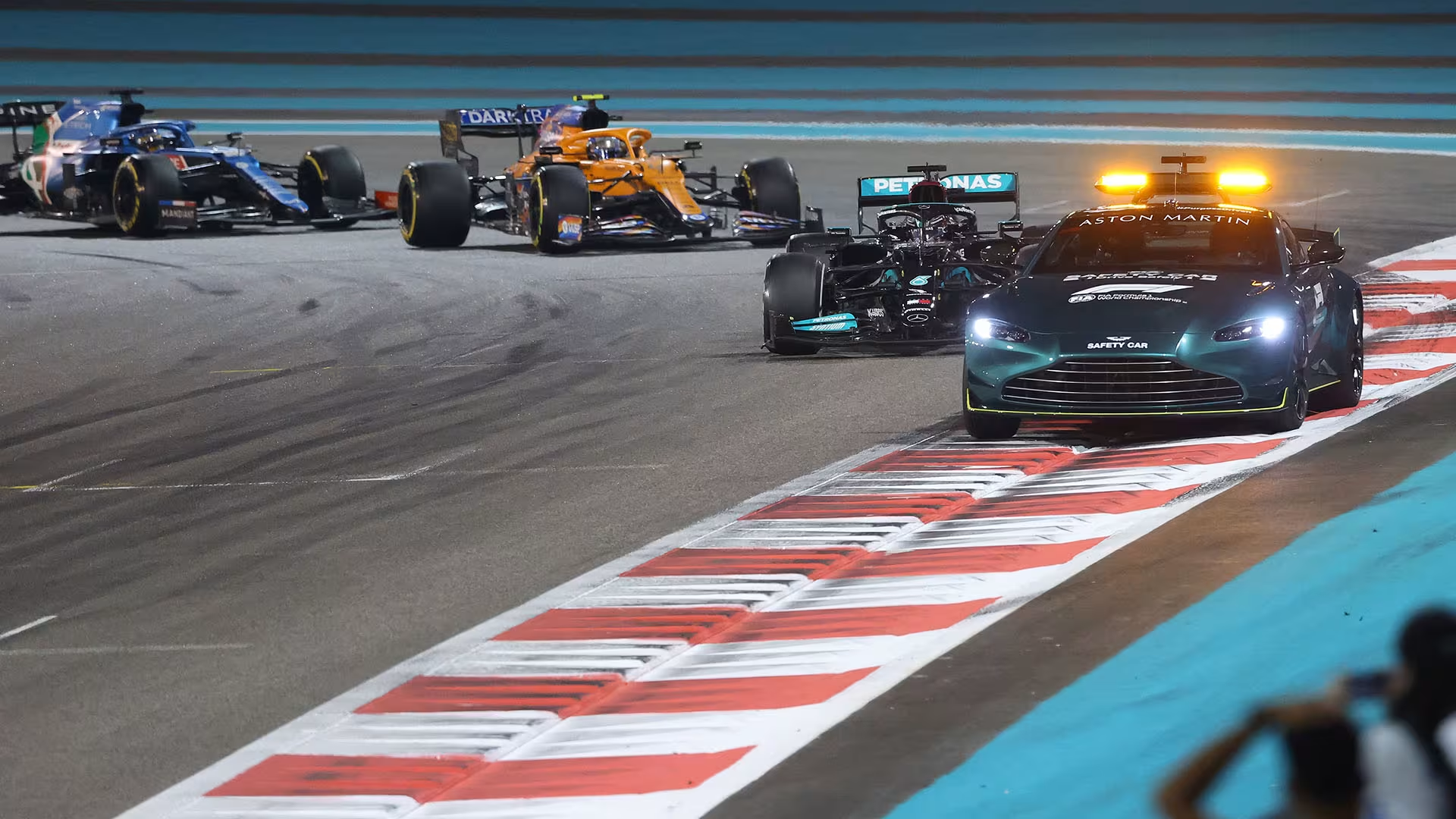
One of the most hypocritical statements from an F1 team boss in recent years will haunt fans at the British Grand Prix. Mercedes boss Toto Wolff defended the debacle which saw fans robbed of a race to the line by stating that “sporting integrity should favour the spectacle.”
Yet all we have heard since Liberty Media bought the commercial rights to F1 is that the “product” must be improved. In other words, the spectacle is now treated as far more important than the historic, sporting nature of the sport.
As it turned out at Silverstone, the instruction from race control to wave around the lapped cars was issued just one second too late. Under the contrived rules devised following the infamous Abu Dhabi 2021 last-lap shootout for the drivers’ championship, this meant the cars would trundle over the line at the checkered flag without contesting the finish.
Back in 2021, former F1 race director Michael Masi had been under intense pressure all season from the teams to do everything in his power to prevent a Grand Prix from finishing under a Safety Car. Because that was no ordinary Grand Prix—with the drivers’ title directly on the line—the spectacle of an uncontested finish was too much for the Australian FIA official to countenance.
Using the discretion available to him in the face of fast-diminishing laps, Masi chose to wave around only the select lapped cars positioned between the two championship protagonists. He then instructed the field that there would be a single-lap sprint to the checkered flag.
An Archaic Rule in a Modern Era
The first thing to note is that in many other racing series, a much more expedient view is taken to re-order the field during a neutralization period. Rather than waving lapped cars ahead to unlap themselves across an entire tour of the circuit, they are simply instructed to fall to the back of the snake of cars in drop-back order. This prevents pointless, lengthy delays.
The FIA has been repeatedly challenged over why Formula 1 regulations insist that cars must advance rather than drop to the back of the line. They continually defend this archaic rule based on the absolute integrity of the number of racing laps being completed. Of course, in the days when timing was organized by officials holding manual stopwatches, this physical method of clearing lapped cars prevented massive scoring confusion. Yet in the modern era of a multi-billion-dollar sport, this farcical process looks long past its sell-by date.
Even with these clumsy sporting regulations, the finale of the British Grand Prix could have still seen a grandstand one-lap shootout. Ferrari had pitted both their drivers for fresh, soft rubber, while Mercedes—echoing their costly Abu Dhabi 2021 strategy—left George Russell out on track to prioritise track position.
By doing so, Russell gained second place from Lewis Hamilton (who was switching his rubber in the pit lane), but the Mercedes driver faced the harsh reality of a restart on 17-lap-old, cold tires against a charging Ferrari on brand-new softs. Russell was staring down the exact same fate that Hamilton suffered in Abu Dhabi. A green-flag restart seemed inevitable to everyone watching.
The One-Second Mistake
Yet, a one-second-late call from race control to the lapped cars saw this thrilling final lap completely canceled. The first driver in line to unlap himself was Oscar Piastri. TV replays showed that the Australian had momentarily crossed the start/finish line just as he received the instruction, then accelerating past the car directly ahead.
Had that instruction come a single second earlier, the McLaren driver would have not yet crossed the line. This would have allowed the mandatory one-lap delay required after the unlapping message to be fulfilled with exactly one racing lap left to play with.
The fact that nobody in race control had a firm grip on this crucial piece of timing is truly astounding. There is no way that final one second was critical to the safety of the drivers or the track marshals, yet it was critical to the millions watching around the world.
The Case for the Red Flag
This timing error aside, there were other, better options open to race control when Max Verstappen lost control of his Red Bull on Lap 48 and went spinning into the gravel at Stowe corner.
The subsequent restart would have included either a single lap behind the Safety Car or a standard formation lap before a standing restart on the grid. This would have afforded the fans three brilliant final laps of flat-out racing and a memorable racing finish for the eventual winner, Charles Leclerc.
Following the race, Jenson Button muttered on about how red-flagging the race under those conditions would lead to a “contrived” finish, in what appeared to be a brief moment of madness from the 2009 World Champion. Surely halting the race with the cars frozen in their exact order at the time of the incident is not contrived at all, but rather a precise, fair recognition of the sporting state of play?
Prior to this weekend, purists would argue that only eleven times in F1 history has a Grand Prix finished under the Safety Car. They view it as a rare, unfortunate anomaly. Then again, that represents eleven distinct times that paying fans were completely robbed of a grandstand finish.
Since Abu Dhabi 2021, this anti-climax has happened twice before yesterday’s mess. The first occurred in Italy, where with six laps remaining Daniel Ricciardo’s broken McLaren was stuck in gear and marshals couldn’t clear it in time. The other occasion was last season at the Canadian Grand Prix, when Lando Norris crashed into the pit-straight barriers with three laps remaining.
On both of those occasions, just as was the case yesterday at Silverstone, the races could have easily been red-flagged. The technical rules chose to deny the fans a proper racing finish once again
The Sport Must Outgrow Its Past
Ultimately, Formula 1 cannot have it both ways. The sport cannot aggressively market itself as a peak entertainment product to millions of new fans while simultaneously hiding behind manual, decades-old administrative procedures when a race hangs in the balance. The ghost of Abu Dhabi 2021 was supposed to usher in an era of procedural clarity; instead, it has created a rigid, over-corrected system where a single second of hesitation in race control can completely kill a Grand Prix.
If Liberty Media truly wants to prioritise the spectacle without compromising sporting integrity, the solution is glaringly obvious. It is time to abandon the slow, archaic unlapping process entirely, and mandate red flags for late-race incidents. Until the FIA updates its sporting code to reflect the pacing of modern broadcasting, paying trackside fans and millions watching at home will continue to be robbed of the one thing they tune in to see: real racing to the checkered flag.
Would you like to see more TJ13 Formula 1 coverage? Add us to your favourites list on Google to receive trusted F1 news

A.J. Hunt is Senior Editor at TJ13, where Andrew oversees editorial standards and contributes to the site’s Formula 1 coverage. A career journalist with experience in both print and digital sports media, Andrew trained in investigative journalism and has written for a range of European sports outlets.
At TJ13, Andrew plays a central role in shaping the site’s output, working across breaking news, analysis, and long-form features. Andrew’s responsibilities include fact-checking, refining editorial structure, and ensuring consistency in reporting across a fast-moving news cycle.
Andrew’s work focuses particularly on the intersection of Formula 1 politics, regulation, and team strategy. Andrew closely follows developments involving the FIA, team leadership, and driver market dynamics, helping to provide context behind the sport’s biggest stories.
With experience covering multiple seasons of Formula 1’s modern hybrid era, Andrew has developed a detailed understanding of how regulatory changes and competitive shifts influence the grid. Andrew’s editorial approach prioritises clarity and context, aiming to help readers navigate complex developments within the sport.
In addition to editorial duties, Andrew is particularly interested in how media narratives shape fan perception of Formula 1, and how reporting can balance speed with accuracy in an increasingly digital news environment.

I was there you couldn’t believe how annoyed people in the grandstand were it was unbelievable. Fans getting up and leaving early. Grandstand tickets for grand prix weekends aren’t cheap and liberty media are not fulfilling there contract when a race finishes like that it was not racing.the rules should be changed for any accidents within the last five laps to be redflagged and restarted when the damage has been repaired. Won’t happen but someone should be refunding the fans. NOT THE SPECTACLE WE EXPECT.
Neutralized finishes have overall been very rare since the introduction of SC in 1993, so people should’ve stopped making a fuss about them long ago, especially since a neutralized finish isn’t even any worse than a neutralized start (i.e., starting behind the SC) in comparison, & rather worse, if anything.
Besides, the only change the 2021 Abu Dhabi GP fallout caused was the change of word from ‘any’ to ‘all ’, even though all lapped drivers had always been required to be unlapped & so had the one full lap requirement existed ever since this practice began in 2012 & it began for a reason, so nothing pointless in it.
The only issue is that the unlapping process more often than not gets unnecessarily delayed, even though the lapped driver(s) could simply have SC delta requirement for the relevant mini sector after which they’d return to full speed, & in this case, the process could’ve very well been started a lap or even two sooner, & certainly on the Hangar straight of that lap since Max’s car’s recovery process wasn’t ongoing anymore; hence, the wait until after Piastri had crossed the timing line while still lapped was excessive since doing the same 3-4 corners earlier wasn’t even safety critical by any means.
However, Toto was right to point out that the 2021 Abu Dhabi GP should’ve also ended in this manner, & nothing hypocritical about it.
Besides, almost all the neutralized ends over the years (including VSC finishes like in the 2024 Australian GP) happened with too little race distance left for even immediate red-flagging to avoid the final lap being neutralized, which was also the case in Canada last season.
Mandating red-flagging for late incidents would be excessive because red-flagging should only ever be the resort when actually necessary, regardless of which race phase is in question, just like SC should be the resort over VSC only if a situation is too unsafe for VSC, & so on, rather than for the sake of entertainment, especially in the event of a very lengthy race due to weather conditions & or multiple neutralizations by that point.
Btw, the championship-deciding 2012 Brazilian GP also ended under SC conditions, yet no one complained at the time, & neither did anyone complain about the same regarding the 2014 Canadian GP.