
Mercedes are leading the Constructors’ Championship comfortably, and Kimi Antonelli is almost two race wins ahead of his nearest rival, Lewis Hamilton. Yet, all is not well in Brackley and Brixworth given their dominant form at the start of the season.
A stunning 1:18.518 pole position time from George Russell saw him claim pole position in Melbourne from his teammate, with the nearest non-Mercedes contender almost a second off the pace. The Grand Prix on Sunday was equally predictable, with Russell delivering a 1-2 for the Silver Arrows as Charles Leclerc’s Ferrari trailed home over a quarter of a minute later. With five consecutive wins next up for Antonelli, surely Mercedes have one hand on both 2026 titles?
Red Bull 2023 vs. Mercedes 2026: The Illusion of Dominance
If we compare this season for the Brackley-based team with Red Bull’s über-dominant year of 2023, the numbers are indeed surprising. After seven rounds three years ago, Red Bull had scored 287 points to Mercedes’ 152 in second place—a difference of 135 points. Clearly, sitting just 72 points ahead of Ferrari, Mercedes are nowhere near the unstoppable force that Red Bull were, and Toto Wolff attempted to suggest he understands the root of their problems in Barcelona.
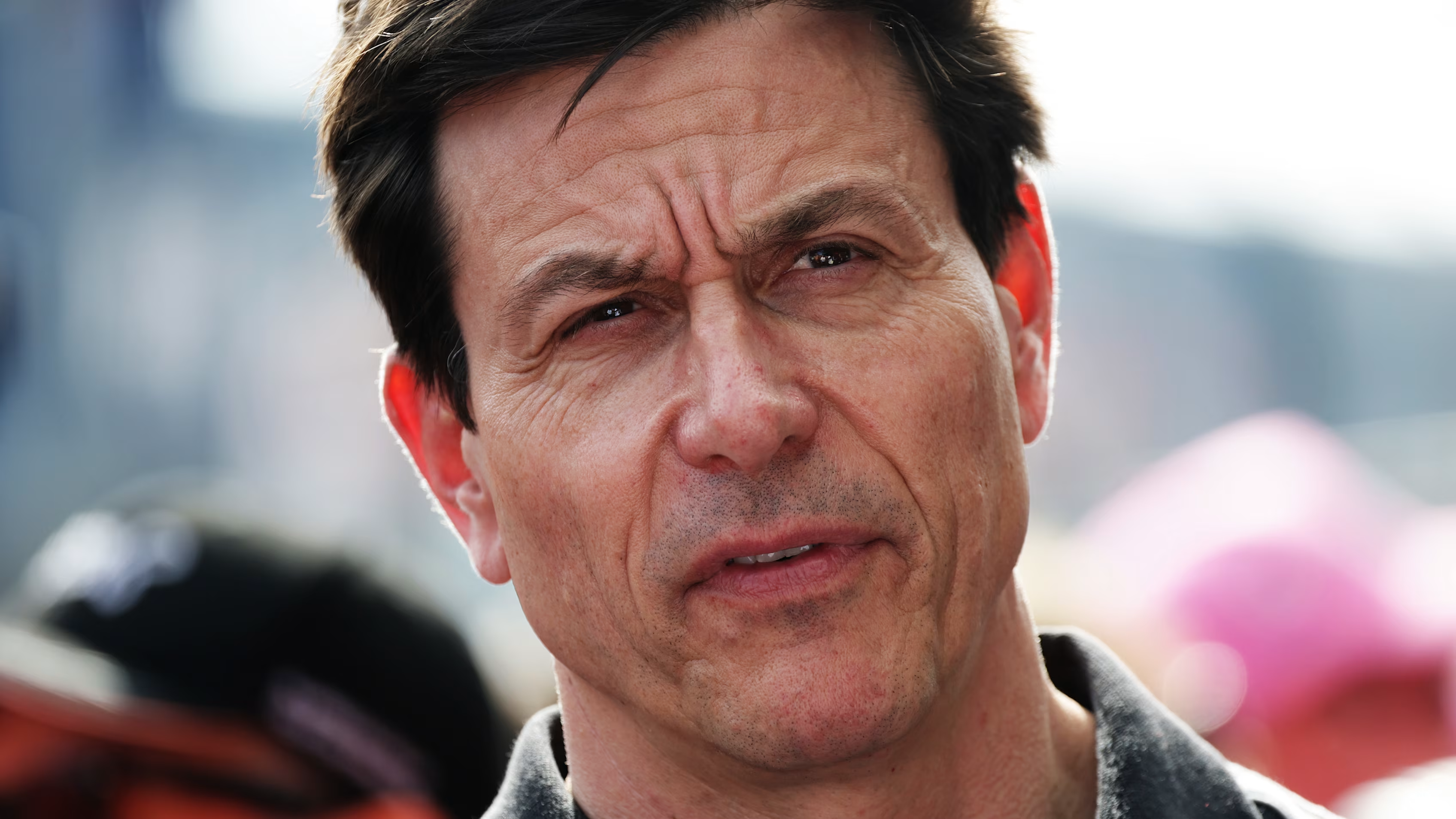
“I’m underwhelmed,” claimed the Mercedes boss after another power unit failure for Kimi Antonelli with just four laps of the race remaining. “You can’t DNF cars in a kind of regular, continued way. Losing 25 points in a Constructors’ Championship [fight] in Montreal and losing another 18 points today. In order to finish first, first you have to finish. Reliability—this is what we need to get on top of. That’s number one,” a clearly frustrated Wolff told Sky F1.
The Costly Math of Engine Failures
The difference between Red Bull’s mega-season and this one for Mercedes is indeed due in part to shocking reliability. By most people’s calculations, in this respect they are the team who have thrown away the most points. The cold, hard math suggests Russell’s engine failure in Canada when leading the Grand Prix cost him 25 points and the team a massive haul. In Barcelona, Kimi Antonelli’s engine failure with four laps to go cost him 18 points and the team 15 net points. Ferrari, by way of contrast, have lost just ten points from engine issues on Charles Leclerc’s car, with Lewis Hamilton enjoying a completely clean season so far after seven race weekends.
Yet, pure engine failures are not the entire story as to why Mercedes are nowhere near as dominant as Red Bull were in 2023. Russell suffered some software glitches in the final qualifying session in Shanghai. While it cost Mercedes nothing in the race context with their second 1-2 of the year, Russell was highly capable of claiming pole from his teammate, meaning another seven points (a 14-point swing) was lost for the British driver.
The Logistical Nightmare of 2026 Power Units
The problem for Mercedes is they have not been able to properly analyze the physical issues behind Russell’s failure in Canada, as Bradley Lord, Mercedes’ Deputy Team Principal, explained on the team’s own podcast:
“We got the car back [to the garage in Montreal] and were able to get the module out of it. It had to undergo some unusual safety procedures and then has to be shipped back to the UK. So it will therefore be several months before the hardware gets back, and we need to really dig through the data to understand exactly what went wrong and then work out how we try and prevent a repeat on any of the other modules in the future.”
The extremely powerful batteries used by F1 these days mean they cannot be legally sent on commercial airliners. Consequently, Russell’s failed energy store will be bobbing around on a cargo ship in the Atlantic until F1’s summer break.
All this is well and good, and Mercedes must indeed get on top of their reliability issues. Yet, all this talk is masking a far bigger problem within the Silver Arrows—operational errors that are costing George his shot at a championship and allowing the conversation to now include a surging Lewis Hamilton.
Missing the Mastermind: The Ghost of James Vowles
Before James Vowles became the Williams Team Principal, he had proven to be a crucial cog in the Mercedes trackside machine. He was a key individual in the eight consecutive Constructors’ titles claimed by the team and Hamilton’s six championships with Brackley. Masterclass strategy games at the Grand Prix in Hungary in 2019 and in Barcelona in 2021 proved Vowles’ worth to the team in the heat of battle. Yet, this tactical edge is something Mercedes are woefully lacking at present, making a number of amateur strategic mistakes in recent weeks.
Monaco: A Comedy of Operational Errors
In Monaco, there were two enormous blunders which cost the team and George Russell dearly. Firstly, the confusion over whether he should pit or not under the Safety Car, where a late, frantic call from the pit wall failed to make the team’s intentions clear to their driver. This, of course, led to the pit crew failing to wait for the mandatory five seconds to serve the penalty Russell had been given for speeding in the pit lane.
This layout error then resulted in a further drive-through penalty for Russell when the race restarted for an infraction a handful of laps after the red flag incident involving Charles Leclerc. Now, having been handed a drive-through penalty with the field completely condensed, there was little hope Russell could score points. The team should clearly have realized the best solution would be to ignore the latest penalty for Russell on track and take their chances in the stewards’ office after the race—as Alpine did with great success.
Barcelona: Panic on the Pit Wall
The next weekend in Barcelona, the strategy team fared no better. They originally opted for a straightforward two-stop race for their drivers, but Hamilton exposed Ferrari’s aggressive intentions when starting on the soft tire. Predictably, Hamilton stopped very early on Lap 13, and the Mercedes strategy team blinked instantly, forcing Russell to pit way before his optimal window for the medium tire.
Ferrari split their race into perfect stints for the rubber they gave to the seven-time world champion, while Russell was forced to stretch a massive, painful 29 laps at the end of the race on the hard compound. To add to his woes, the team admitted they actually gave him the wrong front wing flap adjustment for that final run, adding to a multiplicity of basic, operational errors across both the Monaco and Barcelona Grands Prix.
Would you like to see more TJ13 Formula 1 coverage? Add us to your favourites list on Google to receive trusted F1 news.

A.J. Hunt is Senior Editor at TJ13, where Andrew oversees editorial standards and contributes to the site’s Formula 1 coverage. A career journalist with experience in both print and digital sports media, Andrew trained in investigative journalism and has written for a range of European sports outlets.
At TJ13, Andrew plays a central role in shaping the site’s output, working across breaking news, analysis, and long-form features. Andrew’s responsibilities include fact-checking, refining editorial structure, and ensuring consistency in reporting across a fast-moving news cycle.
Andrew’s work focuses particularly on the intersection of Formula 1 politics, regulation, and team strategy. Andrew closely follows developments involving the FIA, team leadership, and driver market dynamics, helping to provide context behind the sport’s biggest stories.
With experience covering multiple seasons of Formula 1’s modern hybrid era, Andrew has developed a detailed understanding of how regulatory changes and competitive shifts influence the grid. Andrew’s editorial approach prioritises clarity and context, aiming to help readers navigate complex developments within the sport.
In addition to editorial duties, Andrew is particularly interested in how media narratives shape fan perception of Formula 1, and how reporting can balance speed with accuracy in an increasingly digital news environment.

Very interesting article. The reliability of the new engine/ battery packages brings DNFs to a level of the 1970s and the early turbo period .
I have a plea. Don’t use the term math . In the UK 🇬🇧 it’s maths please.