
The political paddock games ahead of the Spanish Grand Prix have once again erupted. In a bizarre twist of regulatory mathematics, the FIA has left the entire grid stunned by crowning Red Bull Ford Powertrains as the definitive benchmark engine manufacturer of Formula 1.
The provisional findings from the FIA’s ADUO (Additional Development and Upgrade Opportunity) evaluation have triggered widespread disbelief. Under this system—designed to allow lagging engine suppliers to close the gap—Red Bull Ford’s Internal Combustion Engine (ICE) was mathematically rated as the strongest package on the grid. Consequently, Red Bull has been completely barred from upgrading its power unit, while its dominant, undefeated Mercedes rivals have been handed a development lifeline.
The Shock ADUO Hierarchy: Who Gets Upgrades?
The FIA shared its preliminary horsepower figures with the teams, establishing a performance index based strictly on the internal combustion element. The resulting handicap allowance has turned paddock logic upside down:
This hierarchy has left the Milton Keynes management flabbergasted. Mercedes has utterly dominated the 2026 season so far, winning every single Grand Prix and Sprint event. Yet, the FIA’s metrics claim the Silver Arrows are actually lagging behind Red Bull in raw horsepower, granting them a shock allowance to develop their engine further.
Verstappen and Mekies React: “We Are Surprised and Confused”
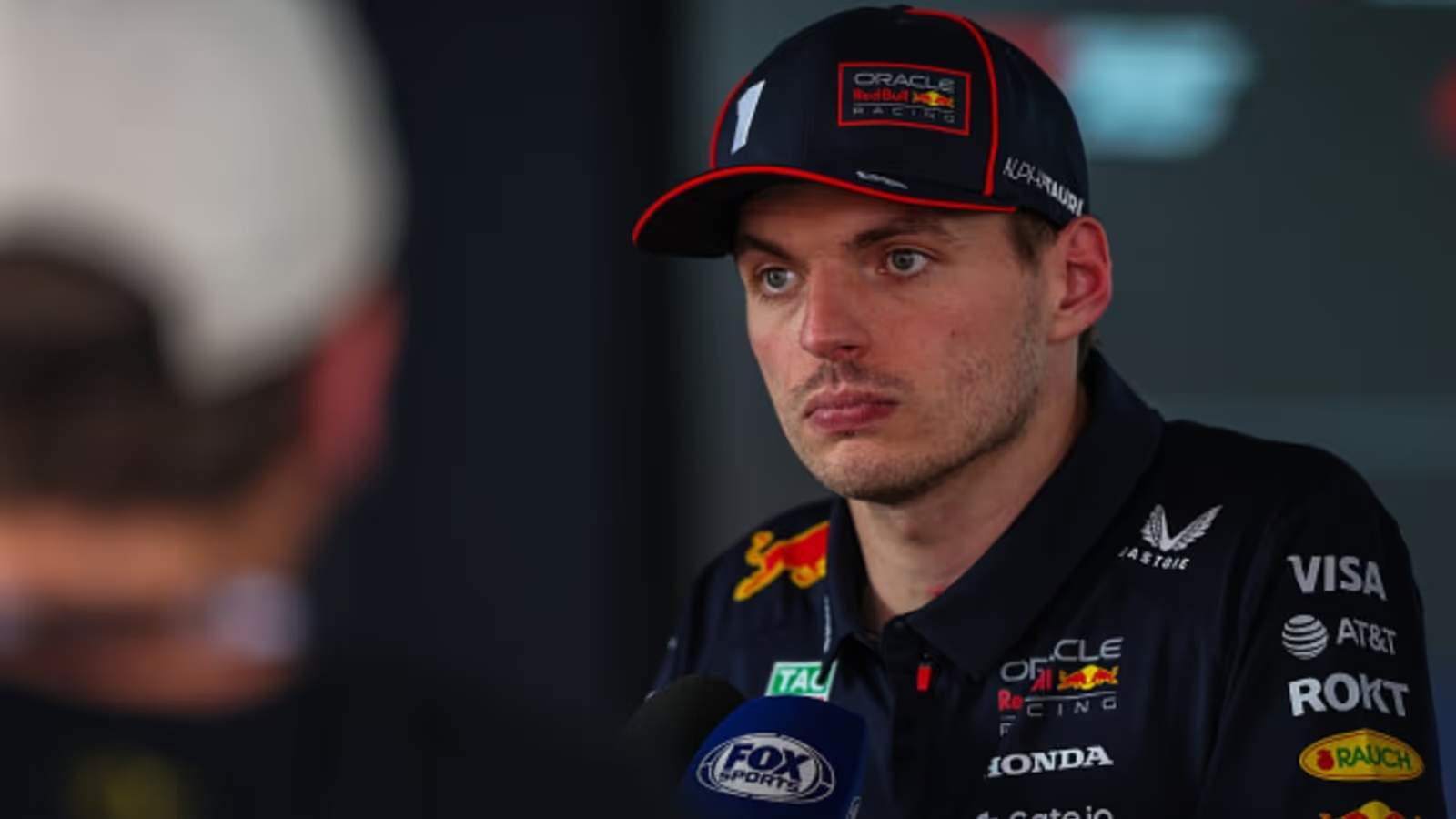
Speaking on Media Day in Barcelona, Max Verstappen broke his silence on the regulatory storm, openly questioning how an unproven engine program is being painted as the sport’s gold standard.
“We just feel surprised, because we don’t feel like we are the best,” Verstappen admitted. “Of course we are proud, just a bit confused with suddenly being portrayed as the best, because we don’t feel like that.
“It is super impressive what Red Bull Powertrains have done in such a short timeframe. We still have some reliability things, but overall it’s honestly nice to be a part of it. But we are just a bit confused by the decision.”
Red Bull Team Principal Laurent Mekies was equally cautious, emphasising that the figures remain highly provisional as intense discussions between the team and the FIA rage behind closed doors. Mekies pointed out that the FIA’s calculation model is fundamentally flawed because it isolates the internal combustion engine while ignoring how modern power units actually deploy speed.
“Direct comparisons are highly complex,” Mekies explained, highlighting that differences in turbo concepts, architecture, and the sophisticated interaction between the ICE and electrical components make a simple horsepower index unrepresentative of real-world lap times.
The FIA Defends the Rules: “The Teams Asked for This”
As criticism intensifies, the FIA has been forced to re-examine the outcome of its preliminary evaluation. F1’s governing body is currently auditing its calculations—not to intentionally manipulate the result, but to double-check the mathematics and explain to a bewildered Red Bull Ford team how they ended up on top.
However, FIA Single-Seater Director Nikolas Tombazis hit back at the complaining manufacturers, reminding them that they made their own bed back when the ADUO criteria were signed off in 2025.
“The universal position by the PU manufacturers back then was that we should keep it simple,” Tombazis revealed. “So the fact that it is the current horsepower measurement of the internal combustion has been appreciated right from the start.
“I would be personally quite open to the idea of complicating the parameter bit [incorporating more technical variables], but that discussion was had back more than a year ago, and it was quite clear what it concluded.”
The 2027 Engine “Fudge” Signed Off
The ADUO controversy lands at the exact moment F1 officially signed off on radical engine regulation amendments for 2027 and 2028. The sport is actively backing away from the highly criticised 50:50 hybrid power split, reshaping the rules to feature a 60:40 split in favour of internal combustion power.
Verstappen, who previously branded the original rules as “Formula E on steroids,” gave a calculated nod of approval to the adjustments, even if he feels the sport’s political red tape delayed a total fix.
“Of course I would have hoped next year would be what we get already in 2028,” Verstappen stated. “But I also understand that there are politics involved in that. At least the changes they are making are heading in the right direction. So that’s a good thing.”
With Mercedes already holding a monopoly on the 2026 trophies, the paddock is now holding its breath. If the FIA’s audited calculations stand, a dominant Mercedes team will receive the green light to bolt performance upgrades onto their engine, while an encrypted, frozen Red Bull team is left completely defenceless.
Behind the Backroom Politics: Ferrari and Audi’s Stance
The reason for the stepped, gradual progress towards the 60:40 hybrid layout is once again purely political. Ferrari argued that making such a massive regulatory leap all in one go would completely nullify their advantage in terms of the ADUO development tokens they expected to receive. Their underlying reasoning was to prevent Mercedes from being allowed to completely change their power unit layout in 2027.
Yet, the bizarre results emerging from the FIA’s power unit measurements mean Mercedes will get this upgrade freedom regardless of Ferrari’s attempts to block it.
Audi, too, were strictly against changing the power unit blueprint at all. Given that they are in their very first year in the sport, they are desperately trying to establish stable baseline data for each circuit. Furthermore, they suggested they’d rather spend their budget in other developmental areas—although they, too, were always going to receive ADUO engine upgrade tokens, which will cost them cold, hard cash to manufacture anyway.
Would you like to see more TJ13 Formula 1 coverage? Add us to your favourites list on Google to receive trusted F1 news.

A.J. Hunt is Senior Editor at TJ13, where Andrew oversees editorial standards and contributes to the site’s Formula 1 coverage. A career journalist with experience in both print and digital sports media, Andrew trained in investigative journalism and has written for a range of European sports outlets.
At TJ13, Andrew plays a central role in shaping the site’s output, working across breaking news, analysis, and long-form features. Andrew’s responsibilities include fact-checking, refining editorial structure, and ensuring consistency in reporting across a fast-moving news cycle.
Andrew’s work focuses particularly on the intersection of Formula 1 politics, regulation, and team strategy. Andrew closely follows developments involving the FIA, team leadership, and driver market dynamics, helping to provide context behind the sport’s biggest stories.
With experience covering multiple seasons of Formula 1’s modern hybrid era, Andrew has developed a detailed understanding of how regulatory changes and competitive shifts influence the grid. Andrew’s editorial approach prioritises clarity and context, aiming to help readers navigate complex developments within the sport.
In addition to editorial duties, Andrew is particularly interested in how media narratives shape fan perception of Formula 1, and how reporting can balance speed with accuracy in an increasingly digital news environment.

This all smacks of a backhander in a brown envelope, doesn’t it!!
As if F1 ruling bodies were not ALREADY a complete and utter laughing stock this season …