


Ferrari has warned its Formula 1 drivers; the team must come first. Following Ferrari’s disastrous double retirement at the São Paulo Grand Prix, a dark mood has settled over Maranello. What should have been an opportunity to demonstrate resilience instead served as a stark reminder of how quickly things can unravel at Formula 1’s most iconic team. Both Charles Leclerc and Lewis Hamilton failed to finish, and the repercussions have gone far beyond the race itself.
Leclerc’s hopes ended on lap six through no fault of his own, when he was caught up in a collision involving another driver. Hamilton’s race spiralled into misery after a series of early incidents left him struggling with his car for more than 40 laps, before Ferrari finally ended his afternoon. For the seven-time world champion, the Interlagos weekend crystallised a troubling truth: his dream move to Ferrari has so far been closer to a nightmare.
“I’ve been living it now for a while,” Hamilton admitted after the race. ‘The flip between living the dream of driving for this amazing team and the nightmare of the results we’ve had.’
His words conveyed frustration, but also something deeper: disbelief that even a team with Ferrari’s history, resources and reputation could feel so vulnerable. Yet, for those familiar with the team’s culture, such emotions are rarely left unaddressed by those at the top.
Elkann has intervened
Usually measured and rarely prone to public comment, Ferrari chairman John Elkann has stepped forward with what many are interpreting as a direct warning to his two high-profile drivers. His intervention, coming just days after the double DNF, left little room for interpretation.
Speaking at an event to promote the 2026 Milan-Cortina Winter Olympics, Elkann made it clear that the focus in Maranello must now return to discipline, teamwork and discretion.
“It is certainly important that our drivers focus on driving and talk less,” he said pointedly.
“There are still important races left, and second place in the constructors’ standings is still possible.”
In those few words, the chairman reaffirmed a principle that has defined Ferrari for decades: the team comes before any individual, no matter how talented or decorated. His comments are not just about public relations; they are a sharp reminder of Ferrari’s internal hierarchy, insisting that both Hamilton and Leclerc remember their place within it.
Hamilton at war with the FIA stewards
Hamilton warned, the team comes first
Elkann went on to reference Ferrari’s recent success in endurance racing as an example of what can be achieved through unity.
“It demonstrates that when Ferrari is a team, we win,” he said. “We need drivers who do not think about themselves, but who think about Ferrari.”
This was no casual observation. Within Maranello’s culture, such phrases resonate with the gravity of past lessons. Ferrari’s history is littered with moments when internal rivalries, public frustrations and the cult of the driver have threatened to undermine the collective strength of the team. From the explosive clashes between Gilles Villeneuve and Didier Pironi, to the political battles of Fernando Alonso’s era, Ferrari has learned the hard way that discord at the top corrodes everything below.
Elkann’s words were therefore both a reprimand and a signal, a call to refocus the team’s priorities. The endurance programme is widely regarded as a prime example of harmony between engineers, management and drivers. The chairman’s comparison was no accident; he wanted to remind everyone that Ferrari only wins when it acts as one.
Of the two Ferrari drivers, Hamilton has clearly endured the greater struggle and has made a lot of noise about it. While Leclerc’s frustrations have largely been confined to moments of bad luck or mechanical failure, Hamilton’s transition to life at Maranello has been far more turbulent.
The former F1 champion has repeated public comments about the team’s shortcomings and his own discomfort with the car, as well as the stark contrast with his years of dominance at Mercedes, have created an ongoing narrative of discontent.
While his status as a seven-time world champion commands respect, it also amplifies everything he says, and within Ferrari’s walls, his constant commentary is beginning to grate. In a team that values quiet resilience over public emotion, Hamilton’s voice has been the loudest — and the least reassuring.
Russell unfazed by Verstappen: “People thought Hamilton was unbeatable, too!”
A fading campaign
The timing of Elkann’s statement was also critical. Ferrari left Brazil having fallen from second to fourth in the constructors’ standings. What was once a fight for honour behind McLaren has become a battle to salvage credibility. With only three races left in an underwhelming season, Ferrari’s focus has shifted from glory to damage limitation.
Hamilton, in particular, finds himself in an unfamiliar position. Accustomed to competing for championships, he has instead endured a campaign characterised by mechanical failures, tactical errors and intense media scrutiny. His arrival was intended to signal a new era for Ferrari, combining his experience with Leclerc’s speed to create a powerful partnership. However, their relationship has yet to gel fully, and the results have been inconsistent at best.
Leclerc, too, has reasons for discontent. Despite occasional brilliance, the Monegasque driver has once again seen his hopes thwarted by reliability issues and circumstances beyond his control. In Brazil, his retirement was inevitable, but it continued a pattern that has plagued him for years: potential without reward.
Therefore, the message to him from the chairman is as much about mental reset as performance. With the 2025 season coming to a close and attention already turning to the new regulations for 2026, Ferrari’s leadership team is keen to foster unity rather than introspection.
FIA emergency action over Qatar
A legacy to protect
For Hamilton and Leclerc, the warning is clear: Ferrari’s history demands deference to the collective. Enzo Ferrari’s philosophy has always been paramount — drivers may come and go, but the Prancing Horse endures. Even legends such as Niki Lauda, Michael Schumacher and Alain Prost were reminded at some point that personal ambition must serve the greater purpose of the team.
Ferrari’s power has always come from its identity, not its individuals. Elkann’s intervention revives that ethos at a crucial time. While both drivers are global superstars with substantial personal brands, they must now subsume their individuality under the scarlet banner.
Looking ahead to Las Vegas, Ferrari faces a twofold challenge: to recover lost points and rebuild internal cohesion. A strong finish could restore some pride and momentum before the long winter of analysis and regrouping. However, if the fractures deepen, the repercussions could extend well into next season.
Piastri penalised in Brazil GP clash, but was he really to blame?
MORE F1 NEWS – Stella reveals Piastri achilles heel struck again in Brazil
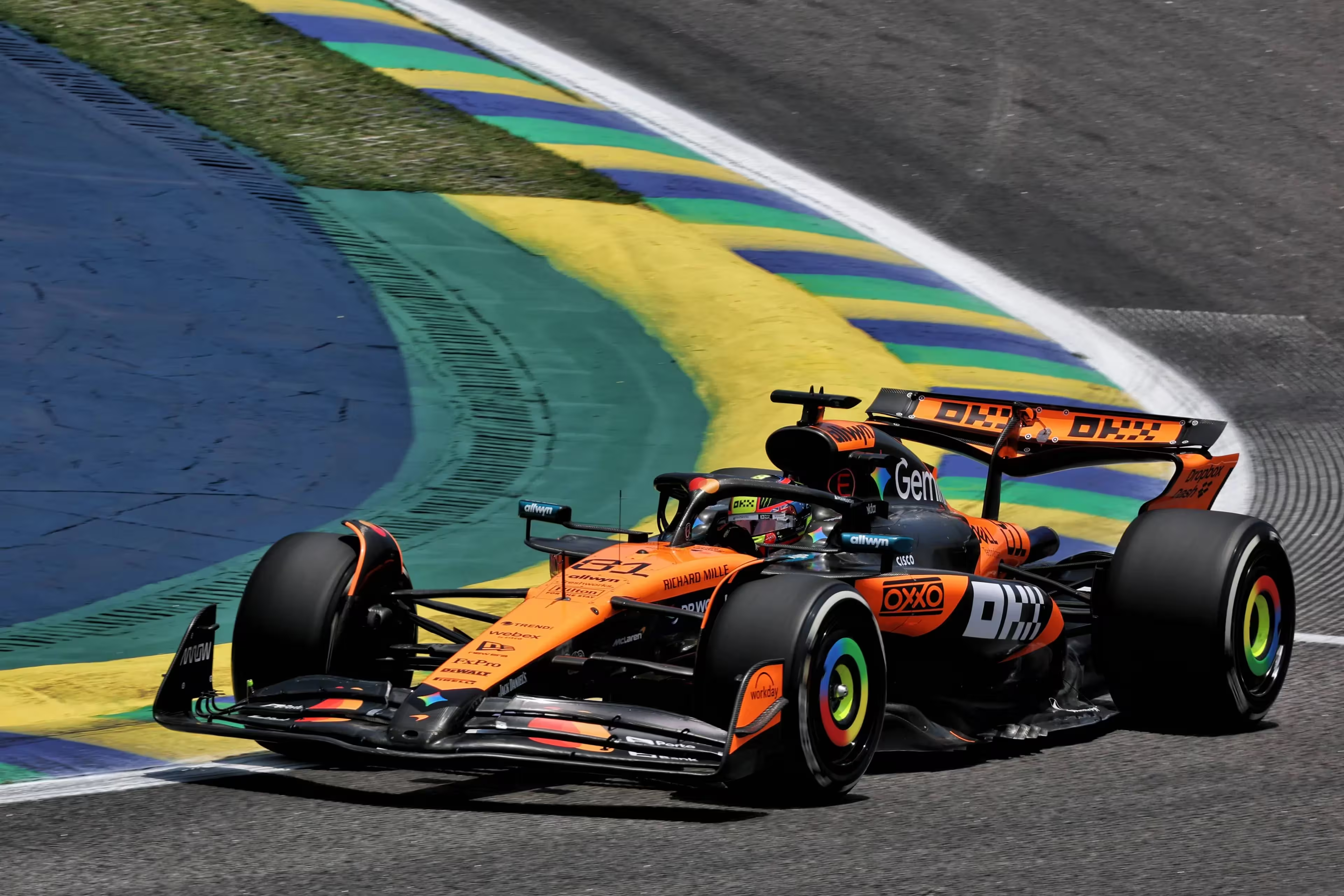
McLaren’s team boss Andrea Stella has been repeating a narrative to explain why his Australian driver struggled so much in Austin and Mexico City. He claims Oscar Piastri’s driving style hampers him when the track conditions are low grip.
The team had encouraged him to adapt his driving style to resolve the issue in Mexico, although Oscar was unsure of how well the experiment had gone. “It’s difficult to say ultimately, I think we certainly tried a lot of different things, but at the back with cars as well, so it was difficult to kind of get a read on whether what I was changing with my driving was working that well or not,” Piastri said in the media pen.
The problem for the McLaren driver is that Las Vegas is next on the F1 calendar where the cold desert night temperatures will again see little grip in Sin City. The team’s expectations for Brazil were much higher for their young driver as the surface in Sao Paulo is abrasive often creating high tyre degradation.
São Paulo circuit more abrasive
And this year the degradation of the rubber was expected to be even higher,. Given the thousands of grooves cut into the track surface to improve drainage after 2024’s rain soaked Grand Prix. This is why Pirelli brought tyre compounds a step harder than last year, an unusual step given they have been generally selecting compounds this season which are softer to promote more pit stops.
It all began so well for the Australian who hasn’t been on the podium since his win in Zandvoort, he was milli seconds behind his team mate in practice with Lando Norris topping the time sheets. Yet come Sprint qualifying the two tenths gap to his team mate re-appeared and it is this which has defined much of Oscar’s woes in recent race weekend.
The Sprint was a disaster for Piastri again as early in the race as he pushed harder he hit the kerb in turn two by mistake, sending his McLaren hurtling into the barrier amidst showers of carbon fibre. He could only make P4 in Grand Prix qualifying and was now almost three tenths away from Norris who claimed his sixth pole position of the season…READ MORE

Clara Marlowe is a Formula 1 writer at TJ13 with over 15 years of experience in motorsport journalism, having contributed features to established sports magazines such as Evo, MCN, Wisden Cricket Monthly and other digital outlets.
Clara specialises in human-interest storytelling, focusing on the individuals behind the sport, including drivers, engineers, and team personnel whose roles are often overlooked in mainstream coverage.
At TJ13, Clara contributes long-form features and narrative-driven pieces that explore the personal and professional journeys within Formula 1. This includes coverage of career-defining moments, internal team dynamics, and the human impact of high-pressure competition.
Clara’s work brings depth and perspective to the sport, complementing news and analysis with stories that highlight the people behind the machinery.
Clara has a particular interest in how personal narratives intersect with performance, and how individual experiences shape outcomes across a Formula 1 season.
