

From the moment Lewis Hamilton stunned the motorsport world by announcing his move to Ferrari, the eyes of the Formula One world have been firmly fixed on Maranello. Synonymous with Mercedes’ dominance for more than a decade, the seven-time world champion made the high-profile move in search of new challenges and perhaps that elusive eighth world title.
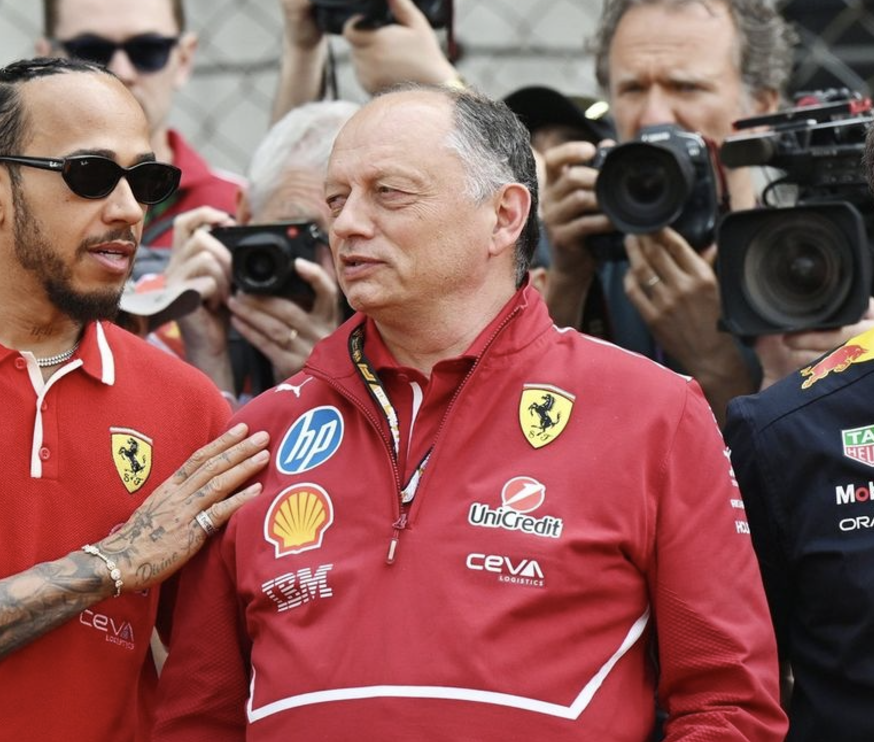
But as the 2025 season unfolds, his early performances have failed to match the media fanfare. In the face of growing scrutiny, Ferrari team principal Frédéric Vasseur has not only come to Hamilton’s defence, but has openly criticised the narrative being spun around his star driver.
Hamilton’s adaptation to life in red has not been seamless. So far, he’s shown flashes of the brilliance that made him one of the sport’s greatest, but he’s struggled with consistency and performance. Sitting seventh in the Drivers’ Championship after a lukewarm performance in Saudi Arabia, Hamilton has yet to enjoy a standout weekend in the SF-25. And yet there is no panic at Ferrari, only determination.
Never one to shy away from speaking his mind, Vasseur has gone on record in recent days to reject what he sees as excessive media criticism and misplaced doom and gloom headlines. In his eyes, the narrative surrounding Hamilton’s slow start is not only unfair – it is outright “b&llshit”.
F1 world reacts: “Piastri is the leader McLaren need”
Ferrari’s faith in Hamilton remains strong
Since pre-season testing, Hamilton has made it clear that adapting to the Ferrari machinery was always going to be a learning curve. Every car has its own quirks and nuances of behaviour, and after spending over a decade mastering the Mercedes chassis and systems, the transition to Ferrari’s unique car philosophy was bound to involve growing pains.
But within the walls of the Scuderia, the belief in Hamilton remains unwavering. According to Vasseur, the team sees the signs of progress, the growing comfort and, most importantly, the untapped potential that lies within their newest driver. In a candid interview following the weekend’s Chinese Grand Prix, Vasseur dismissed the doom and gloom that has been circulating in the media.
“I will be 2000% behind him,” Vasseur declared, leaving no room for ambiguity.
“I will support him and we will start tomorrow morning trying to find solutions and reasons and work on it early in the morning. But to be honest, I am not too worried.”
He pointed to Hamilton’s recent performances, including his run in Bahrain and early pace in Shanghai, as evidence that things aren’t nearly as bad as they’re being made out to be. Vasseur admitted that both Hamilton and the team are still working to get the balance of the car right, particularly how it interacts with the tyres over the course of a race stint. But he believes that’s part of the natural development process – and nothing to worry about.
“We’re not champions or losers after five races”
Vasseur’s frustration is not only with the criticism directed at Hamilton, but also with the oversimplification of F1’s highly competitive and nuanced landscape. In a sport where fractions of a second separate triumph from disappointment, he believes it is misguided to draw sweeping conclusions from just a handful of races.
“It’s not dramatic. We’ve had five races so far,” continued Vasseur. “I know you want to make headlines tomorrow and say ‘Fred said this’. But that’s b&llshit. At the end of the day we’re in a competition. There are ups and downs.”
His comments are a stark reminder that no team, no matter how prestigious, is immune to fluctuations in form. Even during Hamilton’s most dominant seasons with Mercedes, there were weekends when things just didn’t click. The media’s tendency to magnify struggles and ignore context is a disservice not only to Hamilton, but to the sport itself, according to Vasseur.
He insists that Ferrari don’t get emotionally shaken by every result. They know the car has potential, they know Hamilton can deliver and they know that success in F1 requires patience, hard work and unity – not panic.
Ferrari’s 2025 season: The long game
The 2025 F1 calendar is still in its early stages, and while Charles Leclerc has been more consistent this season, Ferrari’s long-term ambitions are built around having two front-running cars. Leclerc and Hamilton may have different driving styles and set-up preferences, but that’s where Ferrari see the opportunity: to develop a car that is flexible and competitive in different conditions and on different tracks.
Internally, the team is continuing to push ahead with upgrades and exploring set-up changes aimed at giving Hamilton a more stable rear end – something he’s historically tended to lean on at high speeds. Vasseur and the Ferrari engineers believe that once Hamilton is comfortable, the results will follow. After all, this is a man who has more wins, pole positions and podiums than any other driver in F1 history.
For Hamilton, the goal has always been bigger than just race-by-race success. His arrival at Ferrari was a multi-year vision – not just to add silverware, but to bring his championship pedigree to a team that had not won a driver’s title since Kimi Raikkonen’s triumph in 2007.
FIA changes to 2026 engine regulations labelled “a joke” by Toto Wolff
A barrage of media pressure
Of course, the spotlight comes with the territory. Hamilton’s celebrity status, record-breaking career and move to the most iconic team in motorsport history were always going to attract attention. The British driver’s off-track influence is also unparalleled, and with that comes a different level of scrutiny. Every comment, every facial expression in the garage, every radio message is analysed to the point of exhaustion.
Yet even Hamilton himself has shown signs of frustration at the way his performances are portrayed. He has remained calm in media briefings, but hasn’t hesitated to correct reporters when they ask questions he feels are misleading or sensationalist.
Vasseur’s comments this week were therefore not just a defence of his driver, but a broader critique of the F1 media circus that sometimes overlooks the long game in favour of immediate narratives. It was a rare moment of candor that cut through the usual PR-filtered language and confirmed that Ferrari sees the criticism as premature and unhelpful.
Horner rejects Verstappen’s manager claims
Looking ahead: Hamilton’s redemption arc?
The next few races could prove crucial to Hamilton’s 2025 campaign. Tracks such as Imola, Monaco and Barcelona will test both driver and car in very different ways. If Ferrari can solve Hamilton’s tyre management issues and refine the car’s balance to his liking, there’s a chance the narrative could change dramatically.
There is also the intangible factor of Hamilton’s own tenacity. This is a man who has come back from title setbacks, mid-season slumps and mechanical gremlins. He has made a career out of overcoming adversity and the idea that he would be put off by a slow start to a new chapter is, frankly, uncharacteristic.
The mood inside the Ferrari camp is far from despairing. If anything, the team seems more motivated to prove the doubters wrong. The media may want drama, but Ferrari is banking on a slow-burning success story.
As Vasseur puts it bluntly: “We’re not world champions if we’re doing well, and we’re not failures if things go wrong. It’s just a competition”.
And with 19 races to go, that competition is far from over.
Red Bull new evidence for Verstappen penalty
READ MORE F1 NEWS – Verstappen’s silence over Jeddah penalty cleverly diverts attention
The roller coaster season start continued for Lando Norris in Saudi Arabia, where the penalty for his crash in the final part of qualifying was to hand the lead of the championship to this fiercest rival, team mate Oscar Piastri. Whilst Piastri was schooled on Saturday by the four times world champion in how to lay down the fastest lap, his cool, calm demeanour under pressure saw him become only the second driver to win the Grand Prix in Jeddah whilst not starting from pole position.
The high speed action along the Red Sea corniche was thrilling to watch, but the race was decided within seconds of the lights going out to signal the start of the race. With the drivers being held for what felt like a split second, Piastri reacted more quickly to the signal to start the race and held a small advantage over Verstappen as the entered the braking zone.
Verstappen veered sharply to the right hand edge of the track to create an angle from which he could attack the corner at a higher speed, but this merely served to allow the McLaren driver the space to move towards the centre of the track rather than remain pinned against the wall on the left hand side….. READ MORE ON THIS STORY


The Judge, a nom de plume of an experienced F1 journalist and site founder with long-standing sources across the paddock. With over 30 years of experience in Formula 1 as an insider journalist, I have built trusted connections across the paddock, from race engineers and mechanics to senior team figures. At The Judge 13, I and a handful of trusted colleagues share exclusive Formula 1 news, expert analysis and behind-the-scenes stories you will not find in mainstream motorsport media.
