
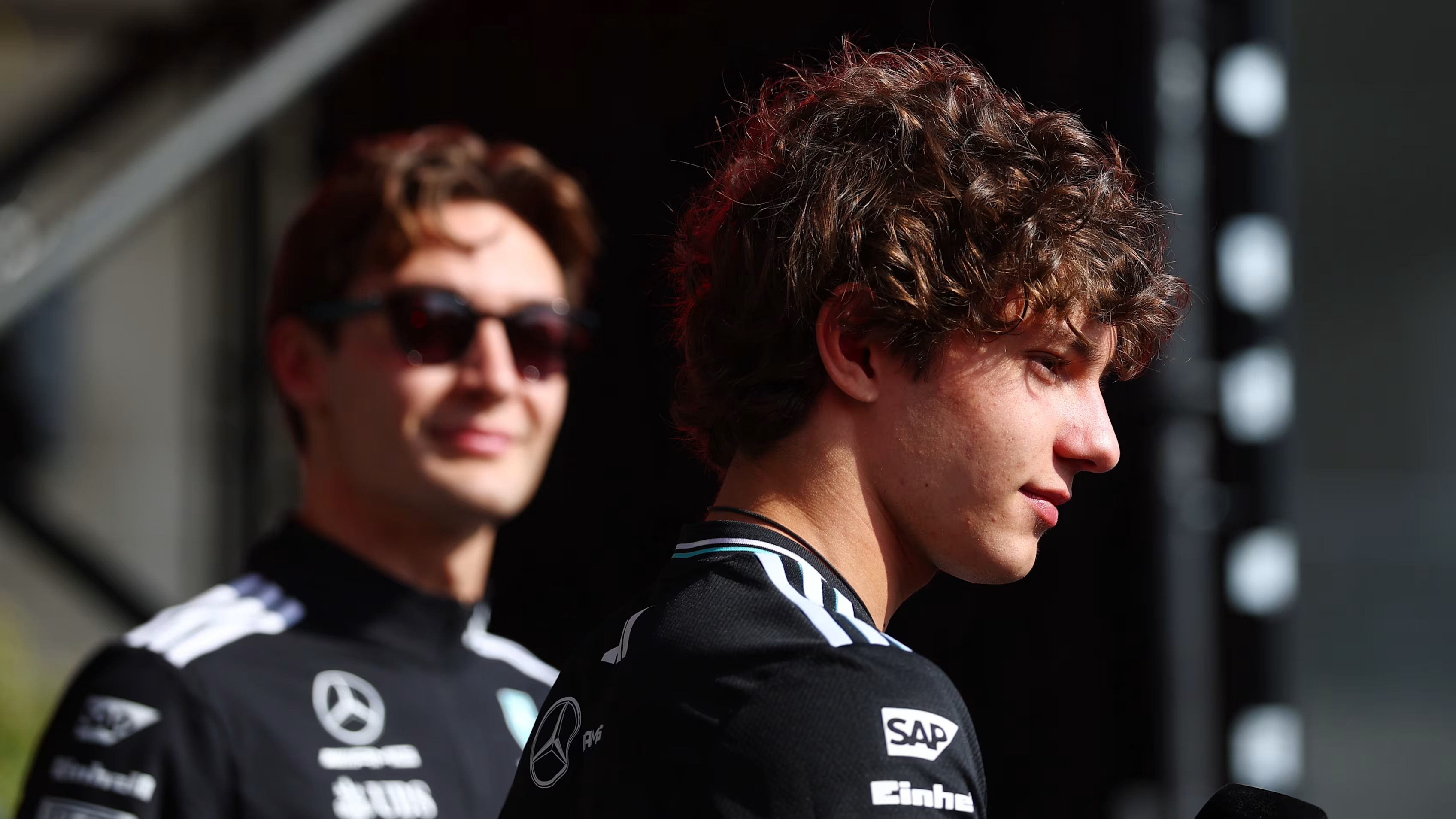
Mercedes declined an offer from newly crowned Formula 1 world champion Kimi Antonelli to surrender his Qatar Grand Prix lead to George Russell after the Briton lost time during a damaged pit-stop sequence. Antonelli said he was prepared to hand the position back, but the team decided there was no need to intervene, allowing the Italian to claim his tenth victory of the season.
The decision followed an unfortunate incident for Russell, who had been leading the race before a piece of polystyrene became lodged beneath his car. The debris caused damage to the underbody and cost him valuable time, opening the door for his Mercedes team-mate to take control at the front.
Antonelli offered to give Russell the lead back
Antonelli revealed after the race that he had raised the possibility of swapping positions over team radio. The 20-year-old was conscious that Russell’s misfortune, rather than a direct on-track overtake, had changed the order between the Mercedes drivers.
Speaking to Sky, Antonelli explained: “As a team, we naturally fight for the team and know how important the championship is. That’s why I was prepared to give the position back. But the team told me it was okay. So I was able to drive to victory.”
Mercedes therefore left the running order unchanged. Antonelli went on to take the chequered flag, recording his tenth win of the campaign, while Russell recovered sufficiently to finish second and secure a strong result for the team.
Russell’s Qatar pit-stop misfortune changed the race
Russell had been in a position to fight for victory before the debris incident disrupted his afternoon. He described finding polystyrene across the track as he exited a corner, saying there was little he could do to avoid driving over it. The impact was significant enough for him to immediately feel that something was wrong with the car.
“Just another thing on a long list. What can I say? As I came out of the corner, there was polystyrene everywhere. I couldn’t avoid it. When I drove over it, the impact was pretty hard. I immediately felt that something was wrong. Now you can see the damage to the underbody. I’m very happy to be on the podium, but it should have been different,” Russell said.
The damage left Russell unable to maintain the position he had held before the incident. Antonelli inherited the lead and was able to control the closing stages, while his team-mate had to settle for second.
Antonelli praised Mercedes’ car and race pace
Although Antonelli acknowledged that Russell had been denied a fair opportunity to contest the win, he was also clear about the strength of Mercedes’ performance in Qatar. The Italian praised the car’s pace, particularly during the final stint, and credited the team’s understanding of its latest upgrade package.
“The car was incredible this weekend and the race pace was superb, especially during the final stint. If you wanted to push even harder, the car felt like it was on rails. It was a real joy to drive. I’m very grateful to the team for giving us this car and for our good understanding of the new upgrade package,” he said.
He also made a point of expressing sympathy for Russell, adding: “I feel very sorry for George that he suffered that damage. I think it would have been a great battle. But ultimately, of course, I’m very happy with the win and our race pace.”
Mercedes’ call avoided an unnecessary team-order intervention
Antonelli’s offer underlined the co-operation Mercedes expects from its drivers when the team’s interests are at stake. However, with Russell’s car damaged and the race already moving towards its conclusion, the team chose not to reverse the positions.
The outcome gave Antonelli another landmark result in his title-winning season and Mercedes a one-two finish. It also left Russell with understandable frustration: second place was a valuable recovery, but the damage meant the contest for victory had been taken out of his hands.

Thiago Treze is a Brazilian motorsport writer at TJ13 with a background in sports journalism and broadcast media, alongside an academic foundation in engineering with a focus on Computational Fluid Dynamics (CFD). This combination of technical knowledge and editorial experience allows Thiago to approach Formula 1 from both a performance and narrative perspective.
At TJ13, Treze covers driver performance, career developments, and key storylines across the Formula 1 grid, while also analysing the technical factors that influence competitiveness. This includes aerodynamic development trends, simulation-driven design approaches, and the engineering decisions that shape race weekend outcomes.
His reporting bridges the gap between human performance and machine development, helping readers understand how driver execution and technical innovation interact in modern Formula 1. Coverage often connects on-track events with the underlying engineering philosophies that define each team’s approach.
With a global perspective shaped by both journalism and technical study, Thiago also focuses on Formula 1’s international reach and the different ways the sport is experienced across regions.
Treze has a particular interest in how Computational Fluid Dynamics and aerodynamic modelling contribute to car performance, offering accessible explanations of complex technical concepts within Formula 1.
