
With the Hungarian Grand Prix taking place at the tight and twisty Hungaroring circuit, expectations were that the all-new 2026 F1 engines would not be the talk of the paddock. Unlike Silverstone and Spa, the circuit just outside Budapest is energy rich, with the drivers constantly braking and lifting from the accelerator.
And indeed, there were no cars slowing on the straightaway long before the braking point, as had happened in both the British and Belgian Grands Prix. Yet the much-hated and ridiculously complex V6 turbo hybrids were to hit the headlines once again.
Grid Slot Promotion Turned Disaster
At the start of the year, Mercedes’ drivers had problems getting off the line at the start of a race and were regularly outraged on the run down to Turn 1. The team was thought to have mostly fixed this issue, but in Hungary, a far worse disaster was awaiting one of their drivers.
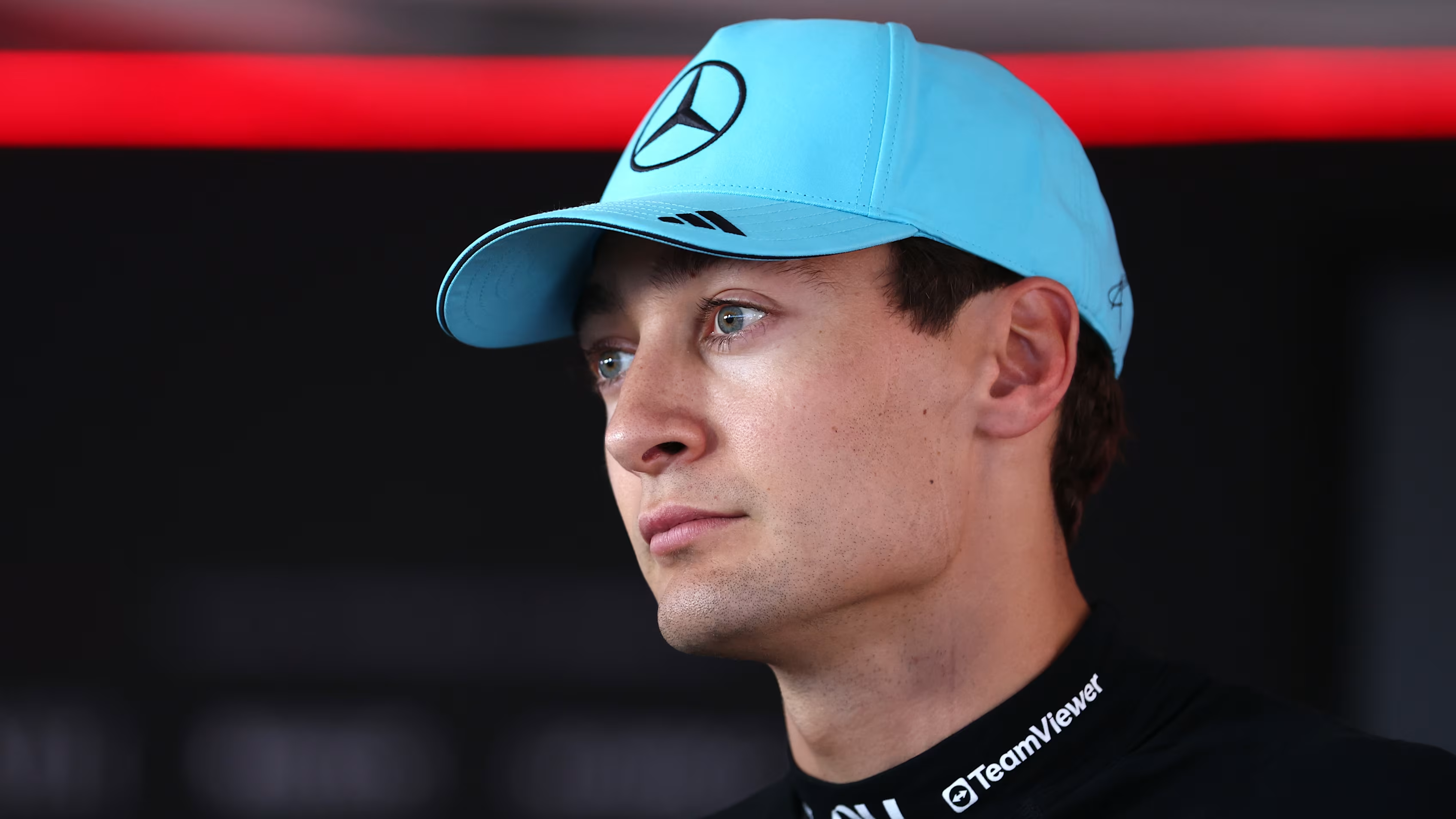
George Russell was once again having a miserable weekend, having qualified in P7, around half a second away from polesitter Lando Norris. Yet it appeared luck was going his way in the intra-team battle with Kimi Antonelli when the young Italian was ruled to have failed to slow sufficiently in qualifying under a yellow flag.
The subsequent three-place grid drop from the stewards saw Antonelli replace Russell in seventh, with the British driver moving up one slot. Yet when the lights went out, Russell appeared stranded on the grid as the rest of the field swept by.
Antonelli Identifies the Boost Failure
The initial thoughts of the likes of Martin Brundle and Anthony Davidson were that the car had entered anti-stall mode, ruining the start for George. Yet the reality of what occurred only became clear when his teammate Kimi Antonelli saw the start in the drivers’ pre-presentation cooldown room.
“He hit the top of the pack and lost boost,” Antonelli observed instinctively as the replay was shown on the big screen. What the young Italian was describing is another of the strange phenomena of the all-new 2026 F1 engines.
The skill of getting off the line in the new hybrid era has become one that is unnecessarily complicated and not entirely foolproof in any way. Given a number of teams had designed their power units with large turbo fans, it was discovered in round one in Melbourne that these designs were taking an age to spool up to speed. This was creating huge differentials in closing speeds between the various PU manufacturers.
The “Blue Light” Launch Sequence Explained
Ferrari, who had anticipated this and designed their power unit with a small turbo, was miffed at the FIA’s response, which was to allow a “blue light” period before the actual red light sequence to start each race.
This gives the drivers several seconds to hold their engine at high revs, which builds the exhaust gases that spin up the turbine and reduce turbo lag before a launch. The purpose is clear: to maximize turbo boost before the start for the initial launch — where the boost from the battery is unavailable until the car reaches 50km/h.
To those uneducated on the matter, the revs across the field rise as the blue lights come on and remain there for what seems an age before the red light start sequence is activated. This is because, as McLaren’s Mark Temple has explained, “The turbo spools better when there is load on the engine; free revving it while stationary doesn’t provide much load.”
How Full Battery Load Stalled Russell’s Start
So, free revving before the start has to be done for an extended time compared to when the engine is engaged and driving the car forward. However, the free-revving engine pre-start is at the same time charging the battery.
If the battery hits ‘full’ during the pre-start process, all kinds of strange things begin to take place. Firstly, with the car stationary, the turbo boost then falls away, and as the revs reach their peak, the throttle opening and fuel flow are cut off.
This is because when the battery is not full, the MGU-K, which recharges the unit, is working and creating some load against the internal combustion engine. When the battery is full, the load drops away and the turbo boost is ineffective. This is what happened to Russell at the start of the Hungarian Grand Prix.
Inconsistent Timings & Driver Frustration
With the time from the blue lights coming on to red lights out and “away we go” not being fixed, the drivers do not know how long they will be revving the car before the start of the race. In Hungary, the entire time for the start procedure including the blue lights lasted around 13 seconds — around 3 seconds longer than last time out in Spa.
Even so, this only affected Russell, who must have had too much charge when arriving on the grid compared to his competitors. Of course, this is all the result of the manufacturers being allowed to run the asylum and set the specification for the all-new 2026 F1 engines. Yet even so, it is on Mercedes to give their drivers a more fail-safe starting procedure.
Before there was time for a debrief, Russell was facing the media after the chequered flag and appeared to be still confused over the issue he had at the start. “I was on the throttle holding the revs and then all of a sudden, about four seconds before the lights went out, the engine just started revving all over the place,” he said.
“I was reacting with my throttle, and it was doing nothing. So, the engine wasn’t reacting to the throttle.” This situation is unacceptable and dangerous, as Lando Norris explained after the 2026 Japanese Grand Prix when his car decided to overtake Hamilton ahead before the chicane at the end of the lap.
Antonelli Extends Championship Lead Over Teammate
Having fallen to the rear of the field, Russell did make it back to where he started come the chequered flag. Yet his teammate Antonelli made third and the podium, increasing his lead over Russell in the drivers’ title race once more.
“Obviously the problems are happening, but the whole team feels it as well,” Russell complained. “They’re as pissed off as I am with how it’s unfolded. We need to look at ourselves and ensure there’s nothing we’re doing wrong that is contributing to these errors. I’ve never had a season like this in my whole career, let alone my F1 career.”
Mercedes need to develop a pre-launch system where the battery pack does not fill up, causing the sequence of cataclysmic failures which mean their drivers have no boost at the start of the race. Ultimately the FIA must to look to the future and ditch the much hated hybrid engines in favour of something much cheaper and simpler with the proper sound of a racing engine, rather than a drone.
Would you like to see more TJ13 Formula 1 coverage? Add us to your favourites list on Google to receive trusted F1 news.

The Judge, a nom de plume of an experienced F1 journalist and site founder with long-standing sources across the paddock. With over 30 years of experience in Formula 1 as an insider journalist, I have built trusted connections across the paddock, from race engineers and mechanics to senior team figures. At The Judge 13, I and a handful of trusted colleagues share exclusive Formula 1 news, expert analysis and behind-the-scenes stories you will not find in mainstream motorsport media.

A.J. Hunt is Senior Editor at TJ13, where Andrew oversees editorial standards and contributes to the site’s Formula 1 coverage. A career journalist with experience in both print and digital sports media, Andrew trained in investigative journalism and has written for a range of European sports outlets.
At TJ13, Andrew plays a central role in shaping the site’s output, working across breaking news, analysis, and long-form features. Andrew’s responsibilities include fact-checking, refining editorial structure, and ensuring consistency in reporting across a fast-moving news cycle.
Andrew’s work focuses particularly on the intersection of Formula 1 politics, regulation, and team strategy. Andrew closely follows developments involving the FIA, team leadership, and driver market dynamics, helping to provide context behind the sport’s biggest stories.
With experience covering multiple seasons of Formula 1’s modern hybrid era, Andrew has developed a detailed understanding of how regulatory changes and competitive shifts influence the grid. Andrew’s editorial approach prioritises clarity and context, aiming to help readers navigate complex developments within the sport.
In addition to editorial duties, Andrew is particularly interested in how media narratives shape fan perception of Formula 1, and how reporting can balance speed with accuracy in an increasingly digital news environment.

How on earth have we reached a point where the driver isn’t in control of the engine? Surely this has to be illegal as well as dangerous! No wonder many of the drivers are p***ed off with these farcical new regulations.