
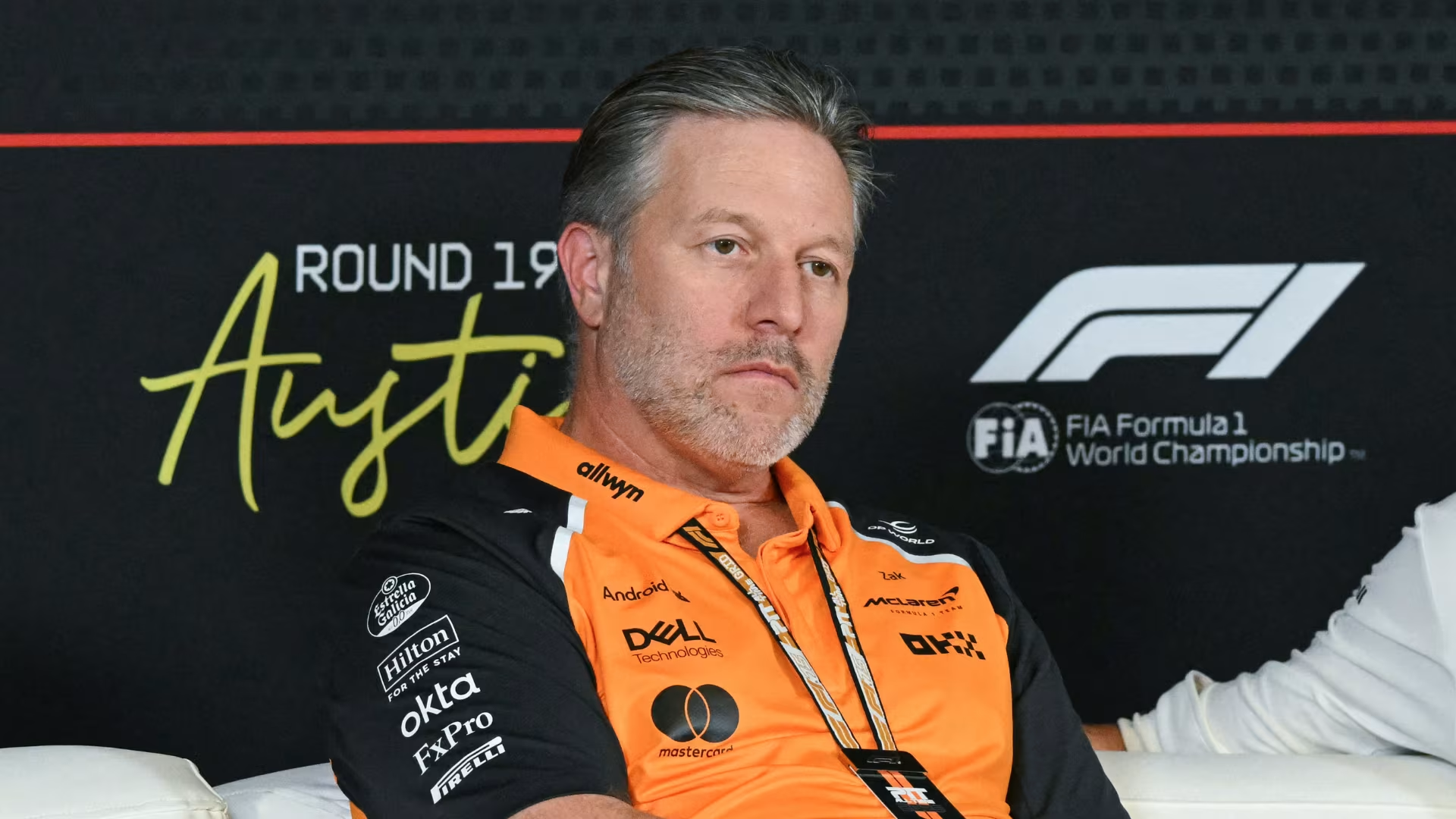
Until recently it was expected that ex-Red Bull boss Christian Horner would make his return to F1 buy leading a consortium to buy 24% of the Alpine team. Then last month in a surprise move it became apparent that Toto Wolff was now the leading contender to acquire the holding held by American investors, Otro Capital.
Of course the immediate question was, why? Was this to prevent his old rival from an F1 return? Why did Mercedes and Wolff feel it necessary to acquire almost a quarter of one of their customer teams?
Of course Brackley immediately denied that Alpine would become Mercedes junior F1 team and the reason for the acquisition was for the pair to work together in closer collaboration. Yet this explanation somehow doesn’t feel completely transparent given Alpine have been F1’s perennial losers whilst Mercedes are topping the rankings in 2026. What do they gain from the Alpine relationship?
Red Bull 2 team ownership a matter of historical context
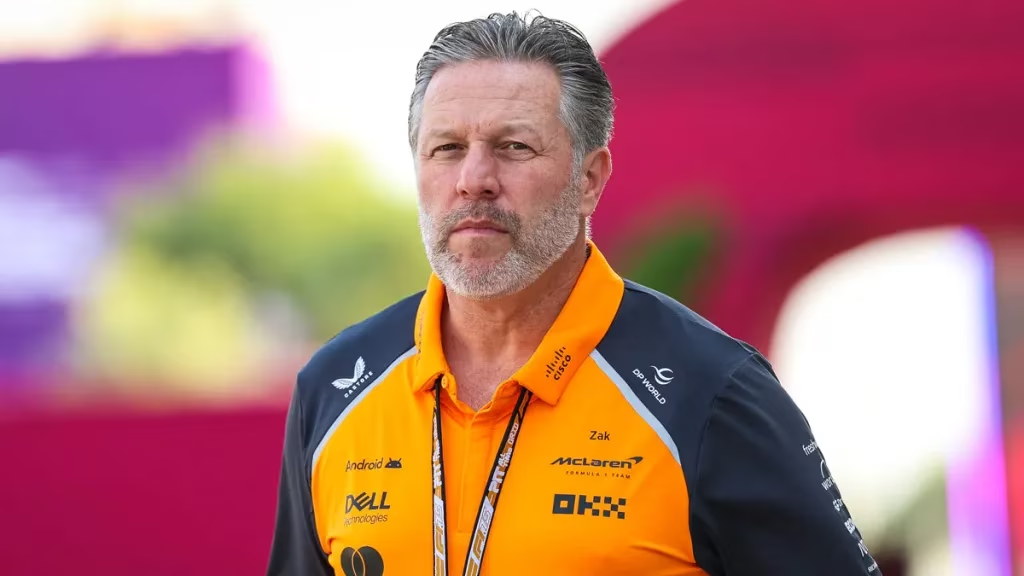
Now McLaren CEO Zak Brown who has long regarded co-owned F1 teams as an anathema to the principles of fair and independent racing has now spoken out against Mercedes’ proposed move. His previous comments have been directed at the relationship between Red Bull Racing and their sister team the Racing Bulls, but now Brown appears to have shifted his position in that regard.
“But I also have a huge appreciation for what they’ve done for the sport [Red Bull Racing and the Racing Bulls] and how that was done a long time ago. So I think as long as it’s managed and watched [the Red Bull situation is OK]. But certainly adding to it [through a different alliance], I think would be a mistake for the sport,” remarked the McLaren CEO.
Back in the middle naughties, F1 was once again in crisis. Manufacturers were leaving the sport and having badly managed their Jaguar F1 programme Ford were about to pull out of F1 altogether. In came energy drinks magnate, Dietricht Mateschitz who bought the ashes of Jaguar F1 to become the Red Bull Racing team.
The following year, minnow team Minardi were on the brink of collapse and then F1 supremo Bernie Ecclestone begged the energy drinks empire founder to acquire the team. Mateschitz agreed and Torro Rosso F1 was born and the sport was grateful for the Red Bull co-owned teams . Yet in the early years there was a significant amount of friction between the Red Bull owned outfits and the rest of the field due to a loophole they exploited.
Verstappen’s secret Silverstone test run: Red Bull breakthrough rumours before Miami
F1 rules tightened for Red Bull two teams
In F1, a team must be a “constructor,” meaning they must own the intellectual property (IP) of their chassis. From 2006 to 2009, Red Bull bypassed this by creating Red Bull Technology, a separate entity that designed a car and then “sold” the design to both Red Bull Racing and Toro Rosso.
Rival teams like Williams and Spyker (now Aston Martin) argued this was a breach of the Concorde Agreement and that it was illegal for two teams to use essentially the same car. In 2007/08 the cars (the RB3/STR2 and RB4/STR3) were nearly identical, differing mainly in their engines (Renault vs. Ferrari). This led to legal threats from Frank Williams, who argued it devalued the effort of independent teams that built everything from scratch.
For the 2010 season, the FIA stepped in banning the use of “customer chassis” forcing Toro Rosso to become a full fledged ‘constructor’ with separate offices and facilities. Further, the FIA instigated a “Listed team Components” list defining the exact components of an F1 car each constructor must design for themselves. “Non-listed Parts” like gearboxes and hydraulics could be shared and acquired by a ‘customer team’ from another.
This appeared to resolve the matter for the best part of a decade before once again the issue of jointly owned F1 teams resurfaced. Zak Brown has been leading the charge for the FIA to force the Red Bull energy drinks empire to sell off one of their teams and revealed it has been discussed as part of the next Concorde Agreement.
Buenos Aires plots Grand Prix comeback as Franco Colapinto visit the new track
Brown changes his tune over Red Bull’s two teams
“There were discussions in the Concorde Agreement about should, over time, one of the [Red Bull] teams be divested,” he said. The matter failed to receive enough support and so the status quo remains for the two Red Bull owned F1 teams. Yet Brown believes any further co-ownership should be banned. “In today’s day and age if that’s permitted, I think it runs a real high risk of compromising the integrity of sporting fairness,” he said.
“And what would turn fans off is if they don’t feel like there’s 11 independent racing teams. I’ve been vocal about it from day one. We’ve seen it play out on track in a sporting way, with [then AlphaTauri driver] Daniel Ricciardo taking the fastest lap point away from us [in Singapore in 2024] to help the other [RBR[ team.”
Brown continues by recalling the big stink in 2010 where Racing Point (a Mercedes customer) appeared to violate the IP rules by running almost identical brake ducts to Mercedes. They were dubbed the ‘Pink Mercedes.’ In this case there had been no collaboration between Mercedes and Racing Point, rather the engineers in Silverstone had ‘reverse engineered’ the Mercedes brake ducts from spy shots taken.
Racing Point were fined €400,000 and deducted 15 world championship points much to new team owner Lawrence Stroll’s outrage and indignant insistence his team had done nothing wrong. Interestingly, brake ducts the previous season were listed parts and Racing Point had acquired them from Mercedes. But for 2020 the brakes were ‘non-listed’ and sharing was not allowed.
Mercedes buy into Alpine for the FIA to decide
Brown was also most vocal after the sacking of Christian Horner by Red Bull Racing because in an instant Laurent Mekies the team boss at the sister team immediately took control. He observed that with independent teams, such moves are subject to financial compensation and periods of garden leave.
“We’ve seen Ferrari and Haas move people back and forth, and we know with IP there’s a lot in your head with that.” Zak Brown goes on to cite a football example where teams owned by the same organisations would simply not be allowed to collaborate. “Can you imagine a Premier League game where you’ve got two teams owned by the same group – one’s going to get relegated if they lose, and the other can afford to lose?
“That’s what we run the risk of. So I think having engine power units as suppliers is as far as it should go.” Mercedes’ supply Alpine with power units. When questioned whether his recent complaint was against Mercedes – who also supply McLaren with engines, Brown was tactful. “It applies to anybody and everybody. So A/B teams, co-ownership, regardless of who it is, I frown upon it. I don’t think it’s healthy for the sport. But it’s not personal or towards any one team or individual.”
What happens with th Mercedes bid will ultimately be decided by the FIA. Yet the question remains we started with. Why do Mercedes want to buy a quarter stake in Alpine – a French owned F1 team? For many it smacks of Wolff’s revenge on Christian Horner following years of bitter rivalry.
F1 2026 Rule Tweaks Fail to Address Safety and Fan Backlash
Brown softens on his approach to Horner
Interestingly, Brown too was a big critic of there ex-Red Bull boss but appears to now have softened his stance to the ;point of bromance. “Christian was a great personality for the sport,” insists Brown. “I think it would be great to have Christian back in the sport. He’s a great operator. His track record speaks for itself. I’d rather have 10 weak team principals, but that’s not going to happen anytime soon, and there’s huge talent that’s coming up all the time.
“There’s been a lot of team principal moves here in the last two to three years. but I think it’d be great to have him back in the sport. And I’m sure, given his passion for the sport and his age, I’d be shocked if he wasn’t back in the sport, whether it was at Alpine or somewhere else.”
It appears Christian Horner’s F1 paddock rehabilitation has begun, and just as Mercedes enter a new era of dominance which Horner led the charge to resist last time around.
Would you like to see more TJ13 Formula 1 coverage? Add us to your favourites list on Google to receive trusted F1 news.

The Judge, a nom de plume of an experienced F1 journalist and site founder with long-standing sources across the paddock. With over 30 years of experience in Formula 1 as an insider journalist, I have built trusted connections across the paddock, from race engineers and mechanics to senior team figures. At The Judge 13, I and a handful of trusted colleagues share exclusive Formula 1 news, expert analysis and behind-the-scenes stories you will not find in mainstream motorsport media.
